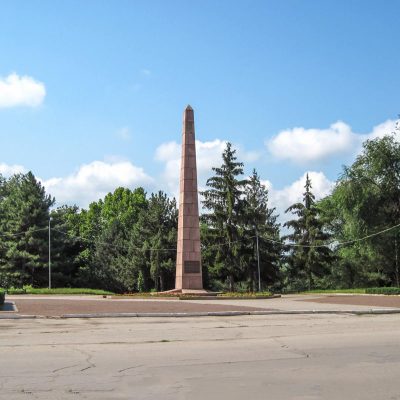
The memorial complex was erected in honor of the detachments of Bulgarian volunteers, formed in Chisinau on the eve of [..]
Shipka Obelisk
The memorial complex was erected in honor of the detachments of Bulgarian volunteers, formed in Chisinau on the eve of the Russo-Turkish war of 1877-1878.
The complex consists of an obelisk, a chapel and a square. The chapel was built in 1882 on the site where on April 12 (1877) the parade of Russian troops and Bulgarian volunteers took place (the famous “Skakovoie Pole” (horse racing ground).
The obelisk was inaugurated in 1966. The guest of honor at the opening of the monument was the world’s first cosmonaut Yuri Gagarin.
From historical sources we learn that the construction of the Church “Saint George” began in 1814, in the historic center [..]
Saint George the Great Church (1819)
From historical sources we learn that the construction of the Church “Saint George” began in 1814, in the historic center of Chisinau, with the blessing of Metropolitan Gavriil Bănulescu-Bodoni.
The works started under the guidance of the priest Gheorghe, helped by his Bulgarian compatriots. One of the architects of the shrine was Archimandrite Ioanikie, a guest from St Petersburg. The main burden fell on the shoulders of Costin Stavaraki.
He was appointed abbot of the church, where he served until 1830. The construction was completed around 1818 and on November 3rd, it was consecrated by the Bishop of Bender Akerman Dumitru, vicar of Chisinau. The official year of completion was 1819, when the Iconostasis was installed.
During the interwar period, divine services were conducted in Romanian and Russian languages.
In the summer of 1940, following the devastating earthquake, the church suffered a major setback. Efforts were needed to restore the holy place.
In 1959 the church was closed. In 1978 the building was declared a monument of architecture protected by the State, and then restoration was carried out.
After the national revival, the church was returned to the faithful.
Hristo Botev Petkov (1848 – 1876) was an exceptional Bulgarian poet, publicist, revolutionary, and a national hero of Bulgaria. Born [..]
Monument to Hristo Botev
Hristo Botev Petkov (1848 – 1876) was an exceptional Bulgarian poet, publicist, revolutionary, and a national hero of Bulgaria.
Born on January 6, 1848 (December 25, 1847 O.S.) in the village of Kalofera, which, like the rest of Bulgaria at that time, was part of the Ottoman Empire, he hailed from a humble family. His father, Botev Petkov (Botyo Petkov), was a teacher, translator, and educator. Hristo was born on the feast of the Nativity of Christ and was given the name Hristo. In the 19th century, Bulgarian surnames were derived from the father’s name, and according to linguistic norms of the time, the surname “Hristo” sounded like “Botev” and was written as “Botjov” (variant – “Botjov”). The writer signed his works as “Botjov,” but according to modern rules, the surname is written and pronounced as “Botev.”
Despite his short 29-year life, Botev left behind a limited literary legacy, notable for embodying the revolutionary idea in artistic form. His poems, as well as his life, exemplified the harmonious fusion of talent for revolutionary work with artistic creation. The small number (about 20) of Botev’s surviving poems had a significant impact on the development of Bulgarian literature, gaining popularity among the Bulgarian peasantry and expressing their revolutionary sentiments.
Throughout his brief life, he passionately fought for Bulgaria’s liberation from the Turkish yoke. He visited Kishinev several times, as evidenced by a memorial plaque at the intersection of Pushkin and Metropolitan Varlaam streets, on the building of the former Victoria Hotel.
The monument to the great poet was erected in Kishinev in 1977, on the 100th anniversary of Bulgaria’s liberation from the Turkish yoke. The architect was G. Solominov. Rehabilitation of the monument took place in 2023, and on October 31 of the same year, it was reopened. The monument bears the poet’s words: “Тоз, който падне в бои за свобода, той не умира” (“He who falls fighting for freedom does not die”).
One of the oldest streets of the “upper” city, Bulgarian Street, still preserves the patriarchal peace and provincial coziness of [..]
Bulgarian Street
One of the oldest streets of the “upper” city, Bulgarian Street, still preserves the patriarchal peace and provincial coziness of old Chisinau. The historical buildings have been partially preserved only on the upper part of the street.
Bulgarian Street was named in 1834 in honor of Bulgarians who fled from the Ottoman yoke from across the Danube to Bessarabia and settled in Kishinev. The Bulgarians settled in Kishinev compactly, and already in 1790s it became necessary to connect the houses of Kishinev Bulgarians with the street, which starts from A. Mateevich Street (former Sadovaya Street). In the past centuries this part of the city was called Galbinskaya side (Yellow). To the left and right there are still residential houses of the early twentieth century.
Not far away is the old St. George Church. It was built in 1830 on the funds of the Bulgarian community. The construction of the church combines different architectural solutions, characteristic, on the one hand, for classicism, and on the other hand – for Moldovan folk architecture. The church was named in honor of the fearless Bulgarian priest George. Back in 1814, he began to collect materials and funds for the construction of this temple. For the missing funds he dared, accompanied by a member of the community to go to fellow believers-Bulgarians in Turkey. Already returning home with a large sum of money, the pilgrims came across Muslims. Father George was subjected to terrible torture. His companion managed to bring the collected donations to Kishinev. He told everyone about the martyrdom of the bishop.
At the 30th anniversary of its activity the “Hristo Botev” branch of the BM “B.P.Hasdeu” has become a focal point of the Bulgarian culture in Chisinau. This statement is proved by the fabulous activity of the given institution. It offers the possibility to ordinary readers and researchers to have access to rare books in Bulgarian language, which can be found only in the collections of this library in our country. Lately the reading room of the library has become a “Collection”, which gathers Bulgarian scholars presenting the results of their researches on the history and culture of the Bulgarian Bessarabians.

 English
 Română
  Русский