Polish Route (Following in the steps of the Polish nobility…) (8)
Tourist routes
Polish Route (Following in the steps of the Polish nobility…) (8)
Railway Station
At the end of the 19th century, the Chisinau railway station held paramount significance as the city’s most crucial edifice, [..]
Railway Station
At the end of the 19th century, the Chisinau railway station held paramount significance as the city’s most crucial edifice, owing to the fact that, during that era, the fastest and most pivotal mode of transportation was the railway.
The initial construction of the railway station occurred in the 1870s, with some records indicating the erection of a provisional wooden structure in its early stages.
The subsequent station building was completed in the late 1870s, following the architectural design by Ghenry Lonski.
Historical accounts vary regarding the inaugural arrival of the first train at the station. While some assert it transpired on August 15, 1871, others contend it took place on August 28 of the same year. The discrepancy might be attributed to the utilization of either the new or old style calendar. Nevertheless, what holds significance is that this event transpired in August 1871, marking the commencement of railway history in Bessarabia during that period. The inaugural train journey originated from Odessa.
The station building, constructed in a rectangular layout, featured brick-lined facades. The central facade exhibited a sizable opening with a semicircular arch-niche, supported by a triple arch at the main entrance.
On July 29, 2004, the station square became home to two distinctive monuments — one being an old locomotive with serial number 1469, situated beneath the bridge adjacent to the station. This locomotive, which once operated the Ungheni to Cornești route until 1969, was manufactured in Poznan, Poland. Following a two-month restoration, it now serves as an open-air exhibit.
The station building faced adversity during wartime, particularly in 1941 when it was attacked by the Red Army. Despite partial restoration, it succumbed to complete destruction in 1944 due to bombing raids.
In 1948, architects A. Shchusev and L. Ciuprin undertook the reconstruction of the station, utilizing stone for construction and brick for finishing. Among the subsequent structures erected in proximity was the tram pavilion, constructed in 1976 adjacent to the station building. Another round of reconstruction commenced on July 30, 2003, focusing on the roof above the departure pavilions.
Carol Schmidt (Karl-Ferdinand Alexander Schmidt) (1846 – 1928)
The longest-serving mayor of Chisinau (1877-1903) was born into a German-Polish family. One of his sons, Alexander Schmidt, also served [..]
Carol Schmidt (Karl-Ferdinand Alexander Schmidt) (1846 – 1928)
The longest-serving mayor of Chisinau (1877-1903) was born into a German-Polish family. One of his sons, Alexander Schmidt, also served as the mayor of Chisinau during the turbulent years of 1917-1918.
Under Carol Schmidt’s leadership, numerous impactful developments took place in the city. Many streets were paved, and various public facilities were established, including an asylum for the homeless (1899) and the People’s Amphitheatre with a performance hall (1900). He played a key role in laying the first tram lines (1881-95) and overseeing the construction of the first aqueduct and sewage system. Street lighting was introduced, and significant educational and cultural institutions were built, such as the Royal School (1886), the Princess Natalia Dadiani Girls’ Gymnasium (1900), the County History Museum (1889), and the present-day Town Hall (1901). Additionally, Schmidt contributed to building houses for invalids (1877-81) and initiated the establishment of a school museum, the “Armonia” Musical Society, and the town school of Fine Arts (1894, today known as the Alexandru Plămădeală College of Fine Arts).
After 26 years as mayor, Carol Schmidt resigned, prompted by the tragic events of the Jewish Pogrom on April 6-8, 1903. Despite his efforts to stop the pogrom, he faced challenges and expressed his frustration to reporters. In response to the crisis, he sent a telegram to the Minister of the Interior in St Petersburg, organized emergency meetings of the City Council to raise funds for the victims, and provided aid to those affected. He even sheltered several Jewish families with children in his own house and donated resources, including wood from his residence, to the Jewish Hospital. Following the resolution of immediate town management matters, Schmidt continued to serve as a judge and remained active in city life until his death in 1928.
Carol Schmidt was the only mayor for whom the townspeople requested a street to be named while he was still alive. Gostinnaia Street, where Schmidt lived, became Carol Schmidt Street until 1944. Today, a street in the Telecentre district bears the name of this legendary mayor. The house where he and his family lived, located at 84 Mitropolit Varlaam Street, still stands and features a memorial plaque in Romanian and German honoring its former distinguished resident.
On May 10, 2014, a bust of Carol Schmidt was unveiled in front of the National Philharmonic in Chisinau, opposite the house where the state official lived. Unfortunately, the mayor’s tomb has not been preserved to date.
Architect Valentin Voitsehovski (Voițehovski) (1909-1977) – a figure who made significant contributions to the post-war reconstruction of Chisinau and the [..]
Valentin Voitsehovski (1909-1977)
Architect Valentin Voitsehovski (Voițehovski) (1909-1977) – a figure who made significant contributions to the post-war reconstruction of Chisinau and the construction of numerous cities in the republic.
Based on his designs, approximately 100 buildings were erected in Chisinau, including the Patria cinema (1951), the structures of the first Botanica microraion (1952-1962), the Ministry of Food Industry building (1953), the study blocks of the University of Medicine “N. Testemițeanu” (1956-1962), the buildings of microraion IV in Rascani (1961), the State Philharmonic “S. Lunchevici” Philharmonic Orchestra of Moldova (1962), several residential blocks on Stefan cel Mare Boulevard in Chisinau, and numerous residential blocks, schools, and cinemas in the cities of Balti and Soroca. In his work, Voițehovski incorporated motifs from Moldovan folk architecture, achieving a harmonious blend with stylized local materials. Drawing inspiration from Byzantine architecture, V. Voițehovski used glazed ceramic elements on building facades for decorative purposes. V. Voițehovski played a key role in the development of Moldovan Soviet architecture and, along with a few architects in his group, established a national school of architecture.
Born in Soroca, he significantly influenced the urban development of his hometown. He was also a co-author of the project to modernize University Square in Bucharest and the author of the project for the Cathedral of Saints Constantine and Helen in Balti.
In Chisinau, a commemorative plaque in honor of the renowned Polish-born architect is installed on the facade of the building at 73 Stefan cel Mare Boulevard, recognizing his lifelong dedication to enhancing the visibility and prominence of the city of Chisinau after World War II.
The Roman-Catholic Cathedral of Divine Providence (1840)
The Roman Catholic community in Chisinau, composed almost exclusively of Polish people, was formed in the late 1830s. Ten years [..]
The Roman-Catholic Cathedral of Divine Providence (1840)
The Roman Catholic community in Chisinau, composed almost exclusively of Polish people, was formed in the late 1830s. Ten years later, with their own financial contributions, the community builts a holy place, in 1840.
The church project was approved in St Petersburg. The architect and sculptor Joseph I. Charlemand played an important role for the design.
The architecture of this cathedral was designed in the spirit of late neoclassicism, influenced by Italian Renaissance architecture.
On 30 September 1964, the church was handed over to the School No 56 and converted into an assembly hall. Later, the church also housed a recording studio and a warehouse of the film studio “Moldova Film”. In 1988, the church was converted into a poetic theatre.
Only at the end of 1989, after numerous appeals to the central authorities of the USSR, the Red Cross and the ONU, was the church returned to the parish and the faithful.
Nowadays, there is an estimated number of 20,000 Catholics in Moldova.
In front of the Roman Catholic Cathedral “Divine Providence” in the capital, the monument of Holy Father Pope John Paul [..]
Monument to Pope John Paul II
In front of the Roman Catholic Cathedral “Divine Providence” in the capital, the monument of Holy Father Pope John Paul II (b. 1920 – d. 2005) was unveiled on August 21, 2016. The ceremony was organized by the Embassy of the Republic of Poland in Chisinau and the Roman Catholic Diocese.
The monument portrays Pope John Paul II seated on a bench. Sculptor Veaceslav Jiglițchi completed the work in just two months.
Pope John Paul II, born in Poland, is the first non-Italian pope and served as the head of the Catholic Church from October 1978 until his passing in April 2005.
The monument to the great Polish writer Adam Mickiewicz was unveiled on April 28, 2021, at the library in Chisinau [..]
Adam Mickiewicz Monument
The monument to the great Polish writer Adam Mickiewicz was unveiled on April 28, 2021, at the library in Chisinau that bears his name. The statue was sculpted by the renowned artist Veaceslav Jiglițchi, with support from the Embassy of the Republic of Poland in Chisinau, the Polish Ministry of Foreign Affairs, and Polish entrepreneurs in the Republic of Moldova.
The personality of Adam Mickiewicz, regarded as one of the finest Polish romantic poets of the 19th century, holds immense significance for the Polish identity in Chisinau and the Republic of Moldova.
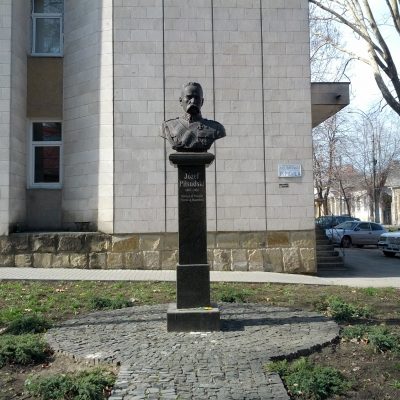
A bust commemorating Marshal Józef Piłsudski was unveiled on November 20, 2014, at the intersection of Mitropolit Petru Movilă and [..]
Bust of Marshal Jozef Pilsudski
A bust commemorating Marshal Józef Piłsudski was unveiled on November 20, 2014, at the intersection of Mitropolit Petru Movilă and 31 August 1989 streets, approximately in the area where the Consulate of the Republic of Poland was situated in Chisinau during the interwar years.
Józef Piłsudski (1867-1935) was a Polish revolutionary and statesman, serving as the first head of state (1918-1922) of the reborn Poland and the founder of the Polish Armed Forces. As the Prime Minister of Poland, Piłsudski worked to bolster his country’s independence through alliances with Western powers, notably France and England, as well as with friendly neighbors Romania and Hungary. During the interwar period, he made several official visits to Romania, including Bessarabia.
In April 1932, Marshal J. Piłsudski visited Chisinau, staying for four days to express unwavering support for his ally and Poland’s refusal of the territorial claims to Bessarabia asserted by the Soviets. The monument commemorates Marshal Jozef Piłsudski’s visit to Chisinau in the interwar period and signifies the amicable relationship between the Republic of Poland and the Republic of Moldova. The statue of this esteemed Polish politician was crafted by the Moldovan sculptor Veaceslav Jiglițchi.
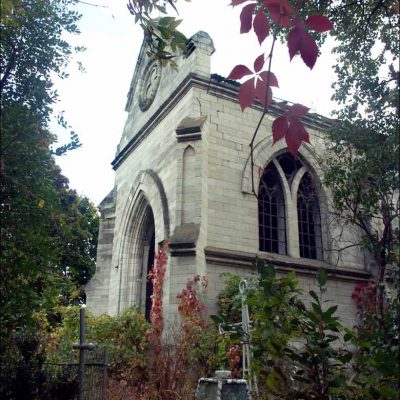
In the Valley of Roses, we find the ruined Catholic cemetery chapel: Polish and Armenian, built in 1912. In the [..]
Tomb of the Oganowici family
In the Valley of Roses, we find the ruined Catholic cemetery chapel: Polish and Armenian, built in 1912. In the west wing, we encounter a memorial building – the tomb of the Polish Oganowici family.
Of modest proportions, the chapel is designed in an eclectic style, inspired by the Gothic style. The plan consists of a nave with a small altar apse, polygonal in shape, with the corners supported by stepped buttresses. The appearance of the building is reminiscent of the small-scale places of worship from the flourishing period of Gothic architecture in the 12th-13th centuries in Eastern Europe, including Poland and Galicia, from where the Polish and Armenian Catholics migrated to Bessarabia…
Construction of the chapel began in 1913, commemorating the burial place of Joseph Kaetanovich Oganovich, who passed away on 14 January 1909.
The construction was completed in 1922 by G.A. Demzhanovich.
Unfortunately, today, the chapel is in an advanced state of decay…

 English
 Română
  Русский