National Museum of Ethnography and Natural History
Its history begins in 1889, when the Zemstva of Bessarabia organized the first Agricultural and Industrial Exhibition, which was also [..]
National Museum of Ethnography and Natural History
Its history begins in 1889, when the Zemstva of Bessarabia organized the first Agricultural and Industrial Exhibition, which was also the basis for the foundation of the museum institution. Being the oldest museum in the Republic of Moldova, its name has often been changed over the years. Today it holds an enormous heritage of about 135 thousand exhibits.
The permanent exhibition operates under the title “Nature. Human. Culture” with an area of over 2000 m2.
The museum also has a Temporary Exhibition Hall, in which numerous seminars, master classes and exhibitions take place, both from its own heritage and from the heritage of other local museums and from abroad. The exhibitions of handicrafts have become traditional and are organized every year.
Its history began in 1889 when the Zemstva of Bessarabia organized the first Agricultural and Industrial Exhibition, laying the foundation for the establishment of the museum institution. As the oldest museum in the Republic of Moldova, its name underwent several changes over the years. Today, it houses an extensive heritage of about 135 thousand exhibits.
The permanent exhibition, titled “Nature. Human. Culture,” occupies an area of over 2000 m2.
The museum also features a Temporary Exhibition Hall, hosting numerous seminars, master classes, and exhibitions, showcasing both its own heritage and that of other local museums and international collections. Handicraft exhibitions have become traditional and are organized annually.
Folklore events, national and international competitions, and festivals regularly take place in the museum, highlighting folk creations from across the country.
Within the museum’s premises, there is a Botanical Garden with a Vivarium, gathering the most prevalent species of plants, trees, and shrubs from the Republic of Moldova, along with exotic birds, reptiles, and fish.
The Museum building, designed by architect V.N. Țiganco, was completed in 1905, and the inauguration took place in June 1906.
Vladimir Tsyganko (1886 – 1919) Outstanding architect, Ukrainian, author of the project of the building of the National Museum of [..]
Vladimir Tsyganko
Vladimir Tsyganko (1886 – 1919)
Outstanding architect, Ukrainian, author of the project of the building of the National Museum of Nature and Ethnography of RM, designed in pseudo-Moorish style. He also designed the National Museum of History and the Balsa Shelter (now the building of the A. Cantemir Lyceum on A. Lapusneanu Street). Tsyganko was the architect of many buildings in Chisinau, including the Church of St. Nicholas – formerly the church of the Zemstvo Hospital. All his works are characterized by a special handwriting and, at times, exoticism. Vladimir Tsyganko is buried in the Central Cemetery.
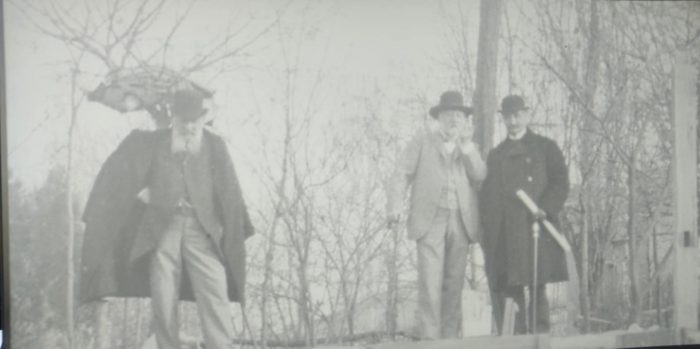
******************************************************************* The only photo on which it is possible Vladimir Tsyganko (right) …
„Mykhailo Kotsyubinsky” Lyceum is an educational institution of the municipality. It is located in the center of Chisinau. The building [..]
„Mykhailo Kotsyubinsky” Lyceum
„Mykhailo Kotsyubinsky” Lyceum is an educational institution of the municipality. It is located in the center of Chisinau.
The building of the lyceum is of historical value: it was founded in 1864 by a pupil of the famous architect Alxandr Bernardazzi. Here in 1873-1918 there was the local superintendence of estates of foreign ecclesiastical establishments of Bessarabia, from 1918 to 1940 – the school for girls F. Nitze, from 1944 to 1952 – the Moldovan men’s school № 4, from 1952 to 1992 – the Russian secondary school № 15. The Lyceum inherited a marble staircase and ceiling molding.
The profile of the lyceum is humanitarian, the language of instruction is Russian.
Languages studied: Romanian, Ukrainian, English, French.
The lyceum cooperates with other educational institutions of the municipality and the Republic, as well as with Ukrainian, Polish, Romanian and other countries….
Mykhailo Mykhailovych Kotsyubinsky (Mykhaylo Mykhailovych Kotsyubinskiy) – Ukrainian writer, public figure, classic of Ukrainian literature (September 17, 1864 – April 25, 1913).
Years of Kotsyubinsky’s stay in government service in Moldova and in Crimea gave vital material for his works “For the Common Good” (1895), “Ambassador of the Black Tsar” (1897), “The Witch” (1898), “In the bonds of Shaitan” (1899), “At a dear price” (1901), “On the Stone” (1902), “Into the Sinful World”, “Under the Minarets” (1904). One of the evidences that Kotsyubinsky’s works of the Moldavian-Crimean cycle went beyond local problems is that his story “For the Common Good” was printed in Russian translation in the magazine “Life” (1899, book 12).
Kotsyubinsky’s work still serves as an artistic example for more than one generation of Ukrainian writers.
His works have been translated into Russian, Polish, French, Italian, German, Japanese and Norwegian languages.
Based on the works of the writer, the movies “Bloody Dawn” (1957), “Horses are not to blame” (1957), “At a high price” (1958), “Shadows of Forgotten Ancestors” (1965), “Birthday Present” (1991) were created.
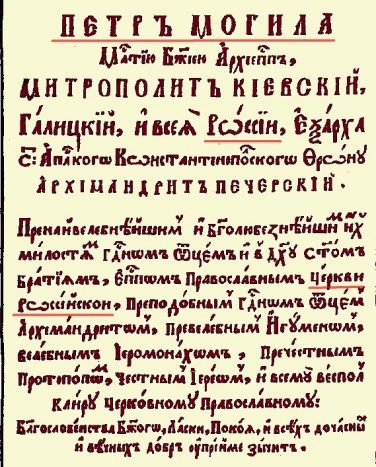
Petru Movilă, a notorious personality and Metropolitan of Kiev, was born in Suceava in 1596, the son of Simion Movilă, [..]
Petru Movila – Metropolitan of Kiev
Petru Movilă, a notorious personality and Metropolitan of Kiev, was born in Suceava in 1596, the son of Simion Movilă, who would later rule in Walla Wallachia, and his wife, Marghita, later a nun by the name of Melania. His father’s brothers were Ieremia Movilă, ruler of Moldavia from 1595-1606, and Gheorghe Movilă, the future Metropolitan of Moldavia.
After his father’s death, the young son of a ruler wandered with his mother and siblings to Walla Wallachia, after which they settled permanently in Poland. He began his education in his parents’ home and continued his studies at the famous Orthodox Fraternity School in Lvov (Lemberg) and at the Zamoiska Academy in Zamosč, where he studied Latin, Greek, Slavonic and Polish, in addition to the standard subjects of the time: grammar, poetics, rhetoric, dialectics, theology. He also studied Latin at the Sorbonne. In accordance with the custom of Polish nobles, he mastered the use of arms and took part in two Polish battles against the Turks, at Țuțora (1620) and Hotin (1622).
Thanks to an inner calling, but also under the guidance of the abbot of the Pecerska monastery, Archimandrite Zachariah Zacharias Kopastenski, he decided to become a monk. Thus, after his spiritual training at his estate in Rubiejovka, where he also built a church dedicated to St. John the New from Suceava, he was to be ordained a monk at Lavra Pecerska after 1625. In the fall of 1627, at the age of 31, he was elected abbot of the monastery. The Orthodox situation at that time was troubled by attempts to Catholicize the nobility. But through his five years of work as abbot, Petru Movilă managed to raise the cultural and ecclesiastical prestige of the monastery to a level unknown before. He worked on the restoration and embellishment of monasteries and caves where the relics of saints were found, and continued the printing work of his predecessors, bringing to light several books of mass and teaching.
The Archimandrite Peter carried out a rich ecclesiastical and cultural activity, continuing to print several books that had the purpose of defending Orthodoxy in the face of Catholic proselytizing. He founded a college, first at the Lavra, then at the Bratska Monastery, from which the famous Kiev Spiritual Academy would develop in 1633. He also placed at the Academy’s disposal his estates at Rubejovka, which he had bought before his monastic life.
On August 16, 1628, he signed the declarations of the Kyiv Ecclesiastical Synod, which condemned the clergymen who had adhered to the 1596 Union. He supported the election as King of Poland of Wladislav I in 1632, who recognized the rights of the Orthodox dioceses of the Kyiv Metropolitanate and maintained the “Orthodox Brotherhoods”.
The monument in Chisinau was installed at the intersection of Stefan the Great and Holy Boulevard and Petru Movila Street on 22.12.1996, sculptors – B. and G. Dubrovin. A high school in the capital also bears the Metropolitan’s name.
Metropolitan Petru Movilă Street. It is located in the central area of the city, between Alexei Sciusev and Columna Streets, [..]
Petru Movilă street
Metropolitan Petru Movilă Street.
It is located in the central area of the city, between Alexei Sciusev and Columna Streets, with a length of about 1 km. It bears the name of Metropolitan Petru Movilă (1565-1646), a notorious personality in the cultural history of Moldavia, Ukraine and Russia, founder of schools and reformer of the Orthodox religion, author and publisher of books: Moghiliovskaia (until 1918), Paul Dicescu (1918-1924), Petru Movilă (1924-1944), Berzarin (1944-1990).
The street dates from the first decades of the last century. The earliest buildings were basically single-storey residential houses. Later important buildings were built: the Commercial Gymnasium, today’s School No. 2, the Tax Department, today’s one of the study blocks of the Technical University, etc. At the upper end of the street, there was originally a vacant lot, which was later redeveloped into a square – the Nemțească Square, where after the war a sports complex was built, later transformed into the “Dinamo” Stadium. In the 60s and 70s of the last century, modern multi-storey buildings were erected on this street: the House of Writers, the House of Publishers, the Polygraphic Combine, the “Știința” Printing House, the “Bucuria” Shop, etc.
Library of Ukrainian Literature and Culture “Lesea Ukrainka” – branch of the Municipal Library “B.P.Hașdeu” was opened on February 16, [..]
Lesea Ukrainka Library
Library of Ukrainian Literature and Culture “Lesea Ukrainka” – branch of the Municipal Library “B.P.Hașdeu” was opened on February 16, 1991, as a result of the project to create a center of Ukrainian language, culture and traditions. The specificity of the library consists in the following fact: it is the only library, which meets the demand of the population for literature in Russian, Romanian and Ukrainian languages.
We are happy to welcome all those, regardless of age, address and nationality.
Informative note:
From the very first days of its activity the library became the place, where:
the children’s Sunday school lessons were held, which through books introduced little Ukrainians to their mother tongue;
meetings of Ukrainian intercultural societies were organized;
religious services;
the first Ukrainian language and literature olympiads were held.
In time the library began to be the place of inspiration and knowledge for the whole family. The need arose to open a children’s section, and in 1998 this was possible.
The capital repair, made in 2003 from the municipal budget, cardinally changed library. The traditional look of Soviet times has been transformed into a 2-story room with free access to the bookshelves. The modern design of the interior, the rational and comfortable design of the reading areas, equipped in accordance with modern trends in the organization of library space, provide users with the ideal space for working both independently and in groups.
Today our library is a true palace of books, where everyone breathes in comfort and with high aesthetic taste.
***********************************************
Lesya Ukrainka, real name Larisa Petrovna Kosach-Kvitka (Ukr. Larisa Petrivna Kosach-Kvitka; February 13, 1871 – July 19 (August 1), 1913 – Ukrainian poetess, writer, translator. A vivid representative of Ukrainian revolutionary romanticism and critical realism.
She wrote in a variety of genres: poetry, lyrics, drama, prose, journalism; worked in the field of folklore (220 folk tunes recorded from her voice); actively participated in the Ukrainian national movement.
She is known for her collections of poems “On the Wings of Songs” (1893), “Thoughts and Dreams” (1899), “Reviews” (1902), poems “Old Fairy Tale” (1893), “One Word” (1903), dramas “Boyarynya” (1913), “Cassandra” (1903-1907), “In the Catacombs” (1905), “Forest Song” (1911) and others.
She participated in the socialist movement, was a co-founder of the group “Ukrainian Social Democracy”; she was engaged in the translation into Ukrainian of the “Manifesto of the Communist Party” by Karl Marx and Friedrich Engels, but there is no reliable evidence that the resulting text belongs to her.
According to the results of surveys of Ukrainians, Lesya Ukrainka is now among the three most outstanding compatriots, along with Taras Shevchenko and Bohdan Khmelnitsky.
She is the only woman whose portrait appears on Ukrainian banknotes. Literary scholars recognize her as one of the brightest European modernists and one of the best representatives of Ukrainian literature. Already at the age of 16 she translated passages from Mickiewicz, and a few years later, just like the classicist asked in her poem the question “Shall I call it friendship? Or call it love?”.
She was born in 1871 in Novograd-Volynsky and at birth was named Larisa Petrovna Kosach-Kvitka. Lesya’s family was prosperous, her parents had a good education (her mother, Olga Petrovna Dragomanova-Kosach, was a writer and literary critic, and her father was a lawyer). However, the poetess’s childhood was not only under the banner of comprehensive creative and intellectual development, but also under the weight of a terrible disease – tuberculosis, which attacked the bones, lungs and kidneys. Because of it, Lesya was often sent abroad for treatment: to Egypt, Georgia, Greece and Italy. Perhaps these travels influenced the girl’s interest in languages and other cultures: Lesya knew Latin, Greek, French, Italian, German and English, perfectly oriented in classical and modern European literature.
“This circumstance strongly influenced the work of the writer, who made the greatest (after Ivan Franko) contribution to the modernization of Ukrainian literature, its development and escape from narrow regionalism” — so wrote about the importance of Lesya Ukrainka’s linguistic skills the writer and translator Tadeusz Chruszelewski, who called the poetess ‘both Ukrainian and European’….
Before World War II, it was a suburb of the city with narrow streets and low-rise houses. It was only [..]
Kiev street
Before World War II, it was a suburb of the city with narrow streets and low-rise houses. It was only at the end of the 19th century that it was bought by the city and included in the city limits. Kiev Street runs from Tudor Vladimirescu Street (former Kalinina Street) to Aleku Russo Square (former Gheorghe Dimitrov Square). It is located in the Riscani sector and is only 0.5 km long.
In 1944, in connection with the creation of the Chisinau aviation detachment, the first airfield was created here. Its runway was located on the site of the present-day Kievskaya Street and Moskovsky Avenue.
In the 60s the construction of a new airport was started, and the territory of the old one began to be built up. The building of the airport has been preserved (Dimitrova Street, 5). It is repaired, somewhat remodeled, and painted in yellow color. In the last Soviet years it was the accounting office of the October District Komsomol Committee. It even stands not parallel to Kievskaya Street, but at an angle, apparently repeating the geometry of the airfield. And the runway was located exactly along a part of the modern Kievskaya Street.
The street was originally named in honor of G. M. Dimitrov, a figure of the Bulgarian and international communist movement.
The street is a continuation of Moskovsky Avenue. It began to be built up in the 1960s with 4 and 5-storey residential buildings. When organizing the adjacent areas, the principles of free planning with the creation of large green spaces were used.
Residential buildings are mostly facing the street, decorated with loggias (“storeys”) and stores and cafes built into the 1st floor.
At the southern end of the street its perspective is closed by a public garden.
In its northern part the street as if merges into the space of Aleku Russo – Georgi Dimitrov Square (until 1981 Reunification Square, then G. Dimitrov Square). It is located at the intersection of Maskouski Avenue and Kievska, Bogdan Voevod and Aleku Russo Streets. By architectural and planning organization it belongs to the type of open squares.
The construction of the square began in the fall of 1959. At first only 5-storey buildings were erected here. After the completion of the construction of a group of 11-storey residential buildings “Yuzhenergo-Remont” and 9-storey frame-panel residential building, the composition of the square was mainly determined.
In the early 1990s, the street was named Kievskaya.
The monument to Taras Shevchenko in Chisinau was erected in 2006 by a Moldovan sculptor with Ukrainian roots Peotr Gherman [..]
The monument to Taras Shevchenko
The monument to Taras Shevchenko in Chisinau was erected in 2006 by a Moldovan sculptor with Ukrainian roots Peotr Gherman and installed in the Riscani sector of Miron Costin Street in the square of the Taras Shevchenko Gymnasium. Taras Shevchenko Gymnasium.
In different years in Moldova monuments to the Great Kobzar were also installed in the cities of Balti, Briceni, Tiraspol, Bender, Camenca.
This honor of the Ukrainian poet was established due to the consolidation of the Ukrainian nation and society around the highest values of establishing a sovereign, independent and democratic Ukraine.
Every year on March 9, on the birthday of the great Ukrainian poet, the Shevchenko Days are held – it is a holiday that consolidates the entire Ukrainian people, both in Ukraine and abroad. This tradition is also alive in Moldova, because in our country Ukrainians are the second largest nation. Taras Shevchenko, undoubtedly, belongs not only to the Ukrainian people, although his creativity and his whole life are inseparably connected with it; – but part of the world heritage. Taras Shevchenko (1814 – 1861) chose a difficult, full of trials fate. All creativity is permeated with ardent love for his native land. His thoughts and fiery word reflected the aspirations of the working people for a better life. He is called a harbinger of a new life, a people’s prophet, a titan of the spirit, who is rooting for the fate of his people. He left a spiritual testament to his descendants, passed on from generation to generation.
Great Kobzar became a great personality not only of Ukrainian, but also of world literature, receiving the right to immortality.
Shevchenko’s songs and thoughts are close to the folk Ukrainian poetry. They are as melodic, simple and heartfelt, as deep in thought as the songs composed by the people. They are vivid pictures, where life itself is seen, given without embellishments and additions …
The Taras Shevchenko Gymnasium in Chisinau is an educational institution located in the Riscaniovca neighborhood and is an important educational institution for the local Ukrainian community. The school actively supports cultural and linguistic diversity, offering education in both Ukrainian and Romanian languages.
The school hosts a variety of cultural events aimed at preserving and promoting Ukrainian culture among students. In recent years, the gymnasium has become an important center for Ukrainian refugee children who have arrived in Moldova. In response to the increasing number of children needing instruction in their native language, the gymnasium has opened additional classes with instruction in Ukrainian and Romanian. This allows children not only to preserve their national identity, but also to integrate more easily into the Moldovan educational system.

 English
 Română
  Русский