A distinguished doctor, social activist, and memoirist from Chisinau, who dedicated 57 years of service to the Jewish Hospital in the same city.
Orphaned early in life, he was raised by his grandfather, Leib Efrusi, in Berdicev. His grandfather, a wealthy and educated individual, owned a truck, four horses, employed a cowhand, and had two traveling clerks who transported pharmacy products from Hamburg and Brod.
He received his education at a cheder and a first-grade Jewish state school. Following his grandfather’s demise, he relocated with his mother and sister to Balti, where his elder married sister lived. He then entered the second grade of the gymnasium in Chișinău, which began admitting a small percentage of Jewish children from 1864. After completing the gymnasium in 1869, he pursued further studies at the Medical Faculty of Kharkov University.
Graduating from the university in 1877, he joined the Jewish Hospital in Chisinau as a junior doctor two years later, eventually rising to the position of chief physician in 1889. In 1899, he became the chairman of the hospital’s board of directors, a role he held for the next thirty-five years.
Under his leadership, the hospital expanded, with the inauguration of the main building in 1892 and the construction of three new hospital blocks by the autumn of 1898, making it the largest medical institution in Bessarabia. The hospital also housed a school for nurses.
During the notorious pogrom in Chisinau in April 1903, the hospital provided refuge to the wounded and homeless Jews in the city, and the doctor, M.B. Slutsky, served as a witness during the subsequent investigations.
On November 23, 1908, the hospital opened schools for midwives and student nurses. In 1919-1920, the hospital sheltered refugees from the Jewish pogroms in Ukraine in its maternity ward. M.B. Slutsky retired in February 1934.
He was not only a medical professional but also a public figure, serving as a city councilor, deputy in the Sfatul Țării (County Council), and the first president of the Jewish community in Chisinau. He held the position of president (1910-1914) and vice-president (1915-1916) of the Medical Society of Bessarabia. In the autumn of 1917, he co-founded the Chisinau branch of the “Jewish Popular Group” and was a State Councillor. His contributions were recognized with decorations, including orders of St. Stanislav, St. Vladimir, and St. Anne, as well as the medal “Badge of Honour of the Red Cross,” and Romanian orders “Romanian Crown” and “Sanitary Merit.”
In addition to his medical publications, he wrote opinion articles in the Unzer Zeit newspaper (in Yiddish) in Chisinau and authored two memoirs: “In three quarters of a century. My Memoirs of Childhood, Youth and Half a Century of Medicine and Social Work” (1927) and “In Sad Days. The 1903 pogrom in Chisinau” (1930). The latter remains the only published memoir by a direct eyewitness to the 1903 Chisinau pogrom. Nestor-History reprinted both books under one cover in 2019.
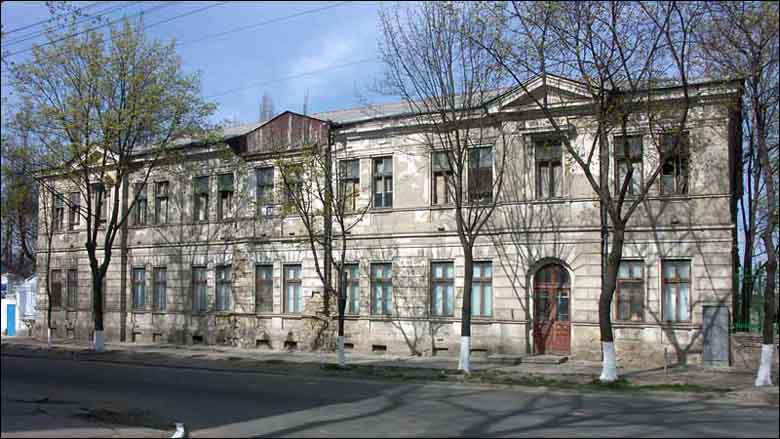
He resided in his own house at 23 Ismail Street (now 31), with his wife Maria Ernestovna Slutskaya and their children: son Leon (1883), daughters Ernestina (1889), and Tatiana (1891).
M.B. Slutsky was laid to rest in the Jewish Cemetery. Unfortunately, it is believed that his grave has not been preserved to this day.

 English
 Română
  Русский