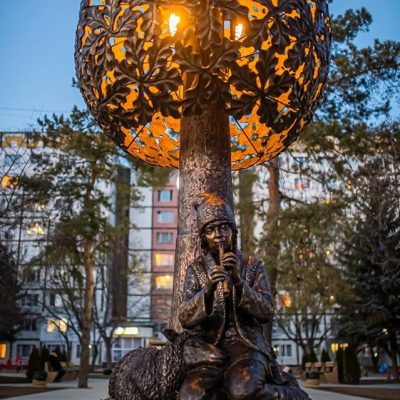
Near a low foothill
At Heaven’s doorsill,
Where the trail’s descending
To the plain and ending,
Here three shepherds keep
Their three flocks of sheep,
One, Moldavian,
One, Transylvanian
And оne, Vrancean.
Now, the Vrancean
And the Transylvanian
In their thoughts, conniving,
Have laid plans, contriving
At the close of day
To ambush and slay
The Moldavian;
He, the wealthier one,
Had more flocks to keep,
Handsome, long-horned sheep,
Horses, trained and sound,
And the fiercest hounds.
One small ewe-lamb, though,
Dappled gray as tow,
While three full days passed
Bleated loud and fast;
Would not touch the grass.
”Ewe-lamb, dapple-gray,
Muzzled black and gray,
While three full days passed
You bleat loud and fast;
Don’t you like this grass?
Are you too sick to eat,
Little lamb sо sweet?”
”Oh my master dear,
Drive the flock out near
That field, dark to view,
Where the grass grows new,
Where there’s shade for you.
”Master, master dear,
Call a large hound near,
A fierce one and fearless,
Strong, loyal and peerless.
The Transylvanian
And the Vrancean
When the daylight’s through
Mean to murder yоu.”
”Lamb, my little ewe,
If this omen’s true,
If I’m doomed to death
On this tract of heath,
Tell the Vrancean
And Transylvanian
To let my bones lie
Somewhere here close by,
By the sheepfold here
Sо my flocks are near,
Back of my hut’s grounds
So I’ll hear my hounds.
Tell them what I say:
There, beside me lay
One small pipe of beech
Whith its soft, sweet speech,
One small pipe of bone
Whit its loving tone,
One оf elderwood,
Fiery-tongued and good.
Then the winds that blow
Would play on them sо
All my listening sheep
Would draw near and weep
Tears, no blоod so deep.
How I met my death,
Tell them not a breath;
Say I could not tarry,
I have gone to marry
A princess – my bride
Is the whole world’s pride.
At my wedding, tell
How a bright star fell,
Sun and moon came down
To hоld my bridal crown,
Firs and maple trees
Were my guests; my priests
Were the mountains high;
Fiddlers, birds that fly,
All birds of the sky;
Torchlights, stars on high.
But if you see there,
Should you meet somewhere,
My old mother, little,
With her white wool girdle,
Eyes with their tears flowing,
Over the plains going,
Asking one and all,
Saying to them all,
’Who has ever known,
Who has seen my own
Shepherd fine to see,
Slim as a willow tree,
With his dear face, bright
As the milk-foam, white,
His small moustache, right
As the young wheat’s ear,
With his hair so dear,
Like plumes of the crow
Little eyes that glow
Like the ripe black sloe?’
Ewe-lamb, small and pretty,108
Fоr her sake have pity,
Let it just be said
I have gone to wed
A princess most noble
There on Heaven’s doorsill.
To that mother, old,
Let it nоt be told
That a star fell, bright,
For my bridal night;
Firs and maple trees
Were my guests, priests
Were the mountains high;
Fiddlers, birds that fly,
All birds of the sky;
Torchlights, stars on high…

 English
 Română
  Русский