
 English
 Română
  Русский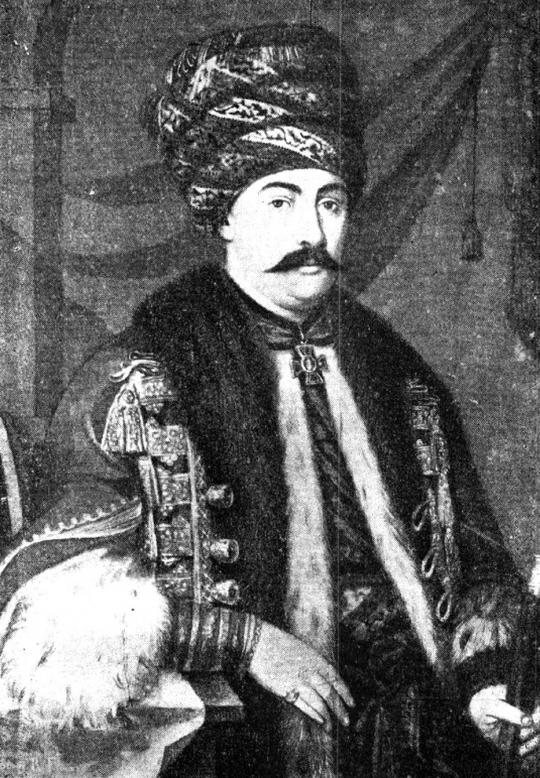

Manuc Bey – Armenian Prince
Historians have found that one of the less developed actors in the events of the Russo-Turkish War of 1806-1812, involved in political-diplomatic actions, who had influence over the Russo-Ottoman negotiations was the influential and wealthy Manuc (Emanuel) Mirzaianț (there are different spellings of his name: Mirzaian, Mârzaian, Manuc bey etc.), of Armenian origin, known in his time as Manuc Bey.
Manuc Bey (son of Mardiros Mirzaian and Mamila Hamum Oglu: 1769-1817), who began his career as a merchant south of the Danube, ended up as a knight of the Order of St. Vladimir (3rd degree), Russian state councillor (equivalent to the rank of general), informer for Russian diplomacy, banker and landowner with ambitious economic plans in Bessarabia and beyond… For his activity in Wallachia he was awarded the rank of serdar (1802) and paharnic (1803).
For his services to the Ottoman Empire, in 1807 he was granted the rank of Grand Dragoman of the Porte (for the first time this position was entrusted to a non-Franco-Katarite), in 1808 – the title of bei (prince) of Moldavia, which turned out to be, de facto, an honorary one (he did not hold any dominion in the Principalities). Subsequently, the title of “bei” i.e. “prince” was not confirmed in Russia. Only the descendants of Manuc Bei in Bessarabia were “ennobled” by marrying descendants of aristocratic descent.
The merchant, merchant and polyglot diplomat (he knew about 12 languages) Manuc Bey benefited from a rich historical-literary bibliography from which it is easy to see that he exercised, often from the shadows, political-economic actions with an impact on the events in the Romanian Principalities, Russia and the Ottoman Empire. At the same time, there are still many less researched aspects and many unexplored documents that would add to the knowledge of this complex and controversial figure. The diplomatic activity of the famous Manuc Bey is primarily linked to the signing of the Russian-Turkish peace treaty of 16/28 May 1812, in the context of influence peddling, after which part of the Moldavian territory was annexed by the Russian Empire and for more than 100 years would bear the name of Bessarabia.
Manuc Bey played an active role as an intermediary in the secret peace negotiations between the Russian and Ottoman authorities, and was a useful agent of Russia, promoting its geopolitical interests and using influence peddling. It should be recalled that, for his services to the Russian crown and at his repeated requests in 1805-1806, just before the outbreak of war with the Turks, he was issued a passport as a subject of the Russian Empire on 22 May 1806. From this point of view, it was also “natural” for a new citizen of Russia, who counted on her political support and material sustenance, to collaborate by all means with the protector state, including those of the intelligence services of the time. Of his many political and economic activities, more or less enlightening, for us he remained, after all, the man who built the famous inn in Bucharest that still bears his name today – where the Peace of 1812 was signed and whose secret (behind-the-scenes) protagonist he was at certain stages of the diplomatic negotiations.
On 18 October 1812 Manuc Bey and Galib Efendi left Bucharest, having been invited by the aian (governor) of Rusk. And already in December he returned to the capital of the Romanian Country, where he was warned of the danger to his life, which led him to take refuge in April 1813 in Sibiu. In June 1813 Manuc Bey’s family reunited in Brasov. After his refuge in Transylvania, he went to Vienna, where, on 3 October 1814, he had an audience with Emperor Alexander I, who gave him the title of titular state councillor (“действительный статский советник”).
In April 1815 the Russian Foreign Minister informed the administration in Chisinau that Alexander I had allowed Manuc Bey, “known for his loyalty to Russia”, to settle in Bessarabia. He settled with his family on his estate in the village of Hancesti, where he died suddenly on 20 June 1817. Legend has it that he fell off his horse because his saddle straps were cut. The evil gurus say that he was thus punished by the Ottomans for treason.
The legendary Armenian leader was buried in the porch of the Armenian church in the old centre of Chisinau.

