The Masonic lodge was established in the house of Katsiki, which was occupied by the divisional doctor Schuler. I am [..]
Masonic Lodge Ovidiu – 25
The Masonic lodge was established in the house of Katsiki, which was occupied by the divisional doctor Schuler. I am not sure whether Schuler or Pavel Pushkin was the main master of the lodge. Among the new members was the Bulgarian Archimandrite Efrem. Katsiki’s house was located in the lower part of the city, not far from the old cathedral, in a square frequented by many Bulgarians and Arnauts. They noticed that the Archimandrite, upon entering the fenced courtyard, would send his carriage away, a practice some others followed as well, which was contrary to the usual custom. This behavior attracted the curiosity of passersby, especially since rumors spread that a “judgment of the devil” was taking place in the house. When the door of the long, one-story house opened, and people saw the Archimandrite coming out, blindfolded and supported by two men, they were startled. After descending three or four steps from the porch, the Archimandrite was led straight into the basement, where the doors were immediately closed. The Bulgarians, believing their Archimandrite was in danger, were incited by the Arnauts—many of whom had fled and joined the Hetaerists. They rushed in a crowd to the basement door, broke it down, and, in their view, triumphantly rescued the Archimandrite, who was immediately surrounded by people asking for his blessing. This event occurred before sunset, and by evening, the whole city knew about it. Alexander Pushkin was one of the first to hear of it, as he was at home when Inzov received the news.
(From the memoirs of I.P. Liprandi (1790-1880), military historian and secret police officer).
Note: While in exile in Bessarabia, living in Chisinau, Russian poet Alexander Pushkin became an alleged member of the Masonic Lodge “Ovidiu-25.” Pushkin gladly accepted the invitation to join, and the initiative came from his protector during that time. It is said that the governor of Bessarabia, Ivan Nikitich Inzov, was also a member of the “Ovidiu-25” Lodge. The lodge was named after the Roman poet Ovid, who lived in the region near the Black Sea. The number 25 refers to the lodge’s order number. Preparations for the founding of the Masonic organization in Chisinau began in the spring of 1821 under the auspices of the Grand Lodge “Astrea” in St. Petersburg.
The “Ovidiu-25” Lodge was officially inaugurated on July 7, 1821, with Major General Pavel Pushkin as its head. However, some leaders of the “Astrea” Lodge were skeptical about the opening of the lodge in Chisinau, so it was not officially registered until October 7, 1821. Pushkin became a member of the lodge in May 1821 and, according to some sources, played a secondary role in its activities. It is worth noting that the “Ovidiu-25” Lodge, like all official Masonic lodges in Russia, was destined to exist for only one year, until the Tsar’s decree “on the Prohibition of Masonic lodges and any secret societies” was issued…
This museum is also an important national monument, listed in the Register of Historical and Cultural Monuments of Chisinau. The [..]
The Chisinau „Aleksandr Pushkin” House-Museum
This museum is also an important national monument, listed in the Register of Historical and Cultural Monuments of Chisinau.
The building is historically significant because it was the residence of the young Russian poet Aleksandr Pushkin, who, at the age of 21, lived here for several months after being exiled by the Russian Tsarist government to the capital of Bessarabia. Pushkin arrived in Chisinau in September 1820.
Originally owned by General Inzov, the house became an official museum on February 10, 1948. The museum’s exhibits include materials related to Pushkin’s time in Chisinau, such as paintings, prints, decorative art objects from the late 18th and early 19th centuries, sculptures, and editions of his works written during his time in Bessarabia.
It is worth mentioning that only two houses where Pushkin lived are believed to have been preserved worldwide, and one of them is located in Chisinau.
The church was founded by two brothers of Greek origin, Ivan and Victor Sinadino, honorary citizens of Chișinău. They were [..]
Church of St. Great Martyr Panteleimon (1891)
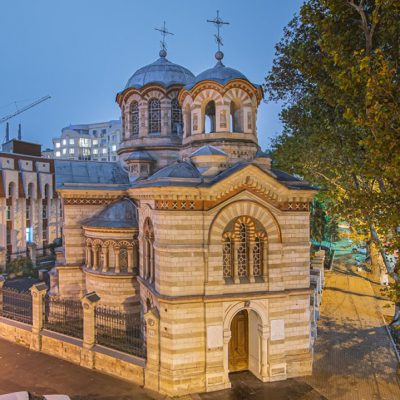
The church was founded by two brothers of Greek origin, Ivan and Victor Sinadino, honorary citizens of Chișinău. They were the sons of Pantelimon Sinadino, a former mayor of the city who served two terms, from 1837-1839 and 1840-1842. Construction of the church, designed in the neo-Byzantine style by architect Alexander Bernardazzi, took five years to complete. The church was built with a basement and vault intended to hold the remains of up to 26 individuals. Through this ecclesiastical gesture, the Sinadino family ensured their burial place within the church. The last member of the Sinadino family to oversee the church was Pantelimon Victor Sinadino, grandson of another mayor from the same family, also named Pantelimon Sinadino, who served from 1905-1910.
The family tomb, which contained the remains of Sinadino family members, was destroyed by the Soviet authorities, and the remains were reported as missing. For many years, the church was repurposed for various functions, including as a warehouse for building materials, a film storage facility, and later as an exhibition space and room for tasting alcoholic beverages.
After a long period of disuse, the church was reopened in 1992 thanks to the efforts of Father Valeriu Bazatin. On November 8, after necessary preparations, he celebrated the first mass in the church after its reopening.
At the end of the 19th century, the then-mayor of the city, Karol Schmidt, initiated the construction of a new [..]
Chisinau City Hall building
At the end of the 19th century, the then-mayor of the city, Karol Schmidt, initiated the construction of a new headquarters for the City Duma (town hall) on the site previously occupied by the fire station. The design was entrusted to the city architect Mitrofan Elladi. The renowned architect Alexandru Bernardazzi supervised the construction, which was completed in 1902.
In 1941, the building was destroyed by retreating Soviet troops. The Romanian administration managed to rebuild it by 1944, but in August of that year, during the Iasi-Chisinau operation, the building was again destroyed in the bombings.
After the war, Robert Kurtz, the city’s chief architect (1944-1951), was appointed head of reconstruction. Work on the site took place between 1946 and 1948, but the local administration did not return to the building until 1951.
Robert Kurtz restored the building to its original appearance, with one change: smaller towers were added above the main entrance, replacing the original larger ones.
The Chisinau City Hall building is a national architectural and historical monument, registered in the Register of Historical and Cultural Monuments of Chisinau.
Monastery ,,Saint Great Martyr Teodor Tiron” (Ciuflea) (1854-1858)
It is the only convent of nuns in the territory of Chișinău. Its cathedral is a white stone temple with [..]
Monastery ,,Saint Great Martyr Teodor Tiron” (Ciuflea) (1854-1858)
It is the only convent of nuns in the territory of Chișinău. Its cathedral is a white stone temple with nine gilded domes and was built at the request of brothers Teodor (1796-1854) and Anastasie (1801-1870) Ciufli, based on the design of architect Luca Zaușchevici. It is popularly known as “Ciuflea Monastery.” The construction of the cathedral began in 1854 and was completed in 1858. The founders of this holy place, brothers Teodor and Anastasie, are buried near the south wall, as evidenced by the inscription on the marble slab inside the cathedral of the monastery. A tragic event, related to the First Jewish Pogrom in Chișinău, is also associated with this holy place. The pogrom began on Easter Day, 6 April 1903, in front of Ciuflea Cathedral, where Jewish shops and stores were located. The pogrom lasted three days: 6, 7, and 8 April 1903. These days coincided with Orthodox Christian Easter. According to the Jewish calendar, the first day corresponded to the last day of Pesach (Passover), called “Acharon shel Pesach.” The pogrom in Chișinău attracted attention from the Jewish world, Russia, and the entire civilized world due to a new element: people being killed. Previously, in the pogroms of 1881-1882 in southern Russia, the defining element had been robbery. This time, however, there was murder — a type of murder that had not occurred in pogroms for about 250 years. During the Chișinău pogrom, 51 people were killed, including 49 Jews (24 women and children), over 300 were wounded (75 of them seriously), and about 800 Jewish homes and shops were destroyed, damaged, or looted. The former cathedral, now the Monastery of Saint Great Martyr Teodor Tiron, remained a beacon of the ancestral Orthodox faith throughout the difficult years of Soviet atheism (1962-2002). On 2 May 2008, the Icon of Our Lady ” Panagia Portaitissa ” was brought to Ciuflea Monastery from Mount Athos. The icon is currently kept in the Winter Church of the monastery. A small part of the Holy Relics of the Great Martyr Teodor Tiron is also kept here.

 English
 Română
  Русский