Ruins of Nursing Home and Synagogue… The former Țirilson synagogue, which is located on the street of the same name, [..]
Tirilson synagogue
Ruins of Nursing Home and Synagogue…
The former Țirilson synagogue, which is located on the street of the same name, was built at the beginning of the 20 th cent. Currently only a historical ruin remains of it.
The architectural complex consisted of two connected buildings: a synagogue and a nursing home. The prayer hall was illuminated by windows in two levels, as well as the ritual rooms. The facade had a symmetrical composition, which was reflected in the structure of the building. The decoration of the facade contained details in the Baroque style.
Note:
In Chisinau, by the beginning of the Second World War, 77 synagogues and prayer houses were registered. At that time Chisinau was considered as a core of the Bessarabian Jews. According to Jewish law, for every 500 people a synagogue was to be built.
At the beginning of the twentieth century, the Jews of Chisinau had factories in which thousands of Jewish workers worked. There were 16 operating schools. In 1903, the first Jewish pogrom took place in Chisinau, which resulted in the death of 49 people. The famous Mayor Carol Schmidt, outraged by what happened, immediately resigned. But two years later, in 1905, another Jewish pogrom took the lives of another 19 Jews. The community was shocked, that caused numerous emigration flows from the city and country.
The liquidation of the Jews was continued by the Nazis during the Second World War – all of them, who didn’t manage to leave the country, were imprisoned in the Chisinau ghetto. Out of several tens of thousands of people, in 1944, only 6 Jews remained alive. During the period of communism, restrictions were imposed on the Jews who remained here: in 1961 bars mitzvahs were banned, and Jews were persecuted and sentenced to charges; and in 1964 all synagogues in the city were closed and reprofiled, except for one, which still operates today.
Chabad Lubavitch Central Synagogue (Synagogue of the glassmakers)
This Synagogue was built in 1896-1898 by the architect Tsalel Gershevich Ginger. For a long time there was an unspoken [..]
Chabad Lubavitch Central Synagogue (Synagogue of the glassmakers)
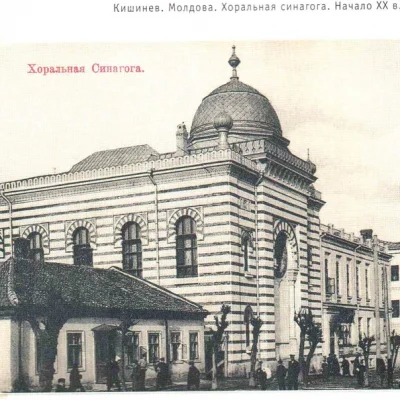
This Synagogue was built in 1896-1898 by the architect Tsalel Gershevich Ginger. For a long time there was an unspoken rule in Chisinau: for every 500 Jews in the city there must be one synagogue.
In 1964 the city authorities ordered the closure of all synagogues except the Glaziers’ Synagogue, which remained the only legally operating synagogue for more than 40 years. It is now run by the Chabad-Lubavitch Hasidic movement. The original mural paintings have been preserved inside. The synagogue complex includes the building and the mikveh.
CENTRAL SYNAGOGUE OF CHISINAU its founded in 1886. “Sennaya” synagogue, located in the historical part of Chisinau, is one of [..]
Central Synagogue of Chisinau
CENTRAL SYNAGOGUE OF CHISINAU its founded in 1886.
“Sennaya” synagogue, located in the historical part of Chisinau, is one of the oldest functioning synagogues in the capital and the Republic of Moldova as a whole. Its role in the formation of the Jewish community in the region is exceptional.
In recent years an abandoned synagogue building in Chisinau has been restored and transformed into an active Community Center open to all comers. Most of the activities are subsidized and carried out by volunteers who work out of a sense of ideology and a mission to feel a sense of belonging and pride in the Jewish community of Moldova.
The Jewish Community of the Republic of Moldova was officially registered in 1997, being the successor of the Republican Society of Jewish Culture (created in 1989) and the Jewish Community of Bessarabia.
CERM is a non-governmental, non-political, non-profit, public organization, which unites all Jewish communities and organizations of the Republic of Moldova, including the regional communities of Balti, Orhei, Soroca, Bender, Tiraspol, Grigoriopol, Dubasari, Ribnitsa.
In 1998, Pushkin Boulevard was renamed Jerusalem Street on the 3000th anniversary of the first recorded Jerusalem. Previously, before b-l [..]
Jerusalem Street
In 1998, Pushkin Boulevard was renamed Jerusalem Street on the 3000th anniversary of the first recorded Jerusalem. Previously, before b-l was named A.S. Pushkin, this street had no name.
Between Grigore Vieru Boulevard and Pushkin Street, a monument to the victims of the Jewish ghetto in Chisinau was erected on Jerusalem Street. Nearby is the main entrance to the former ghetto, which was established in the lower part of the city in July 1941 after German and Romanian units took control of Chisinau. Within weeks, more than 11,000 Jews – men, women and children – were imprisoned in the ghetto. An information board in front of the monument shows the ghetto’s boundaries.
The exact number of Jews remaining in the city at the time is unknown. Some were deported by the Soviets shortly before the war, while others were evacuated or conscripted into the Red Army. However, thousands of Jews were unable or unwilling to leave the city. Only six people emerged alive from the ghetto in 1944…
It was inaugurated on April 22, 1993. The authors – the architect S. Şoihet and the sculptor N. Epelbaum. The [..]
Monument to the Victims of the Chisinau Ghetto
It was inaugurated on April 22, 1993. The authors – the architect S. Şoihet and the sculptor N. Epelbaum.
The Chisinau ghetto was created on July 25, 1941 by order of the military governor of Bessarabia, General Constantin Voiculescu. On August 11, there were 10,578 people in the ghetto, later the number increased to 11,525 with the arrival of Jews from nearby towns. According to the 1942 census of the authorities, only 100 Jews remained in Chisinau, of which 99 were in the ghetto. Only 6 Jews survived until the Soviet army entered Chisinau in the summer of 1944.
One of the old Jewish cemeteries preserved in what is now the city is the one in the Buiucani sector, [..]
Jewish cemeteries
One of the old Jewish cemeteries preserved in what is now the city is the one in the Buiucani sector, next to the fire station on Milano Street. It is estimated that between 40,000 and 50,000 Jews are buried here. The current land is 12 hectares, originally around 15-16 hectares. The town gradually “swallows” its territory.
According to statistics, the dead were buried here at the beginning of the 19th century. Here, among the later monuments, is a memorial to the victims of the 1903 Chisinau pogrom, and not far from it is the grave of Rabbi Leib Jehuda Cirilson, chief rabbi of Bessarabia for many decades. It is believed that the rabbi died during a bombing raid under the roof of his house in August 1944.
There are also the ruins of a synagogue, the only one of its kind in Moldova. The aviator’s grave has also been preserved – the monument is decorated with a propeller, which still rotates in the wind to this day…
During World War II, the eastern part of the cemetery was badly damaged. In 1958, the area was divided into two parts, one of which the authorities later turned into a farmers’ market. By 1960 the eastern part of the cemetery was completely destroyed, the tombstones were crushed and used to build the fence for the rest of the Jewish cemetery and other cemeteries in Chisinau, as well as to pave paths in the park. Alunelul Park, tennis courts, and residential neighborhoods were developed on the territory once occupied by the cemetery.
The western part of the Jewish cemetery survives to this day, but most of the graves are in poor condition, with gravestones damaged, plaques broken and erased, and fences rusted. Vandals, natural influences and ruthless time are destroying even the most durable stones and memories…
It was founded on November 5, 1934, in Tiraspol. The first show staged was “Hate” by S. Ialțev. In 1940, [..]
Russian State Drama Theater “A. P. Cehov”
It was founded on November 5, 1934, in Tiraspol. The first show staged was “Hate” by S. Ialțev. In 1940, the theater moved to Chisinau, where in the same year it presented the show “Unchaining” by B. Lavreniov. During the Second World War, the theater was evacuated to Turkmenistan, where it staged productions such as “Russian People” by C. Simonov, “Partisans in the Steppes of Ukraine” by A. Korneiciuc, “Machenka” by A. Afinoghenov, “Guilty without guilt” by A. Ostrovskii, and others.
Upon returning to Chisinau in 1944, the theater continued to stage plays from classical and contemporary Russian drama. Additionally, original performances were produced based on the works of Moldovan playwrights, including “When the Grape Ripens” by P. Darienco (1960), “The Source of Brotherhood” by L. Corneanu (1964), “And Under That Sky…” by A. Busuioc (1980), “The Year of Death, the Year of Immortality” by I. Druță (1982), “Badea Cozma” based on G. Malciuc (1984), and more.
From 1985 onward, Veniamin Apostol, an esteemed master of art from the Moldavian SSR, served as the theater’s chief director until his passing. The theater conducted numerous tours in Moscow, Leningrad, Kiev, Odessa, Breansc, Krasnodar, Stavropol, with its performances earning high praise from audiences.

 English
 Română
  Русский