Monastery ,,Saint Great Martyr Teodor Tiron” (Ciuflea) (1854-1858)
It is the only convent of nuns in the territory of Chișinău. Its cathedral is a white stone temple with [..]
Monastery ,,Saint Great Martyr Teodor Tiron” (Ciuflea) (1854-1858)
It is the only convent of nuns in the territory of Chișinău. Its cathedral is a white stone temple with nine gilded domes and was built at the request of brothers Teodor (1796-1854) and Anastasie (1801-1870) Ciufli, based on the design of architect Luca Zaușchevici. It is popularly known as “Ciuflea Monastery.” The construction of the cathedral began in 1854 and was completed in 1858. The founders of this holy place, brothers Teodor and Anastasie, are buried near the south wall, as evidenced by the inscription on the marble slab inside the cathedral of the monastery. A tragic event, related to the First Jewish Pogrom in Chișinău, is also associated with this holy place. The pogrom began on Easter Day, 6 April 1903, in front of Ciuflea Cathedral, where Jewish shops and stores were located. The pogrom lasted three days: 6, 7, and 8 April 1903. These days coincided with Orthodox Christian Easter. According to the Jewish calendar, the first day corresponded to the last day of Pesach (Passover), called “Acharon shel Pesach.” The pogrom in Chișinău attracted attention from the Jewish world, Russia, and the entire civilized world due to a new element: people being killed. Previously, in the pogroms of 1881-1882 in southern Russia, the defining element had been robbery. This time, however, there was murder — a type of murder that had not occurred in pogroms for about 250 years. During the Chișinău pogrom, 51 people were killed, including 49 Jews (24 women and children), over 300 were wounded (75 of them seriously), and about 800 Jewish homes and shops were destroyed, damaged, or looted. The former cathedral, now the Monastery of Saint Great Martyr Teodor Tiron, remained a beacon of the ancestral Orthodox faith throughout the difficult years of Soviet atheism (1962-2002). On 2 May 2008, the Icon of Our Lady ” Panagia Portaitissa ” was brought to Ciuflea Monastery from Mount Athos. The icon is currently kept in the Winter Church of the monastery. A small part of the Holy Relics of the Great Martyr Teodor Tiron is also kept here.
Architectural monument of national significance, included in the Register of monuments of history and culture of the municipality of Chisinau, [..]
Jewish Hospital
Architectural monument of national significance, included in the Register of monuments of history and culture of the municipality of Chisinau, compiled by the Academy of Sciences.
The Jewish Hospital was founded before 1812 and received official status in 1843. Since the 70s of the 19th century, projects for the buildings of the curative establishment were elaborated. The hospital is made up of several buildings, freely arranged, pavilion-like, on a vast territory. The buildings were built in stages from the 1880s to the early 20th century.
The administration, pharmacy and laboratory buildings were built between 1889 and 1890, and the surgery pavilion between 1887 and 1901. It also had a maternity ward. At the beginning of the 20th century it became the largest hospital in Bessarabia.
It played a decisive role in the rehabilitation of the victims of the Pogrom of April 1903. It could receive 500 patients at a time, who were always treated free of charge.
Carol Schmidt (Karl-Ferdinand Alexander Schmidt) (1846 – 1928)
The longest-serving mayor of Chisinau (1877-1903) was born into a German-Polish family. One of his sons, Alexander Schmidt, also served [..]
Carol Schmidt (Karl-Ferdinand Alexander Schmidt) (1846 – 1928)
The longest-serving mayor of Chisinau (1877-1903) was born into a German-Polish family. One of his sons, Alexander Schmidt, also served as the mayor of Chisinau during the turbulent years of 1917-1918.
Under Carol Schmidt’s leadership, numerous impactful developments took place in the city. Many streets were paved, and various public facilities were established, including an asylum for the homeless (1899) and the People’s Amphitheatre with a performance hall (1900). He played a key role in laying the first tram lines (1881-95) and overseeing the construction of the first aqueduct and sewage system. Street lighting was introduced, and significant educational and cultural institutions were built, such as the Royal School (1886), the Princess Natalia Dadiani Girls’ Gymnasium (1900), the County History Museum (1889), and the present-day Town Hall (1901). Additionally, Schmidt contributed to building houses for invalids (1877-81) and initiated the establishment of a school museum, the “Armonia” Musical Society, and the town school of Fine Arts (1894, today known as the Alexandru Plămădeală College of Fine Arts).
After 26 years as mayor, Carol Schmidt resigned, prompted by the tragic events of the Jewish Pogrom on April 6-8, 1903. Despite his efforts to stop the pogrom, he faced challenges and expressed his frustration to reporters. In response to the crisis, he sent a telegram to the Minister of the Interior in St Petersburg, organized emergency meetings of the City Council to raise funds for the victims, and provided aid to those affected. He even sheltered several Jewish families with children in his own house and donated resources, including wood from his residence, to the Jewish Hospital. Following the resolution of immediate town management matters, Schmidt continued to serve as a judge and remained active in city life until his death in 1928.
Carol Schmidt was the only mayor for whom the townspeople requested a street to be named while he was still alive. Gostinnaia Street, where Schmidt lived, became Carol Schmidt Street until 1944. Today, a street in the Telecentre district bears the name of this legendary mayor. The house where he and his family lived, located at 84 Mitropolit Varlaam Street, still stands and features a memorial plaque in Romanian and German honoring its former distinguished resident.
On May 10, 2014, a bust of Carol Schmidt was unveiled in front of the National Philharmonic in Chisinau, opposite the house where the state official lived. Unfortunately, the mayor’s tomb has not been preserved to date.
One of the old Jewish cemeteries preserved in what is now the city is the one in the Buiucani sector, [..]
Jewish cemeteries
One of the old Jewish cemeteries preserved in what is now the city is the one in the Buiucani sector, next to the fire station on Milano Street. It is estimated that between 40,000 and 50,000 Jews are buried here. The current land is 12 hectares, originally around 15-16 hectares. The town gradually “swallows” its territory.
According to statistics, the dead were buried here at the beginning of the 19th century. Here, among the later monuments, is a memorial to the victims of the 1903 Chisinau pogrom, and not far from it is the grave of Rabbi Leib Jehuda Cirilson, chief rabbi of Bessarabia for many decades. It is believed that the rabbi died during a bombing raid under the roof of his house in August 1944.
There are also the ruins of a synagogue, the only one of its kind in Moldova. The aviator’s grave has also been preserved – the monument is decorated with a propeller, which still rotates in the wind to this day…
During World War II, the eastern part of the cemetery was badly damaged. In 1958, the area was divided into two parts, one of which the authorities later turned into a farmers’ market. By 1960 the eastern part of the cemetery was completely destroyed, the tombstones were crushed and used to build the fence for the rest of the Jewish cemetery and other cemeteries in Chisinau, as well as to pave paths in the park. Alunelul Park, tennis courts, and residential neighborhoods were developed on the territory once occupied by the cemetery.
The western part of the Jewish cemetery survives to this day, but most of the graves are in poor condition, with gravestones damaged, plaques broken and erased, and fences rusted. Vandals, natural influences and ruthless time are destroying even the most durable stones and memories…
In the western part of the city, situated within the Buiucani district, lies a modest park covering just 11 hectares [..]
Park ”Alunelul”
In the western part of the city, situated within the Buiucani district, lies a modest park covering just 11 hectares – “Alunelul” Park. Established in 1958, this park occupies the grounds of a former Jewish cemetery. A portion of the cemetery was dismantled, and some remains were relocated to a new cemetery nearby.
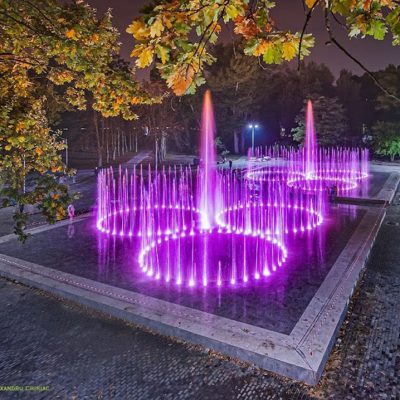
Nestled deep within the park is the memorial complex dedicated to the victims of the 1903 Chisinau pogrom, which was erected in 1993. Notably, Alunelul Park underwent a splendid renovation at the end of 2020, much to the joy of both locals and visitors to the capital. The park’s focal point is the multicolored flowing fountain, featuring 284 water jets and lights. During the summer, these water jets dance to the rhythm of the music, reaching impressive heights.

 English
 Română
  Русский