In the heart of Chișinău, on Columna Street 106, you can find Planeta Moldova – Creative Workshop, a space dedicated [..]
“Planeta Moldova” Workshop
In the heart of Chișinău, on Columna Street 106, you can find Planeta Moldova – Creative Workshop, a space dedicated to art, crafts and creativity, where local traditions are reinterpreted in a modern and accessible way.
Here, Carolina and Ruslan Grimovici invite visitors to discover the world of ceramics and experience the art of pottery. During the workshops, participants have the opportunity to work directly with clay, learn basic modelling techniques and create their own objects, turning a simple piece of clay into a personal souvenir.
The experience is suitable for both children and adults and offers a different way to discover local culture – not only by admiring handmade objects, but by actively taking part in the creative process.
In addition to pottery workshops, Planeta Moldova also offers a variety of handmade creations, from ceramics and tableware to souvenirs and accessories. Each piece reflects a combination of traditional inspiration and contemporary artistic expression.
For visitors who want to discover Chișinău through authentic experiences, Planeta Moldova is a place where craftsmanship becomes a creative adventure. Here, everyone can work with clay, learn something new and take home a creation made with their own hands.
Planeta Moldova – where tradition is shaped in clay and every visitor becomes part of the story.
Eugen Doga Street, currently the only pedestrian street in the center of Chisinau, was previously named after Alexandru Diordiță from [..]
Eugen Doga Pedestrian Street
Eugen Doga Street, currently the only pedestrian street in the center of Chisinau, was previously named after Alexandru Diordiță from 1997 to 2015. The street stretches for 250 meters between Columna and Constantin Tănase streets.
This historical street, connecting Cathedral Square to Constantin Tănase Street, first appeared on the map of Chisinau in the early 19th century as part of Pavlovskaia Street, linking the Square to Albișoara Street. This layout roughly corresponds to the present-day Eugen Doga and Petru Rareș Streets. After Bessarabia became part of Romania, the street underwent a series of name changes, initially becoming Saints Peter and Paul. Until 1940, it was renamed several times, first as Lascăr Catargiu and later as Petru Rareș.
In the late 1940s, the street became part of Tentralnyi Luci Boulevard (from Russian “Central Ray”), currently divided into Renaissance and Grigore Vieru Boulevards. However, despite being part of the boulevard, traffic was redirected around it to parallel streets, Metropolitan Gavril Banulescu-Bodoni and Aleksandr Pushkin (their current names). After gaining independence, the street became Cosmonautilor Street, now known as Constantin Tanase Street. In 1997, it was renamed in memory of politician Alexandru Diordița, according to Government Decision No. 686 of 13 December 1996. However, in November 2015, the Chisinau Municipal Council decided to rename it in honor of the composer Eugen Doga.
The authorities expressed the intention to convert the street into a pedestrian area in February 2013. Since April 22, 2013, car circulation has been prohibited, except for residents and service vehicles, although this rule was initially violated. In May 2013, a local manufacturer assumed the costs of 5 million lei for redevelopment, but the actual expenses reached 12 million lei, with the economic agent contributing 3 million and the remaining funds allocated from the municipal budget. The improvements included the installation of granite paving, a storm drainage system, new lampposts, and other cosmetic changes. The transformation into a pedestrian street took two years, with multiple delays in the opening.
The inauguration of the pedestrian street finally occurred in 2014, but the press has repeatedly highlighted the poor quality of the granite pavement. In 2023, the central part of the pavement was replaced with giant piano clapboards to enhance convenience for pedestrians.
In Chișinău, traditions and creativity come together through an unusual yet fascinating form of art – String Art, a technique [..]
Elena Beznos – String Art
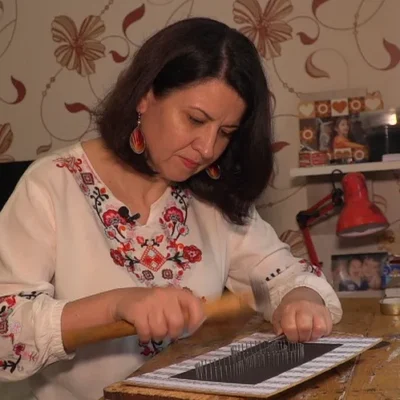
In Chișinău, traditions and creativity come together through an unusual yet fascinating form of art – String Art, a technique in which threads stretched between nails on a wooden surface are transformed into unique works of art.
Elena Beznos, a folk artisan from Chișinău, has been practicing this technique for more than 15 years. She discovered String Art during her maternity leave, and what began as a simple curiosity gradually became a true passion and an original way of highlighting traditional Moldovan symbols and motifs.
In her works, Elena combines a contemporary artistic technique with elements that are representative of Moldovan culture – grapes, the Tree of Life, traditional patterns and national symbols. Each piece is handmade, and depending on its size and complexity, creating one can take anywhere from several hours to several weeks or even months.
For Elena, String Art is more than creating decorative artworks. It is a way of sharing her passion for craftsmanship and bringing people closer to the beauty of handmade art. Over the years, she has taken part in exhibitions, fairs and educational activities, including workshops where visitors can discover this technique and create their own artworks.
One of the most fascinating aspects of her work is the use of traditional Moldovan motifs in String Art. In this way, a modern artistic technique becomes a means of reinterpreting elements of Moldova’s cultural heritage in an original and accessible form.
If you want to discover Chișinău through its traditional crafts and creative experiences, meeting Elena Beznos offers something truly special – an opportunity to see how, with patience and skill, threads and hundreds of nails can tell the story of Moldova. Elena Beznos’ workshop can be discovered on Eugen Doga Pedestrian Street in the heart of Chișinău, where visitors can explore this unique artistic technique and admire works inspired by Moldovan culture and traditions.
The cornerstone of Chisinau is a purely symbolic stone, placed in 1986, commemorating 550 years since the first mention of [..]
Сornerstone of Chisinau
The cornerstone of Chisinau is a purely symbolic stone, placed in 1986, commemorating 550 years since the first mention of the place name “Cheșeneu.” The initial inscription was in the Cyrillic alphabet.
On October 12, 2011, the inscription was renovated, and the text, now in the Latin alphabet, was modified.
It is believed that the city of Chisinau started its history from this location.
Any human settlement is born on the shore of a water. And where the waters are, after a while the [..]
Red Mill (urban legend)
Any human settlement is born on the shore of a water. And where the waters are, after a while the wheel appears which makes flour. The same was in Chisinau, many wind and water mills were built. Years passed, and the city grew like yeast. It already needed a new mill, not dependent on the power of water or wind. The new owner of the mill, a Jew, had just arrived in the city and took over a wooden mill. When there was time to be dressed in white stone and be enlarged – the misfortune happened.
The owner, it was said in the fair, had only one daughter – gentle and educated. He was raising his own child, he wanted to be a good father, to leave his profitable mill to make her life easier. That is why he often took the child with him in the carriage to see the people, the mill, in order to show how things are. That was incredible behavior for those times of a father towards a daughter. Girls had to be brought up at home, taught to sew their dowry and taught to take care of the house.
Soon the building of the walls began. The craftsmen carefully laid the white stones of the walls and outlined the walls. One night the bells of the nearby church were ringing rascally announcing a misfortune. Red flames engulfed the mill as if an unseen blast scorched the wall. The powerless eyewitnesses watched the fire devouring wood and stone insatiably. In the morning the sun rays brought to light the burnt and unfinished walls. It was quickly rumored in the fair that it was not the first property of the Jew that was burnt, that there were others, and they whispered that the Jew was cursed and that his wife also perished in the flames. It is no longer known if it was man-made accident or just a mischance. He diligently built new walls, with new craftsmen, and new stone, working day and night. It was known from the elders that a durable building requires a mortal gift. And the mill asked for his sacrifice-a living being. The Old Jew had made the covenant with himself and fate: he will pay a living sacrifice – the first who enters the mill on Friday evening will be left to die overnight. She had called an old maid to bring her food and prayed to God to bring the Old Lady’s steps to the mill. He had thus thought that he would be able to overcome the power of the curse. But the old maid had fallen ill and told the girl that she couldn’t go. The child of the Jew, eager to be of help, set off with the food to the mill. Neither the darkness of the moonless night, nor the dogs barking in the huddles, nor the loneliness did not frighten the girl. When she opened the door of the mill and called her father, the Echo went up on the walls, and was lost in height. The old father is in pain. Destiny had asked for the hardest sacrifice – her own child, and the covenants demanded their fulfillment. He told the girl that she was going to wait for him a little, he left the locked mill and with heavy steps he moved away to the prayer house.
At night the fire announced by the church bells took its toll. The flames seemed alive and rose as they could be seen from every corner of the fair. People awakened in the middle of the night watched the misfortune of destruction. By morning, full of pain, with braided steps and bleached hair, the old father was desperately searching for the remains of the child. With amazement they were all looking at his search, but he found no sign of the girl. Only the mill had its walls reddened forever.
Years have passed. The mill no longer grinds flour, but the legend says, that even these days inside you can hear crying and sighing, and sometimes you can see in places at the windows a whiff of light, and a girl dressed in white robes with a candle in her hand.
Note:
It is one of the first steam mills in Chisinau, built in 1850. In the period of several decades it became one of the most important buildings not only on the Inzov Hill, but in city as well. Since it was not a simple mill, but a five-story white stone building, always shrouded in flour ”dust”, the locals initially called it ”White Mill”.
In 1889 Avram Levenzon became the owner of that mill. He and his wife’s brother built a shop next to the mill where Chisinau residents could buy baked goods from freshly sifted flour.
The name “Red Mill” appears later after an unfortunate accident. In 1901 there was a large fire, in which some people lost their lives, and the owners had to rebuild the mill again.
The Church Museum was legally founded on April 4, 1904, with the establishment of the Church Historical-Archaeological Society in Chisinau, [..]
Ruins of the Church Museum/Old Cathedral
The Church Museum was legally founded on April 4, 1904, with the establishment of the Church Historical-Archaeological Society in Chisinau, initiated by the distinguished Basarabian scholar Ioan Halippa.
According to the by-laws, the Society’s objective was the comprehensive study of the local Church’s history, starting from the dawn of Christianity in Bessarabia. The Society focused its activities on researching, preserving, and studying monuments related to the establishment of churches, the formation of parishes, the ecclesiastical hierarchy, religious-moral life of the clergy and laity, educational aspects, and efforts against the spread of heresies and sects. The Society collected written documents concerning the ecclesiastical domain, ecclesiastical books, icons, and other ecclesiastical items. It also gathered, described, and processed archaeological-church, historical, and ethnological materials held by institutions and private individuals.
To achieve its goals, the Society had the authority to maintain church antiquities, operate a museum, library, archive, and publish a magazine. Between 1909 and 1934, the Society published a scientific magazine, featuring contributions from Romanian hierarchs, priests, theologians, and researchers from Bessarabia and later from all over Romania, totaling twenty-four volumes.
The Society pursued another goal outlined in its regulations, namely, to enrich the collection of the church museum.
In 1920, the museum received a visit from Romanian King Ferdinand I and Queen Maria, accompanied by Royal Princess Elisabeth. Other notable visitors included Metropolitan Miron Cristea (future patriarch of the Romanian Orthodox Church), Octavian Goga (Minister of Religious Affairs), and Visarion Puiu (Bishop of Argeș). In 1919, O. Tafrali, a professor at the University of Iasi, visited the museum. Nicolae Iorga, who took interest in the museum’s treasures, noted his impressions in the visitors’ golden book in 1919: “I have examined the beautiful collection, taking it upon myself to enrich it; I have admired what love united with faith and hard work can do.”
Until 1940, the Museum was situated in the building of the Diocesan House on Emperor Alexander Boulevard, known as the “Serafimovsky Dom” (Serafim’s House) in honor of Archbishop Serafim Ciceagov, the building’s founder. In 1941, the Soviet army demolished the building, and after the war, it was completely razed.
In 1940, the museum was evacuated to Romania. With the re-establishment of church life in Bessarabia in 1941, efforts were made to revive the Museum, initiated by parish priest Father Paul Mihail. However, the Soviet return halted the Museum’s progress, and the heritage disappeared without a trace.
After 1944, the museum was devastated, and the museum’s possessions were evacuated to Plopșor, Dolj County, Romania. When the Soviet army occupied Romania, the crates containing the museum’s possessions disappeared, and the fate of the exhibits remains unknown.
The curator of the Museum, Father Paul Mihail, worked tirelessly for the rehabilitation and conservation of church antiquities. However, he suffered greatly after the museum’s destruction and the disappearance of the artifacts.
The building of the Museum, situated near the church of St. Archangels Michael and Gabriel, was demolished in the 1960s. The Old Sobor was also demolished by Soviet authorities and replaced by the “Moscow” cinema, later transformed into the “Eugen Ionesco” Theatre. The Diocesan House building was demolished in 1960 during urban architectural changes, with a monument dedicated to the heroes of the komsomol erected in its place.
On November 5, 2021, on the occasion of the 200th anniversary of the death of Metropolitan Gavriil Bănulescu-Bodoni and his canonization, archaeological excavations were initiated near the “Eugen Ionesco” Theatre to uncover the foundations of the Church Museum building and the residence of Metropolitan Bănulescu-Bodoni. Traces of a building and three underground stone structures, demolished in the 1960s, were discovered and partially excavated in this area. Plans are underway to initiate a project to preserve and transform the remnants of the disappeared buildings, including the Church of Archangels Michael and Gabriel (Old Cathedral) and the Church Museum, into a museum complex on the land adjacent to the Eugen Ionesco Theatre.
These actions aim to contribute to the restoration, preservation, and sustainable valorization of archaeological sites with significant historical and architectural value.
The provided text is based on an article signed by Father Maxim Melinti.
Some flavors are about more than food — they carry memories of childhood, family, and the places we come from. [..]
Babă Neagră” Café by Mariana Zabrian
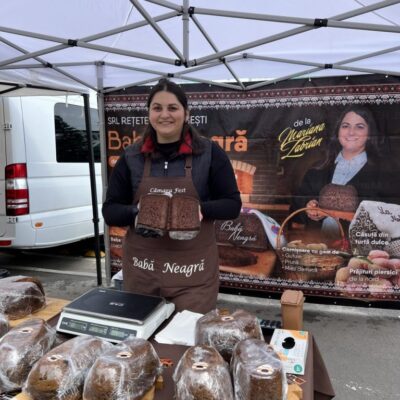
Some flavors are about more than food — they carry memories of childhood, family, and the places we come from. For Mariana Zabrian, one of these flavors is Babă Neagră, a traditional Moldovan dessert particularly associated with the northern part of the country.
Inspired by a recipe passed down from her grandmother, Mariana turned a family tradition into an entrepreneurial story, bringing this traditional dessert to a wider audience. She first began preparing and promoting Babă Neagră at local fairs and events, where the dessert quickly became popular among those who remembered its authentic taste from childhood.
Babă Neagră is a dessert that impresses not only with its simple ingredients, but also with its traditional preparation method. Its distinctive texture and dark color, which gives the dessert its name, are the result of a long baking process. For Mariana, preserving its authentic taste is essential, while the family recipe is carried forward with care and respect for tradition.
Today, the story of Babă Neagră can also be discovered in the heart of Chișinău at Babă Neagră Café by Mariana Zabrian, a place dedicated to traditional Moldovan flavors. Visitors can enjoy the famous Babă Neagră and discover other tastes inspired by homemade Moldovan cuisine.
For those visiting Chișinău and wishing to discover Moldova through its authentic flavors, Babă Neagră is an experience worth trying. It is more than a dessert — it is part of Moldova’s gastronomic heritage and a story about how a recipe passed down through generations can be given a new life.
Behind this story is Mariana Zabrian, who shows that Moldovan traditions can become not only cherished memories, but also experiences to be shared with visitors, tourists, and future generations.
There was a time when the Bears fulfilled the will of men, contrived destinies, changed the fate of all living [..]
The story of a pie “Black Baba”
There was a time when the Bears fulfilled the will of men, contrived destinies, changed the fate of all living beings – either for good or for evil. Some of them were young and beautiful, and they wore white, silky clothes, and others – old and quarrelsome, they wore black clothes, covered with ash. They gave or punished at the will: women and men, young and old, and often entangled in the warp. Many things in our lives have remained from the days when bears were part of people’s lives.
Once upon a time there was an old woman who lived in a village with her niece. She lost her parents very early and was raised by her grandmother. The girl was as good as a prayer and as lenient as a Sunday, but she did not say a word. They were all amazed at her silence, because she heard and understood what they were saying, but she did not speak to anyone, and no one had ever heard her voice. The grandmother guarded the girl with her life and taught her the crafts she knew: she treated sick, she took care of the women of the village, and she was good at field and forest plants. And in all the houses the grandmother was invited when large meals were prepared: wedding, baptism or memorial. The old woman knew the secrets of ovens, the purpose of baking bread, and she knew how to prepare dishes for a multitude of people out of few dishes. It increased the work in her hands, so that everyone was amazed at everything she was good at. She knew how to clog the oven full of pots, to keep the right fire so that the meals and dishes are towards fulfillment on the table: sausages, meat or pies. The girl learnt her grandmother’s hidden secrets, being of great help to her. And she was silent…
One day the child was sent by her grandmother to bring elderberry and jasmine flowers from The Enchanted Valley. No one remembered why this place was called so. There was a clearing in the middle of the forest, where the path from the edge of the village reached. Often the girl could be seen here, gathering healing weeds, mushrooms or flowers. But this time, arriving in the valley, the girl heard a secret call-like breeze of wind, or a tremor of leaves, as before the rain. Always cautious, now she succumbed to the call and headed to the place where the barely felt noise came from. The girl had forgotten that at the end of prayer the bears gathered in places close to the eyes of the world – and danced, and sang, and plotted mysteries and fates… ordinary mortals were not given to see them even in a million years . Only a pure and upright soul was allowed to see their dance. She remained in hiding, amazed at what her eyes could see. The Bears, with wreaths of flowers on their heads, had each come with a gift to the Enchanted Glade: they brought their own doughnut to bake gingerbread in the sunset. One of the bearers had brought some eggs from the Great Bird, oil from the chalice with myrrh, flour from the fruitful abundance of the Earth, milk from the Milky Way, and white honey from the silver bees. An old bear, dressed in a black robe, gathered all the gifts in measures known to her, with a special care of the order in which they were mixed. The Bears charmed the dough and endowed the pie with virtues: with joy, with affection, with fulfillment, with love and self-giving. At sunset, in its last rays, the pie was baked, scattering around it dizzying scent, so the mouth was watering.
The child, tired in her wake of secrecy, had tried to stretch her tired legs. Only then the witches noticed the girl. They were so surprised when they understood that the girl could see them and hear them. Only the old bear, with her wisdom, told them that it had been written in the stars that this pure soul might know them. She could not tell anyone about what she had seen and because she was good she was given by the bears the secret of knowing this sweet pie. The old bear invited her to bite off the miracle pie, then they led her to the path leading to the village. The child knew that she had received blessing from the bears to bake the pie and for people…to become a little more sincere, a little more fulfilled, a little happier…
And since then Moldovans began to bake “black baba”, that is old black woman – all the ingredients in it are white at first, but at the end the pie is black…
Located in the heart of Chișinău, at 39 Pushkin Street, Sălcioara Restaurant offers visitors an opportunity to discover the gastronomic [..]
Sălcioara Restaurant
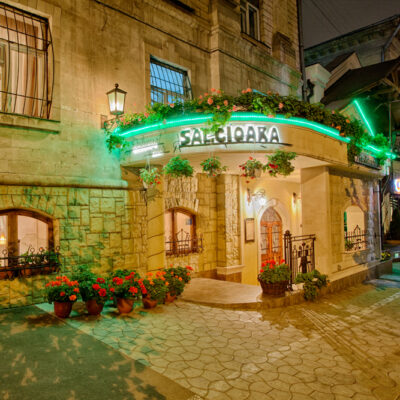
Located in the heart of Chișinău, at 39 Pushkin Street, Sălcioara Restaurant offers visitors an opportunity to discover the gastronomic traditions of the Republic of Moldova in an atmosphere inspired by the country’s cultural heritage and national traditions.
The restaurant’s interior is designed in a traditional Moldovan style, featuring decorative elements that evoke the atmosphere of a traditional Moldovan home and reflect the country’s cultural values. Its menu is based on traditional recipes passed down through generations and adapted for today’s guests.
Among the restaurant’s signature dishes are Sălcioara tochitura, mămăliguță served with brânză, sour cream and scrambled eggs, “Dor de Casă” cabbage rolls, Moldovan zeamă with homemade noodles, pork ribs, traditional plăcinte and oven-roasted lamb. For dessert, visitors can enjoy traditional sweets such as “Cușma lui Guguță”, black babă served with ice cream, and prunes stuffed with walnuts.
The restaurant also offers private spaces for events and gatherings. The main hall accommodates up to 30 guests, “Casa Mare” up to 18 guests, while the VIP room can accommodate up to 12 guests.
Sălcioara is a great choice for travelers who want to discover Chișinău through local gastronomy — from the flavors of traditional dishes to an atmosphere inspired by Moldova’s cultural heritage.

 English
 Română
 Русский