English
 Română
  Русский

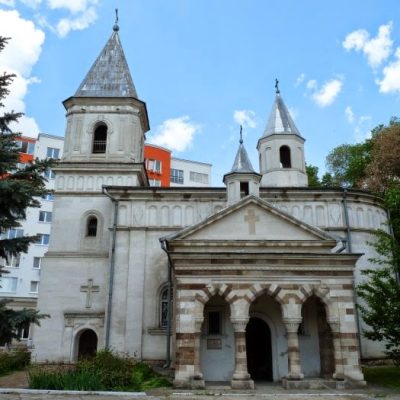
The Armenian Apostolical Church, The Holy Mother of God (1803–1804)
After the annexation of Bessarabia to the Russian Empire in 1812, the Armenian Archbishop (1809-1828) of Moldo-Vlachia, Grigor Zakarian, had to move to Chișinău, his title being limited to that of Archbishop of the Armenians of Bessarabia, although the Armenians across the Prut continued to subordinate themselves to him. The 400 parishes and five churches (Akkerman, Ismail, Tighina, Chisinau, Hotin) of the Armenian community in the region came under the jurisdiction of the Armenian community in Bessarabia.
The Armenian Apostolic Church “Holy Mother of God” in Chisinau dates back to 1803 and was built on the foundation of an old damaged Moldovan church. Built in 1645, during the reign of Vasile Lupu (1634-1653), it was dedicated to “St. Nicholas” and was also known as the “Domnească Church”. Frequent invasions by the Tatars, several earthquakes and destruction caused by the Russo-Turkish wars destroyed it to such an extent that by 1741 it was in total ruin.
At the beginning of the 19th century, the land, and what remained of the church once founded by Vasile Lupu, was bought by an Armenian from the local authorities. This one was Baron Oganes, who contributed to the creation of the church in memory of his parents in 1803.
During the Soviet period, according to the Armenian community, the church was used as a warehouse. From archival documents, we know that its conversion into a storage facility took place in the summer of 1944.
Despite the fact that the building had its religious activity suspended, it continued to gather all the Armenians of the Moldovan SSR, becoming a symbol of the preservation of their spiritual unity and identity – “the Armenian community always gathered around the church, even when it was closed”.
The Armenian community took possession of the Armenian Church again in 1992. The church resumed its activities on 19 June 1993, when it was inaugurated by the head of the Moscow and Nahicevan Eparchy in the presence of high dignitaries, and was served by a priest assigned by the Armenian Patriarchate of Etchimiadzin.
****
Who was Manuc Bey?
Armenian, Emanuel Mârzaian was born in 1769 in Rusciuc to a wealthy merchant family. After the death of his parents and his marriage to a wealthy Armenian woman, he took over the family business and established trade links with Constantinople. Thanks to his talent for cultivating relationships, bribing and sensing opportunities, he soon became the richest man in the Balkans. One of the first people he corrupted was the governor of Rusciucco, who offered him a large sum of money in exchange for guaranteeing his import and export business.
He also turned his business to the Romanian Country and got in the good graces of the ruler Constantine Ipsilanti from whom he obtained the dignities of serdar and paharnic. With a remarkable political intuition he sensed the approach of the Russo-Turkish war and in 1806, through high intermediaries such as the ruler of Muntenia and the Russian consul in Iasi, he requested and obtained Russian citizenship.
During the Russo-Turkish war of 1806-1812, Manuc turned his main business to Wallachia where he began to build the inn that bears his name in Bucharest. He also bought large estates in Wallachia.
Enjoying the trust of the Ottomans, Manuc was commissioned by Pasha to supply the army, maintain the Danubian fortresses and negotiate with the Russians.
He also gained the trust of the Montagnards (Muntenians) by offering the Romanian Country a loan of 160,000 talers without interest and by paying (non-refundable) a debt to the Turks of 60,000. In the meantime the Turks also granted him the title of bei or prince of Moldavia.
Manuc bei, a trusted Turkish agent of the Russian Empire, took part in and hosted in his inn the negotiations at the end of the Russo-Turkish war in 1812, negotiations which for us resulted in the loss of Bessarabia. For this Tsar Alexander I decorated him with the medal of Knight of the Order of Saint Vladimir.
After a short journey to Sibiu, the prudent Manuc Bei moved to Chișinău, where in 1816 he bought a 10-hectare estate in Hâncești for 300,000 lei-gold. He did not get to see the finished palace because he died in suspicious circumstances on June 20, 1817 at only 48 years old in a hunting accident, in which Russian generals were taking part, or, according to other anonymous sources, he was killed by the Ottomans for high treason.
He was buried in the courtyard of the Armenian Church in Chisinau.