From an architectural perspective, a triumphal arch is a monument in the form of an arched portico, featuring one or [..]
Triumphal Arch
From an architectural perspective, a triumphal arch is a monument in the form of an arched portico, featuring one or more arches, constructed to commemorate a significant event or honor a notable personality. For urban planning purposes, it is typically situated in one of the city squares, marking the axis of the main thoroughfare or serving as the epicenter of urban infrastructure.
The construction of triumphal arches continued into modern times, and they can now be found in various European capitals, including Chisinau.
Some intriguing details from the biography of this historical monument:
Historic Chisinau once had several triumphal arches, but only one survives today. The existing arch, designed by Odessa architect Luka Zaușchevici in 1841, took inspiration from the eponymous construction in Rome.
Throughout its history, the monument has undergone several name changes: Arch of Triumph, Arch of Victory (during Soviet times), and Holy Gates.
The present-day Triumphal Arch in Chisinau, an integral part of the architectural complex in the city center, is constructed from polished white stone, square in shape, with four openings. It aligns with the main axis of the Metropolitan Cathedral of the Nativity of God (1830) and the Cathedral Bell Tower (1835). Standing at 13 meters tall, the monument features ceramic ornaments and capitals imitating the Corinthian style. Its base consists of four massive Corinthian pillars, set on special perches that serve as pedestrian walkways. The upper level is adorned in classical style.
Craftsman Vasily Losenko from Kyiv gubernia cast three bells, including a massive 6.4-ton bell, the city’s largest, for the Nativity Cathedral Bell Tower. The bells bear inscriptions such as “By the kind permission of Tsar Nikolai I in 1838” and “For the Nativity Cathedral in Chisinau.” Due to the oversized bell, a triumphal arch was erected, also serving as a bell tower to commemorate the Russian army’s victory in the Russo-Turkish war. The giant bell was installed on the second level of the Arc de Triomphe in August 1839.
Both the bells in Chisinau and some for churches in Ismail were cast from Turkish cannons captured by A. Suvorov (1729-1800) during the military actions of Ismail (1790).
Constantin Ivanov from Chișinau undertook the responsibility to repair the bells for the sum of 1000 rubles, leaving his property as collateral in case of failure.
Inside one of the pillars of the Triumphal Arch in Chisinau, there is a metal ladder leading to the second level, where the clock is situated. The first clock, acquired from donations by Bessarabia governor Pavel Fyodorov, was purchased from craftsman Helzel in Odessa and installed on 3 August 1839. Between 1842-1849, the clock was maintained by clockmaker Spiller. In 1880, the clock was replaced by another from the Hertz factory in the German city of Ulm. The clock struck every quarter of an hour. During the beginning of the Second World War, the clock was destroyed in an explosion and later repaired in 1942 for 18,000 lei.
In 1945, marble memorial plaques were affixed to the Arch of Triumph in Chisinau, dedicated to Soviet patriotic scenes of the Second World War and the names of Soviet Union heroes who fought on the territory of Soviet Moldova. These inscriptions were removed in 1991.
The Arch of Triumph in Chisinau is acclaimed as one of the five most beautiful triumphal arches in the world.
A traveler-monument, inaugurated on April 29, 1928, on the occasion of the 10th anniversary of the Union of Bessarabia with [..]
The monument of Stephen the Great and Holy
A traveler-monument, inaugurated on April 29, 1928, on the occasion of the 10th anniversary of the Union of Bessarabia with Romania. In June 1940 he was moved to Romania, and in 1942 – brought back to Chisinau, in 1944 – moved again. A year later it was brought back and reinstalled in Chisinau. Author – the sculptor Alexandru Plămădeală.
Widely known as the Water Tower, it was reopened in the autumn of 2011, after a break of almost 10 [..]
Museum of the City of Chisinau (Water Tower)
Widely known as the Water Tower, it was reopened in the autumn of 2011, after a break of almost 10 years… Although it has been partially damaged over the years, the building was rebuilt according to the images dated in the 1980-1983 years period, except for the fire-pit at the top, originally built of wood, later re-shaped from stone.
The construction of the Tower began in 1860, and was finished only after 28 years – in 1888 (its doors being opened even later – in 1892), when Carol Schmidt became mayor of Chisinau. He, together with architect Alexander Bernardazzi, built two water towers, only one of which has survived to the present day.
The Water Tower can boast about being one year younger than the Eiffel Tower in Paris. Its height is 27m.
The tower has 4 permanent exhibition halls. The oldest exhibit is a clay vessel from the 4th century AD.
The monument is named “Requiem for Love,” or, as locals refer to it, “Two Twin Hearts.” It is situated at [..]
The monument of Ion and Doina Aldea-Teodorovici
The monument is named “Requiem for Love,” or, as locals refer to it, “Two Twin Hearts.” It is situated at the central entrance of the “Valea Morilor” park, opposite the State University. Inaugurated in 1999, on the 7th anniversary of the passing of the famous couple of musicians, singers, composers, and patriots of the nation. The sculptor behind this creation is Iurie Canașin.
It is a concert and festival venue in the center of Chisinau. The construction of the Palace was completed in [..]
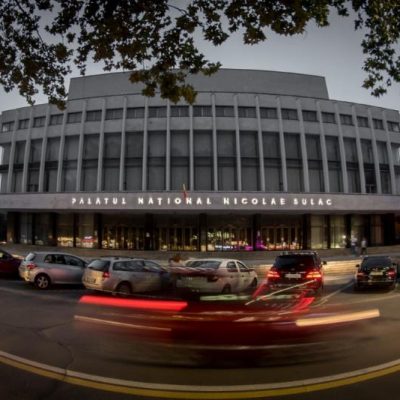
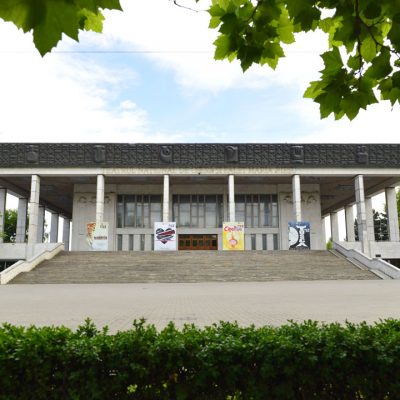
The National Palace “Nicolae Sulac”
It is a concert and festival venue in the center of Chisinau. The construction of the Palace was completed in 1972, and at that time, it was called Sala de Sesiuni (Hall of Sessions), where theater and entertainment performances were organized. It was later renamed in honor of the folk singer Nicolae Sulac (1936-2003).
The cornerstone of Chisinau is a purely symbolic stone, placed in 1986, commemorating 550 years since the first mention of [..]
Сornerstone of Chisinau
The cornerstone of Chisinau is a purely symbolic stone, placed in 1986, commemorating 550 years since the first mention of the place name “Cheșeneu.” The initial inscription was in the Cyrillic alphabet.
On October 12, 2011, the inscription was renovated, and the text, now in the Latin alphabet, was modified.
It is believed that the city of Chisinau started its history from this location.
The Circus of Chisinau was constructed in 1981 by architects S. Shoihet and A. Kiricenko. For an extended period, the [..]
The Circus of Chisinau
The Circus of Chisinau was constructed in 1981 by architects S. Shoihet and A. Kiricenko. For an extended period, the Chisinau Circus held the fourth position globally and the first in the USSR in terms of convenience and capacity, boasting 1900 seats for spectators and 100 for the members of the artists’ bands. The building was designed on a circular basis with a traditional arena diameter of 13 meters. The circus dome, constructed of reinforced concrete, marble, and granite, is removable.
On the front of the Circus, a sculptural-decorative relief showcases a figurative composition featuring two clown-acrobats welcoming visitors. The late sculptor Valeriu Rotari, the author of this emblem, did not live to see the completion of his final work.
In 1982, a veterinary clinic was established behind the Circus, gaining popularity among the townspeople. The clinic operated for over 25 years, initially as a state clinic primarily caring for the Circus’s animal performers, and later as a private clinic.
At present, the Circus is undergoing a restoration phase as the building requires significant repairs.
“Bogdan Petriceicu Hasdeu” Municipal Library Building
The history of the building that houses the Municipal Library “Bogdan Petriceicu-Hasdeu” in Chisinau began in 1835 when the municipality [..]
“Bogdan Petriceicu Hasdeu” Municipal Library Building
The history of the building that houses the Municipal Library “Bogdan Petriceicu-Hasdeu” in Chisinau began in 1835 when the municipality allocated a plot of land for individual construction to the family of college counselor Ivan Monastarsky, a clerk at the Spiritual Consistory of Bessarabia. The house, designed with two floors, was constructed between 1835 and 1844.
Starting in 1846, the building was rented to the Regional Gymnasium in Chisinau, which lacked its own premises. In 1863, the gymnasium relocated to another building, and the house was purchased by the Theological Seminary in Chisinau, using it for one year to accommodate students.
In 1864, the house was rented by Swiss citizen Charles Thomas Accordingidenis, who transformed the student dormitory into a hotel, giving rise to the famous “Suisse” hotel in Chisinau. The Hotel Suisse operated until the years of World War II.
The biography of the scientist-encyclopedist Bogdan Petriceicu-Hasdeu, the Romanian classical writers Constantin Stamati-Ciurea and Constantin Stere, the historian Nicolae Iorga, the Russian singer Fyodor Şaleapin, and the French political activist Henry Barbusse is also associated with this location. All of them stopped in Chisinau on various occasions, being hosted at the Hotel “Suisse.”
In its current form, the building dates from 1946-1947 when it was reconstructed from the ground up after the bombings that the capital endured during World War II. The restoration project was developed by the architect E. R. Spirer under the supervision of the academician A. V. Şciusev. During this restoration, the house underwent several modifications, including the addition of the third floor.
In March 1950, by a decision of the City Committee, part of the rooms on the ground floor was made available to the municipal library, coexisting in close proximity with Pharmacy No. 77 and the “Academic Book” bookstore.
Since June 21, 1988, the library has been named after the illustrious man of culture Bogdan Petriceicu Hasdeu.
On July 5, 1957, the Minister of Culture of the MSSR, A. Lazarev, signed the order for the establishment of [..]
National Opera and Ballet Theatre “Maria Bieșu”
On July 5, 1957, the Minister of Culture of the MSSR, A. Lazarev, signed the order for the establishment of the Moldovan State Theater of Opera and Ballet “A.S. Pushkin,” marking an epochal moment for the further development of this prominent institution of national culture. The historical journey of the Moldovan Opera House begins its chronological account one year before the signing of the ministerial document – from the staging of the first Moldovan national opera on June 9, 1956, specifically, the opera “Grozovanul” by David Ghersfeld.
The theater has undergone several stages of development. The initial period shaped the repertoire and solidified the works, while the period of development of the academic singing school introduced unique names to the world, such as Prima Donna Maria Biesu. She earned the title of the world’s First Cio-Cio-San in 1967 and shared the stage with lyrical performers like Miura Tamaki (in Tokyo, Japan).
In 1983, the premiere of the national ballet “Luceafarul” took place, based on Mihai Eminescu’s poem. “Luceafarul” represents the first ballet work of the composer Eugen Doga.
In September 1990, due to the insistence of the Prima Donna, the First International Festival of Opera and Ballet Stars was inaugurated in Chisinau, titled “The Invitation of Maria Biesu.”
Following Maria Biesu’s death in 2012, the Festival’s name changed to the “Maria Biesu International Festival.” Today, the Festival stands as one of the main symbols of culture in the Republic of Moldova, with Chisinau emerging as one of the capitals of opera and ballet music in Europe.
The building, constructed between 1984 and 1987, was designed by architects Iuri Tumanian, A. Zalțman, and V. Iavorski. Initially conceived [..]
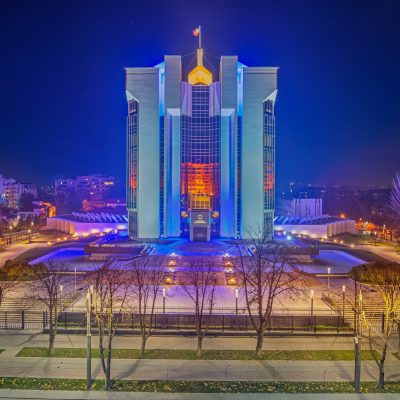
Presidental Palace of the Republic of Moldova
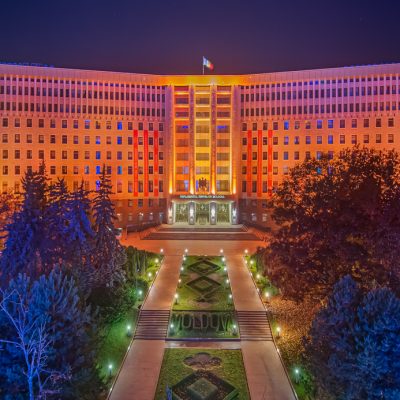
The building, constructed between 1984 and 1987, was designed by architects Iuri Tumanian, A. Zalțman, and V. Iavorski. Initially conceived as an administrative facility to accommodate the Supreme Soviet of the Moldovan SSR, the structure was repurposed in the early 1990s, with minimal modifications, to serve as the seat of the Presidency of the Republic of Moldova.
During the protests of April 7, 2009, the Presidency of the Republic of Moldova building was vandalized by protesters. Repair works commenced in 2009 and, with intermittent interruptions, persisted until autumn 2018.
The construction is cast in reinforced concrete, adorned with white stone slabs, and features significant areas covered with tinted glass. The base and access stairs are crafted from red and black marble. Positioned above the central portal are the bronze coat of arms of the Republic of Moldova and the text “Presidency of the Republic of Moldova.”
The building of the Presidency of the Republic of Moldova is recognized as a monument of national significance.
The holy place was given the name “Saint Hierarch Nicholas” in memory of the first founder – the felcher Nicholas [..]
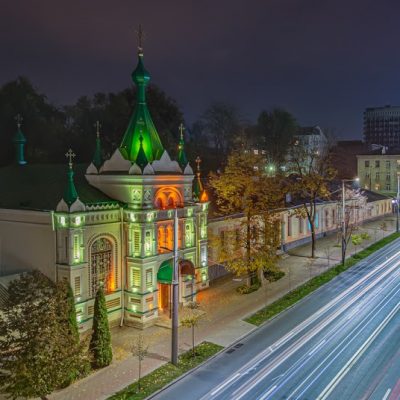
Saint Hierarch Nicholas Church (1901)
The holy place was given the name “Saint Hierarch Nicholas” in memory of the first founder – the felcher Nicholas Ivanov. The construction of the church began in 1901, according to the project of the city architect Vladimir Tiganko.
After the death of the main founder, Catherine’s wife sells the house for 5500 rubles and the whole amount is transferred to the account of the future church. The construction of the building was finished in December 1901.
The total amount for the erection of the church was 20 thousand 944 rubles 45 kopecks. The first parish priest was Sofronie Celan.
Next to the church a home for the elderly was built and operated for a long time, where 20 people were housed at the same time.
The church has a combination of different styles, so that each parishioner can find comfort in his soul.
It was closed in 1940 during the period of rampant atheism. During the USSR, the House of Culture of the medical faculty students operated here.
The holy place was reopened in 1992, when it was given back to the Metropolitanate of all Moldova by the administration of the Institute of Medicine.
The “Ion Creanga” State Pedagogical University of Chisinau
The “Ion Creanga” State Pedagogical University of Chisinau was formed according to the Decision of the Government of the Moldovan [..]
The “Ion Creanga” State Pedagogical University of Chisinau
The “Ion Creanga” State Pedagogical University of Chisinau was formed according to the Decision of the Government of the Moldovan S.S.R. of August 16, 1940, with the initial name of Moldovan State Pedagogical Institute, which in 1955 was renamed “ION CREANGĂ” State Pedagogical Institute of Chisinau. In 1992, on the basis of the Decision of the Government of the Republic of Moldova No 330 of 21 May “On the reorganization of the university education system”, the Institute was reorganized into the State Pedagogical University “Ion Creanga” in Chisinau.
In accordance with the order of the Ministry of Education of 20 July 1946, an aspirancy was formed in addition to the Institute, which trained specialists in the fields of philology, history, mathematics, physics, botany, etc.
In 1948 the Institute began training specialists in English and French. In connection with the need to train teachers of physical culture, the Faculty of Physical Culture was opened in 1949. In the year of formation, the Institute had five faculties: History and Philology, Physics, Mathematics, Biology, Geography.
Today, the University comprises 5 faculties. During the last ten years of activity, the University has considerably broadened the profile of school teacher training, the nomenclature of specialities has been renewed and curricula have been revised. The University’s faculties train teachers for over 130 study programmes. The University has highly qualified teaching and scientific staff.
Not far from the Parliament building, along Stefan the Great Boulevard, stands a house that resembles a cake – the [..]
Hertza House
Not far from the Parliament building, along Stefan the Great Boulevard, stands a house that resembles a cake – the city villa of Titular Counselor Vladimir Herz, constructed in 1903, purportedly designed by the Austrian architect Heinrich Lonsky in the style of Viennese Baroque. The building takes on the appearance of a birthday cake due to its roof’s protruding risolits and somewhat unconventional-looking domes. The exterior decoration includes elaborate molding, vases atop the facade, and abundant bas-reliefs featuring floral ornaments and allegorical figures, contributing to its distinctive facade.
Internally, the house was once richly adorned with decorative elements, including walls and ceilings adorned with frescoes depicting mythological themes, intricately embellished with gilded moldings. Drawing inspiration from Viennese Baroque and Art Nouveau, with a hint of Moorish style, the building stands as a splendid example of eclecticism, a characteristic feature of Chisinau’s architecture at the turn of the century.
Built between 1976 and 1979, the building has the curious shape of an “open book”. The authors were the architects [..]
Parliament of the Republic of Moldova
Built between 1976 and 1979, the building has the curious shape of an “open book”. The authors were the architects Alexandru Cerdanțev and Grigore Bosenco.
Designed from the beginning as an administrative building to house the Central Committee of the Communist Party of the MSSR, this building was prepared in the early 90s of the twentieth century, without essential changes, for the location of the Presidency of the Republic of Moldova.
It is an integral construction, poured in reinforced concrete, with a granite slab façade. Above the central entrance is the text with the name of the institution: “Parliament of the Republic of Moldova”, with letters cast in metal. Inside, the offices are distributed only on the side of the building on Stefan cel Mare Boulevard, and the Parliament meeting room is located in the opposite direction. The building of the Parliament of the Republic of Moldova is considered to be a monument of national importance.
It was rebuilt after the protests of April 7, 2009. Currently, the Parliament is an ensemble of buildings, with a total area of about 10 thousand square meters.
The central park in Chisinau, Moldova, is the oldest park in the country, covering approximately 7 hectares (17 acres). Originally [..]
Public Garden Stephen the Great (Central Park)
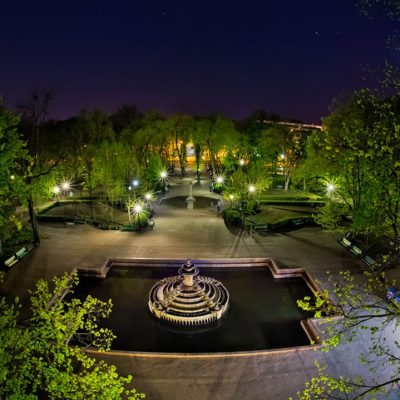
The central park in Chisinau, Moldova, is the oldest park in the country, covering approximately 7 hectares (17 acres). Originally designed in 1818 by Russian military engineers during the reign of Alexander I, the park has undergone several name changes over the years, including Alexander Garden (honoring Emperor Alexander II), Alexander Pushkin Park, and City Public Garden.
Under the guidance of architect Bogdan Eitner, the present-day alleys were established, featuring hundreds of acacias, limes, and flower beds. The park, initially enclosed by a wicker fence, was later surrounded by a cast-iron fence erected in 1868-1869, which still stands today. The park boasts seven entrances around its perimeter, hosting approximately 50 species of shrubs and trees, some dating back almost 200 years, including a towering acacia.
In 1885, the monument to the Russian poet A.S. Pushkin was unveiled in the Public Garden, considered today as the oldest preserved bust in the city. In 1958, the cornerstone of the Alley of the Classics of Romanian Literature was laid, initially featuring 12 bronze busts of classics on polished red granite posts. The current Alley of Classics has 29 busts of prominent personalities, and various cultural events are held there.
A significant masterpiece in the park is the monument to Stephen the Great and Holy, created by sculptor A. Plamadeala and architect A. Bernardazzi. Inaugurated in 1928, the monument commemorates the tenth anniversary of the Great Union of 1918.
Guarding one of the park entrances are two marble lions, their origin shrouded in mystery. Rumors suggest they belonged to a manor house, and after its destruction during World War II, the monuments were brought and installed in the Public Garden.
At the end of the 19th century, the then-mayor of the city, Karol Schmidt, initiated the construction of a new [..]
Chisinau City Hall building
At the end of the 19th century, the then-mayor of the city, Karol Schmidt, initiated the construction of a new headquarters for the City Duma (town hall) on the site previously occupied by the fire station. The design was entrusted to the city architect Mitrofan Elladi. The renowned architect Alexandru Bernardazzi supervised the construction, which was completed in 1902.
In 1941, the building was destroyed by retreating Soviet troops. The Romanian administration managed to rebuild it by 1944, but in August of that year, during the Iasi-Chisinau operation, the building was again destroyed in the bombings.
After the war, Robert Kurtz, the city’s chief architect (1944-1951), was appointed head of reconstruction. Work on the site took place between 1946 and 1948, but the local administration did not return to the building until 1951.
Robert Kurtz restored the building to its original appearance, with one change: smaller towers were added above the main entrance, replacing the original larger ones.
The Chisinau City Hall building is a national architectural and historical monument, registered in the Register of Historical and Cultural Monuments of Chisinau.

 English
 Română
  Русский