The idea of initiating such an alley in the country’s capital belongs to the sculptor A. Plămădeală. The alley was [..]
The Alley of Сlassics (Writer’s Alley)
The idea of initiating such an alley in the country’s capital belongs to the sculptor A. Plămădeală. The alley was inaugurated in 1958 in the Public Garden with the first 12 busts of classical writers and poets. Currently, there are already 29 busts of important writers from Romania and the Republic of Moldova placed on the alleys of the park, with the 30th being the bust of A.S. Pushkin – the renowned Russian poet. His bust was erected in 1885, with funds raised by the city’s honorary citizens. After the tragic death of the poet, Chisinau became the third city in the former Russian Empire to commemorate him with a memorial monument. The author of the bust is the sculptor A. Opekusin.
Vasile Alecsandri (bust installed in 1957) – Writer, playwright, folklorist, politician, and diplomat.
Gheorghe Asachi (bust installed in 1957) – Poet, prose writer, and playwright.
Ion Creangă (bust installed in 1957) – Writer, storyteller, prose writer, theologian, textbook author, politician, poet, teacher, and deacon.
Alexandru Donici (bust installed in 1957) – Linguist, translator, and poet.
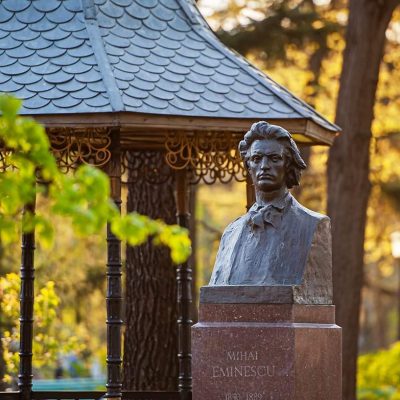
Mihai Eminescu (bust installed in 1957) – Poet, prose writer, and journalist.
Bogdan Petriceicu Hasdeu (bust installed in 1957) – Encyclopedist, writer, philologist, linguist, jurist, folklorist, publicist, historian, and politician.
Alexandru Hâjdeu (bust installed in 1957) – Scholar, lawyer, and writer.
Nicolae Milescu Spătarul (bust installed in 1957) – Writer, scholar, translator, traveler, geographer, and diplomat.
Constantin Negruzzi (bust installed in 1957) – Writer and politician.
Alecu Russo (bust installed in 1957) – Poet, prose writer, essayist, memoirist, literary critic, ideologist, and novelist.
Constantin Stamati (bust installed in 1957) – Writer.
Tudor Arghezi (bust installed in 1995) – Writer, poet, prose writer, and journalist.
George Bacovia (bust installed in 2001) – Poet and writer.
Lucian Blaga (bust installed in 1992) – Poet, writer, philosopher, linguist, translator, journalist, diplomat, essayist, university professor, librarian, and playwright.
George Călinescu (bust installed in 1997) – Historian, writer, journalist, literary critic, biographer, playwright, teacher, and librarian.
George Coșbuc (bust installed in 1996) – Poet, translator, teacher, journalist, literary critic, writer, and linguist.
Mircea Eliade (bust installed in 1997) – Historian of religions, philosopher, essayist, prose writer, and university professor.
Octavian Goga (bust installed in 2000) – Politician, poet, playwright, journalist, translator, and writer.
Nicolae Iorga (bust installed in 1990) – Historian, politician, linguist, poet, writer, philosopher, literary critic, playwright, journalist, orientalist, biographer, children’s literature author, philologist, translator, and university professor.
Alexei Mateevici (bust installed in 1990) – Poet, educator, soldier, translator, and Orthodox priest.
Adrian Păunescu (bust installed in 2011) – Poet, publicist, and politician.
Liviu Rebreanu (bust installed in 2009, restored) – Writer, journalist, playwright, and translator; associated with the “Ion Luca Caragiale” National Theatre.
Mihail Sadoveanu (bust installed in 1990) – Novelist, short story writer, journalist, essayist, translator, poet, public servant, and politician.
Nichita Stănescu (bust installed in 1990) – Poet and essayist.
Constantin Stere (bust installed in 1991) – Journalist, philosopher, literary critic, politician, lawyer, and writer.
Grigore Vieru (bust installed in 2010) – Poet, publicist, and writer.
Mihail Kogălniceanu (bust installed in 1990) – Lawyer, historian, publicist, diplomat, literary critic, and politician.
Ion Luca Caragiale (bust installed in …) – Playwright, short story writer, satirist, poet, author, theatre director, political commentator, and journalist.
Dumitru Matcovschi (bust installed in …) – Poet, prose writer, academician, publicist, and playwright.
The monument is situated in front of the National Library of the Republic of Moldova in Chisinau. Inaugurated in 1997, [..]
The monument of Vasile Alecsandri
The monument is situated in front of the National Library of the Republic of Moldova in Chisinau. Inaugurated in 1997, it stands in memory of Vasile Alecsandri – poet, playwright, folklorist, politician, minister, diplomat, and founding member of the Romanian Academy. The sculptor responsible for this piece is Ion Zderciuc.
“Bogdan Petriceicu Hasdeu” Municipal Library Building
The history of the building that houses the Municipal Library “Bogdan Petriceicu-Hasdeu” in Chisinau began in 1835 when the municipality [..]
“Bogdan Petriceicu Hasdeu” Municipal Library Building
The history of the building that houses the Municipal Library “Bogdan Petriceicu-Hasdeu” in Chisinau began in 1835 when the municipality allocated a plot of land for individual construction to the family of college counselor Ivan Monastarsky, a clerk at the Spiritual Consistory of Bessarabia. The house, designed with two floors, was constructed between 1835 and 1844.
Starting in 1846, the building was rented to the Regional Gymnasium in Chisinau, which lacked its own premises. In 1863, the gymnasium relocated to another building, and the house was purchased by the Theological Seminary in Chisinau, using it for one year to accommodate students.
In 1864, the house was rented by Swiss citizen Charles Thomas Accordingidenis, who transformed the student dormitory into a hotel, giving rise to the famous “Suisse” hotel in Chisinau. The Hotel Suisse operated until the years of World War II.
The biography of the scientist-encyclopedist Bogdan Petriceicu-Hasdeu, the Romanian classical writers Constantin Stamati-Ciurea and Constantin Stere, the historian Nicolae Iorga, the Russian singer Fyodor Şaleapin, and the French political activist Henry Barbusse is also associated with this location. All of them stopped in Chisinau on various occasions, being hosted at the Hotel “Suisse.”
In its current form, the building dates from 1946-1947 when it was reconstructed from the ground up after the bombings that the capital endured during World War II. The restoration project was developed by the architect E. R. Spirer under the supervision of the academician A. V. Şciusev. During this restoration, the house underwent several modifications, including the addition of the third floor.
In March 1950, by a decision of the City Committee, part of the rooms on the ground floor was made available to the municipal library, coexisting in close proximity with Pharmacy No. 77 and the “Academic Book” bookstore.
Since June 21, 1988, the library has been named after the illustrious man of culture Bogdan Petriceicu Hasdeu.
The National Library of the Republic of Moldova, located in Chisinau, serves as the primary state library entrusted with the [..]
National Library
The National Library of the Republic of Moldova, located in Chisinau, serves as the primary state library entrusted with the preservation, valorization, and safeguarding of the written cultural heritage. Operating in accordance with UNESCO’s guiding principles for this type of library, it is also a part of the European Digital Library. Its history dates back to 22 August 1832, marking the inauguration of the Governmental Public Library of Basarabia. Today, the National Library stands as one of the most valuable components of the national heritage, housing a treasury of written and printed cultural heritage from the Republic of Moldova. The library opens its collections for research, study, and informational purposes, providing access to all citizens who have reached the age of 14.
It is the newest museum in Chisinau, inaugurated in 2018 within the National Library. The museum’s collection is primarily sourced [..]
The Museum of Books
It is the newest museum in Chisinau, inaugurated in 2018 within the National Library. The museum’s collection is primarily sourced from the library’s “Old and Rare Books” section, which currently houses over 30 thousand documents.
The museum showcases various intriguing forms of books that have existed throughout history. The compact hall is filled with information, exhibits, and curiosities, offering insights into book binding, the evolution of writing systems, the earliest manuscripts, the history of printing, and the pioneers of printing art, including the fascinating world of “tiny books.”
Among the notable items at the Museum of Books are a fragment of The Quran, a medallion book measuring 11-15 mm, a souvenir edition of the Two Penny Bag measuring 60×40 mm, and many others. The oldest exhibit on display is the manuscript “Ostrog’s Gospel,” dating back to 1056, while the oldest printed book in the collection dates to 1551, featuring a commentary on “Aristotle’s Categories.”
National Museum of Romanian Literature “Mihail Kogălniceanu”
The National Museum of Literature “Mihail Kogălniceanu” was established in the autumn of 1965 under the auspices of the Writers’ [..]
National Museum of Romanian Literature “Mihail Kogălniceanu”
The National Museum of Literature “Mihail Kogălniceanu” was established in the autumn of 1965 under the auspices of the Writers’ Union of Moldova. The museum’s collection comprises over 100 thousand exhibits, including books, art objects, and documents.
Originally named the Republican Museum of Literature of the MSSR, it received several exhibition rooms, a basement for storing collections, staff offices, and a library after the opening of the present House of Writers in Chisinau. At that time, the museum employed 35 people, including researchers in three scientific sections.
In 1983, it was named after Dimitrie Cantemir. In 1990, it was disbanded as a museum and became the “Mihail Kogălniceanu” National Centre for Literary Studies and Museography. In 1997, it was renamed the Museum of Romanian Literature “Mihail Kogălniceanu.” By government decision, it was transformed into a national museum as of January 1, 2013, transferring from the Writers’ Union to the Ministry of Culture and gaining the right to manage its branches. In 2015, the Grigore Vieru House-Museum was inaugurated in the village of Pererîta, and in 2019, the Alexandru Donici House-Museum in the village of Donici was also transferred to the museum.
The museum did not originate from existing collections or funds. Most pieces in the collection were amassed between 1965 and 1991 through the research and collection efforts of the institution’s museographers. In 2019, the museum counted 147,386 items, including books, manuscripts, a rich fine art collection, photographs, audio cassettes, video recordings, etc. The manuscript collection is the largest, with 28,000 items, followed by the book collection with about 22,000 volumes from the 16th to the 21st century. The oldest book is an edition of “Beati Dionysii Areopagitae martyris inglyti” by St. Dionysius the Areopagite (1572). Based on the museum’s exhibits, house-museums for “Alexander Donich,” “Constantine Stamati,” and “Alexei Mateevich” have been established. Unfortunately, a significant portion of the museum’s collections was destroyed, including part of the patrimony gathered under the founding director Gheorghe Cincilei, due to disapproval from communist authorities.
Widely known as the Water Tower, it was reopened in the autumn of 2011, after a break of almost 10 [..]
Museum of the City of Chisinau (Water Tower)
Widely known as the Water Tower, it was reopened in the autumn of 2011, after a break of almost 10 years… Although it has been partially damaged over the years, the building was rebuilt according to the images dated in the 1980-1983 years period, except for the fire-pit at the top, originally built of wood, later re-shaped from stone.
The construction of the Tower began in 1860, and was finished only after 28 years – in 1888 (its doors being opened even later – in 1892), when Carol Schmidt became mayor of Chisinau. He, together with architect Alexander Bernardazzi, built two water towers, only one of which has survived to the present day.
The Water Tower can boast about being one year younger than the Eiffel Tower in Paris. Its height is 27m.
The tower has 4 permanent exhibition halls. The oldest exhibit is a clay vessel from the 4th century AD.
It was founded on October 6, 1921, at the initiative of several personalities led by Sergiu T. Niță, who was [..]
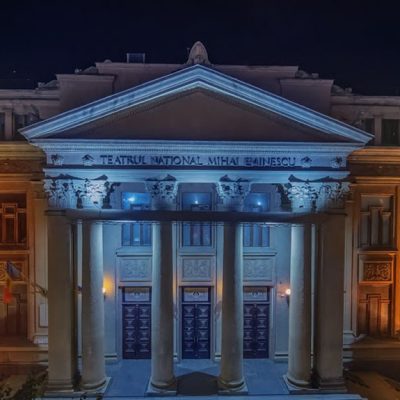
National Theater ”Mihai Eminescu”
It was founded on October 6, 1921, at the initiative of several personalities led by Sergiu T. Niță, who was the Minister of Bessarabia in the Romanian government. Other notable figures involved in its establishment included Stefan Ciobanu (a member of the Romanian Academy), writers Nicolae N. Beldiceanu, Nicolae Beldiman, Leon Donici, and director Gheorghe Mitu Dumitriu.
The inaugural season commenced with the performance of “Fântâna Blanduziei” by Vasile Alecsandri. Despite operating for only one season, the theater successfully staged over 25 productions. In 1922, responding to a request from the Ministry of Culture in Bucharest, a project was developed to establish a Permanent Propaganda Troop of the Ministry of Arts for Bessarabia, Bukovina, and Transylvania. Bucharest actors Vasile Leonescu and Constantin Mărculescu were entrusted with the reorganization of the Chisinau Theater.
Over the next 10 years, the National Theater in Chisinau was directed by notable individuals such as George Topârceanu, Corneliu Sachel Arescu, and Ion Livescu. Renowned actors like Emil Botta, Stefan Braborescu, Sergiu Cujbă, and Mişu Fotino breathed life into characters and stories on the stage of Chisinau’s first professional theater.
However, due to financial constraints, as per the ministerial order of 1935, the National Theater in Chisinau, along with those in Craiova and Chernivtsi, was forced to close its doors.
Many years later, in 1994, the National Theater was revived under the name Mihai Eminescu. In a relatively short span, the Mihai Eminescu National Theater garnered approximately 30 significant awards, winning acclaim not only from the Chisinau audience but also earning recognition at national competitions and international festivals.
The National Theater “Satiricus Ion Luca Caragiale” is a municipal drama theater in Chisinau, the capital of the Republic of [..]
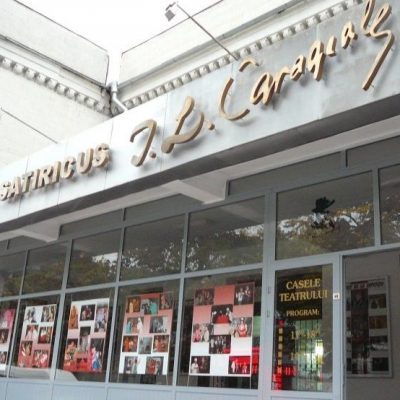
National Theater “Satiricus”
The National Theater “Satiricus Ion Luca Caragiale” is a municipal drama theater in Chisinau, the capital of the Republic of Moldova. It was established in 1990 through the initiative of the actor and director Sandu Grecu.
The theater’s repertoire primarily features satirical and humorous plays. It stands as the first satirical theater in the republic, born out of cultural and historical necessity, reflecting an innovative and combative spirit. Despite changing its location four times over its more than 30 years of existence, the theater has presented approximately 70 productions, with some enduring in the repertoire throughout the years.
It is one of the most famous theaters in Chisinau, founded on 11 September 1991. The theater was created at [..]
National Theatre “Eugene Ionesco”
It is one of the most famous theaters in Chisinau, founded on 11 September 1991. The theater was created at the initiative of a team of actors, graduates of the B. Shchukin Theatre School in Moscow, led by Petru Vutcărău. The playwright Eugène Ionesco personally agreed that the new theater should bear his name, a deeply symbolic gesture. Petru Vutcărău was the first director and artistic director of the theater, and he currently serves as the theater’s director.
The new troupe, already called the “Eugene Ionesco” Theatre, was temporarily based in Romania, in Râmnicu-Vâlcea, where they were provided with accommodation and a stage for performances. After five months of work in Vâlcea, the theater embarked on its first major tour, visiting the biggest cities of Romania. During this period, the troupe, taking its first steps, won several awards at various theater festivals and recorded two shows from its repertoire on Romanian Television.
In the summer of 1991, the theater returned to Chisinau. Its seat was temporarily located in different places, but finally, in February 2007, by governmental decision, the “Eugène Ionesco” Theatre was granted its own place – the building of the former recreation center, called “Moscow.”
Teacher, priest, writer, and poet. In 1897, his parents enrolled him in the theological school in Chisinau, and he successfully [..]
Alexe (Alexei) Mateevici (1888 – 1917)
Teacher, priest, writer, and poet.
In 1897, his parents enrolled him in the theological school in Chisinau, and he successfully completed his studies in 1902 “with privileges.”
Subsequently, he attended the theological seminary, forming a lasting friendship with the future sculptor Alexandru Plămădeală, who was also a student at the seminary during the same period. Thirty years later, A. Plămădeală would erect a monument on the grave of his youthful friend.
In 1907, the early issues of the newspaper “Basarabia” featured his poems “Peasants,” “I Sing,” and “Country.” He also contributed articles such as “Saint Basil – New Year in the customs of the Basarabian Moldovans” and “From the Folk Songs of Bessarabia.” He published several religious studies and articles, delving into the customs of the Basarabian Moldovans.
Among his notable works is the poem “Our Language,” an ode to the Romanian language, penned just a month before his demise. In 1994, the lines from this poem were chosen as the text of the State Anthem of the Republic of Moldova.
To honor his memory, Chisinau named a street in the city center after him, and a college in the capital also bears his name. He resided on the street now named in his honor, with a commemorative plaque installed on the wall of his house.
Lawyer, judge, writer, translator (especially from Russian), fabulist, descendant of a line of noble Moldovans. He began his activity in [..]
Alecu (Alexandru) Donici (1806 – 1865)
Lawyer, judge, writer, translator (especially from Russian), fabulist, descendant of a line of noble Moldovans. He began his activity in Chisinau, then in Iasi, holding an important position in the Epitropia of Schools. Later, he became an assessor at the Court of Appeal, and in 1846 he was elected president of the Neamt Tribunal. He was an active member of the parish Divan and collaborated to the magazines “Albina Românească”, “Dacia literară”, “Propășirea” and other publications of that period. Apart from fables, he composed verses and plays. Some of his ancestors are buried in the cemetery of the church of “Saints Constantine and Helen” in Chisinau, which several generations have founded over the years, Donici himself finding his final resting place in Iasi. Today, a street in Chisinau bears his name.
Translator, writer, theatre director and mayor of Iasi. He spent several years in Chisinau, where, in 1821, he also met [..]
Constantin (Costache) Negruzzi (1808 -1868)
Translator, writer, theatre director and mayor of Iasi. He spent several years in Chisinau, where, in 1821, he also met the poet A.S.Pushkin, who was in exile. The Russian poet awakened his early interest in world literature. His first literary essays date from this period: “My Stanzas from Bessarabia in 1821-1822”.
He translates the verses of Russian poets and French writers. He was one of the leaders of the cultural movement, together with Mihail Kogalniceanu, collaborating with the magazines “Dacia literară” (1840) and “Propășirea” (1844).
Later he took over the direction of the National Theatre of Iași, together with V. Alecsandri and M. Kogălniceanu. He is particularly noted for his novel “Alexandru Lăpușneanul” and the work “Scrisorile”.
Having become a follower of the reign of the lordship, it is explainable that he did not participate in the revolution of 1848 and the Union of the Principalities of 1859. He knew 6 foreign languages. A high school and a street in Chisinau bear his name.
The famous poet, whose verses have been translated into more than 30 world languages. He made his debut in 1957 [..]
Grigore Vieru – (1935 – 2009)
The famous poet, whose verses have been translated into more than 30 world languages.
He made his debut in 1957 (while still a student at the Pedagogical Institute “Ion Creanga” in Chisinau, Faculty of Philology and History) with his verses for children “Alarm”, highly appreciated by literary critics. He works as an editor for the children’s magazine “Scânteia Leninista”, now “Noi”, and for the newspaper “Tânărul Leninist”, now “Florile Dalbe”.
In 1960 he became editor of the magazine “Nistru”, now “Basarabia”. Between 1960 and 1963 he was editor of the publishing house “Cartea Moldovenească”.
He was a frequent guest of the “Poetry House” in the village of Cociulia. Here he also wrote the famous book for pre-school children “Albinuța”.
In 1988 he was awarded the most prestigious international distinction in the field of children’s literature – the Andersen Honorary Diploma.
In 1993 he was elected corresponding member of the Romanian Academy.
He died in a tragic road accident and was buried on 20 January 2009 in Chisinau, in the Central Cemetery on Armenească Street. Several tens of thousands of people attended the funeral. 20 January 2009 was declared a day of mourning in the Republic of Moldova.
The poet was posthumously decorated with the National Order “Steaua României” in the rank of Grand Cross.
Several high schools in the Republic of Moldova, a central avenue in Chisinau and a street in Iasi bear his name.
In 2010 a bust of the poet was installed on the Alley of Classics in Chisinau.
Grigore Vieru Boulevard (until 2010 it was part of bd. Renașterii, in the years 1950-1959 Țentralnîi Luci Street) is located [..]
Grigore Vieru Boulevard
Grigore Vieru Boulevard (until 2010 it was part of bd. Renașterii, in the years 1950-1959 Țentralnîi Luci Street) is located in Râșcani sector, Chisinau. It is a main urban thoroughfare with a length of about 1.5 km, starting from Cosmonautilor Street and ending at the intersection with Albișoara Street.
Between the two lanes of the boulevard there is a narrow green space, consisting of an alley with benches and trees on the edges, which runs the length of the boulevard. The mini park is fragmented into two intersection sites. On the perimeter of the boulevard are built social and public buildings, 4-storey apartment blocks with shops on the ground floor, including:
National Bank of Moldova (no. 7, 1973, arch. B. Vaisbein);
Turist hotel complex (no. 13, 1971, architect R. Bekesevich);
Theoretical high school and student dormitories of the Agrarian University (no. 6/2, 1950s)
At the intersection with Albișoara Street, 10-12-storey dormitories were built, which complete the composition of the boulevard crossing towards the Bâc estuary.
The monument, dedicated to the ballad “Myoritsa” was installed in Chisinau at the beginning of March 2022, author – Veaceslav [..]
„Myoritsa”’s Monument
The monument, dedicated to the ballad “Myoritsa” was installed in Chisinau at the beginning of March 2022, author – Veaceslav Jiglițchi.
For Moldovans, „Myoritsa” is a historical memory. Although the plot of the Moldovan folk ballad is far from heroic, on the contrary – the hero of the ballad believes in the irreversibility of fate, which should not be fought at all, but accepted as it is… Sheep Myoritsa warns the young shepherd that two other shepherds are plotting to kill him out of envy. Anticipating his doom, the shepherd turns to his favorite sheep and shares his last wishes with it… The symbols present in „Myoritsa” originate from ancient rituals and beliefs. Historians believe that the ballad dates back to the XII-XIII centuries and is one of the oldest sources where the nationality “Moldovan” first appears.
In 1846, the writer Alecu Russo heard from the Leutarians and wrote down his version of “Myoritsa,” which was later published by another writer – Vasile Alexandri. A few years later, Alexandri encountered another version of the ballad, altered the original text, and published the revised “Myoritsa” in two collections of folk poetry.
“Myoritsa” has been translated into foreign languages many times. Like any masterpiece of folk art, it is very challenging to translate into poetic for
On 15 May 2021, a new square was inaugurated in the capital. It is located in the Rascani sector, on [..]
Monument Gugutsa
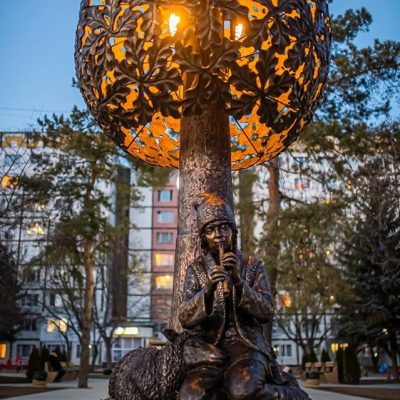
On 15 May 2021, a new square was inaugurated in the capital. It is located in the Rascani sector, on Kiev Street, and is called Guguță Square. A monument to the famous character invented by writer Spiridon Vangheli was also installed there.
The green space is called “Guguță”, and the monument to the character is the focal point of the area. The work is made of bronze, is 1.5 metres high and was created by sculptor Veaceslav Jiglițchi.
The writer Spridon Vangheli, also nicknamed “Guguță’s father” died at the age of 92 on June 21, 2024. He was buried at the Central Cemetery in Chisinau. June 24, 2024 was designated a day of mourning for the entire country.
The “Ion Creanga” State Pedagogical University of Chisinau
The “Ion Creanga” State Pedagogical University of Chisinau was formed according to the Decision of the Government of the Moldovan [..]
The “Ion Creanga” State Pedagogical University of Chisinau
The “Ion Creanga” State Pedagogical University of Chisinau was formed according to the Decision of the Government of the Moldovan S.S.R. of August 16, 1940, with the initial name of Moldovan State Pedagogical Institute, which in 1955 was renamed “ION CREANGĂ” State Pedagogical Institute of Chisinau. In 1992, on the basis of the Decision of the Government of the Republic of Moldova No 330 of 21 May “On the reorganization of the university education system”, the Institute was reorganized into the State Pedagogical University “Ion Creanga” in Chisinau.
In accordance with the order of the Ministry of Education of 20 July 1946, an aspirancy was formed in addition to the Institute, which trained specialists in the fields of philology, history, mathematics, physics, botany, etc.
In 1948 the Institute began training specialists in English and French. In connection with the need to train teachers of physical culture, the Faculty of Physical Culture was opened in 1949. In the year of formation, the Institute had five faculties: History and Philology, Physics, Mathematics, Biology, Geography.
Today, the University comprises 5 faculties. During the last ten years of activity, the University has considerably broadened the profile of school teacher training, the nomenclature of specialities has been renewed and curricula have been revised. The University’s faculties train teachers for over 130 study programmes. The University has highly qualified teaching and scientific staff.

 English
 Română
  Русский