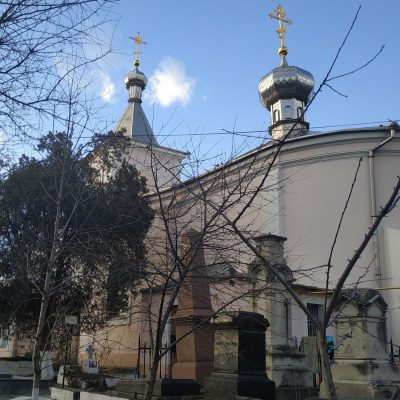
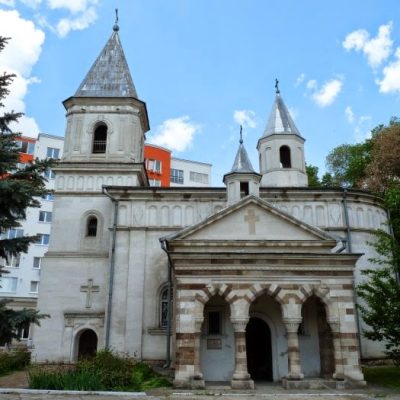
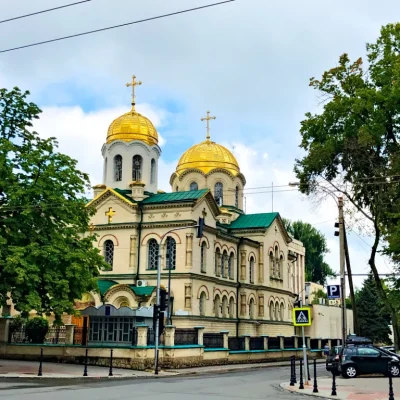
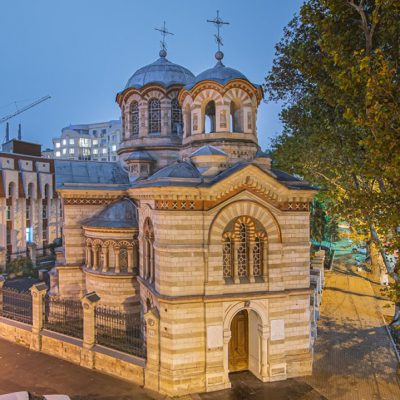
The Chapel of the Resurrection of the Savior is an Armenian Apostolic place of worship and an architectural monument of [..]
The Chapel of the Resurrection of the Savior
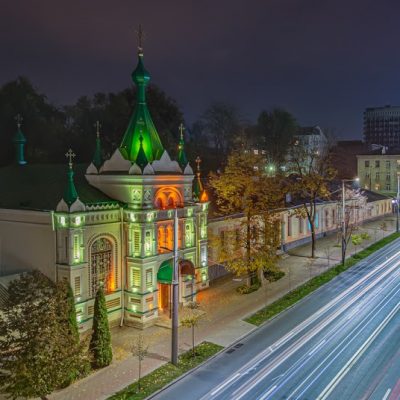
The Chapel of the Resurrection of the Savior is an Armenian Apostolic place of worship and an architectural monument of national importance, listed in the Register of Historical and Cultural Monuments of Chișinău. Since 2025, it has also been a historical, artistic, and architectural monument of national importance included in the Register of State-Protected Monuments of the Republic of Moldova, together with the cemetery.
It is the chapel of the Armenian-Gregorian cemetery, built in 1916 by architect A. Hacikeanț. It is also a memorial building, with the tomb of B. Bogdasarov located under its western wing.
Modest in size, the chapel is decorated with decorative plastic elements that reduce its volume. The plan is cruciform, obtained by widening the square nave with narrow side projections. Through the side projections, a polygonal apse and a small porch to the west were added. The entire appearance of the building refers to the places of worship from the heyday of ecclesiastical architecture in the 12th-13th centuries in historical Armenia.
The Armenian cemetery contains funerary monuments dating from the 18th to 20th centuries, belonging to eminent historical figures.
Cathedral of Christ’s Nativity, Bell Tower,Triumphal Arch
The cathedral was built between 1830-1836. The idea of building such an important object of worship belonged to Metropolitan Gavriil [..]
Cathedral of Christ’s Nativity, Bell Tower,Triumphal Arch
The cathedral was built between 1830-1836. The idea of building such an important object of worship belonged to Metropolitan Gavriil Bănulescu-Bodoni. But the foundation stone was laid only 9 years after his death.
The architect Avraam Melnikov, chosen by competition, used the late neoclassical style (empiric style) for the building, with the use of ancient Greek forms for the columns.
It has a symmetrical composition, representing a square with a side of 27 m, by joining to the cubic body four porticoes with six Doric columns each, resulting in a cruciform plan with identically designed facades. It was built of stone and brick, with three altars – one main altar – the Nativity of the Lord, and two side altars – the one on the left, dedicated to St. John the New, and the one on the right – St. Nicholas the Martyr (current names).
The first radio station in Chisinau, Radio Basarabia, was officially inaugurated by broadcasting the liturgy from the Metropolitan Cathedral on 8 October 1939.
The cathedral suffered during the 1940 earthquake, then during the World War II, with the spire, dome and interior being rebuilt in 1956, but with deviations from the original forms. During the USSR it was used as an exhibition hall.
The reopening in a new format took place on August 25th, 1996 with the consecration of the Cathedral Cross.
The original bell tower was built at the same time as the cathedral. It was located 40 m away from it, symmetrically with the cathedral and in relation to the geometric centre of the cathedral section. It had four levels, three prismatic, with successively receding sides, and the fourth in the form of a flat circular belfry for the bell chamber, covered by a dome. On the first level was a chapel, the entrance to which was through a portico with two columns on the south side. Identical porticoes adorned each facade of the bell tower, creating a small-scale repetition of the composition of the cathedral and harmonising with it in the shape of the domes.
It was demolished in the 1960s and rebuilt in 1998 according to the old images.
The history of the construction of the “Holy Gates” is curious – after the original project (which involved the erection of the Cathedral and the Bell Tower), they were not planned. At the time, when the bell tower was already erected, it was discovered that the largest of the bells could not fit through the windows to be mounted. The giant bell, cast from Turkish cannons, weighed about 400 poods (about 6.5 t).
In order to accommodate the big bell, a decision was taken to build the Triumphal Arch, located at the entrance to the square from the direction of the Mitropolis (it has not been preserved to this day – it was destroyed during the World War II).
The official version was that the Arch was erected to commemorate the victory of the Russian armies over the Turks, of course.
The first arched clocks appeared in 1842. They were brought from Odessa, but in 1849, a strong hurricane tore off the dial, but its mechanism continued to work until 1881. The new mechanism was purchased from Austria. The actual clock worked without repair until it was bombed in 1941.
In 1945, plaques with the names of Soviet army fighters and citizens, who fought on the territory of Bessarabia in World War II and received the distinction of “Hero of the Soviet Union”, were nailed on the walls. The plaques were removed in 1991, after Moldova gained its independence.
Since its erection, the Triumphal Arch bore several names – it was also called the Holy Gates, and under the Soviet regime it was called the Arch of Victory.
Church of the Mother of God (Măzărache Church,1752)
The oldest building (including ecclesiastical) that has survived to date on the territory of present-day Chisinau, and the only one [..]
Church of the Mother of God (Măzărache Church,1752)
The oldest building (including ecclesiastical) that has survived to date on the territory of present-day Chisinau, and the only one that preserves medieval Moldovan architecture. The Măzărache Church is documented in 1752 (year of consecration). It is popularly named after its founder – the nobleman, merchant of Chisinau Vasile Măzărache.
The oldest necropolis of the capital, dating back to the 15th-16th centuries, it’s located around the church, and on the same hill flowed the famous springs, from which the city of Chisinau takes its name.
In 1955, in an almost fantastic gesture, the Soviet authorities gave the church to the Russians of the Old Rite (Lipovins) in exchange for their cathedral, which had been demolished during the construction of the Boulevard of the Youths (today Grigore Vieru Boulevard).
Since then, access to the church has been limited; guests of the capital may visit only the churchyard and the surrounding buildings, including some tombstones with inscriptions in Slavonic and Old Romanian.
The archaeological site known as the “Ruins of the Church Museum – Episcopal House – Teodor Sabau’s House” will be [..]
Teodor Sabau’s House
The archaeological site known as the “Ruins of the Church Museum – Episcopal House – Teodor Sabau’s House” will be included in the Register of Historical Monuments of Local Significance in the municipality of Chisinau.
In addition to the classification of the site as a historical monument, the proposed decision also allows for the continuation of archaeological research in the area of the Old Cathedral.
The remnants of the building were recently unearthed in the historical center of Chisinau, located in the Riscani sector. Foundations of structures and three subterranean stone constructions, which were demolished in the 1960s, have been discovered and partially excavated in this vicinity.
Teodor Sabău served as a captain in the border police in Soroca county. Following his retirement, he resided in his Chisinau house until the end of the 18th century. The subsequent owner of his residence was Metropolitan Gavriil Bănulescu-Bodoni. It is still unclear whether the house was purchased by the metropolitan or given to him as a gift.
In 1808, Sabău acquired a piece of land in Orhei county from the landlord Dumitrache Clemente and donated it to the Curchi Monastery, one of the wealthiest monasteries in the region between the Prut and Nistru rivers at that time. Subsequently, Teodor Sabău and his wife, who became monks and adopted the names Filaret and Magnisia, donated approximately 800 desetines of land within the boundaries of the village of Pripiceni to the Curchi monastery. Part of this land was afforested, now known as Monk Forest, while the remaining portion was allocated for agricultural use, cultivated by monks and novices from Curchi.
Located at the entrance of Chisinau, near the City Gates, the Village Museum can be considered an oasis of revelation [..]
The Village Museum
Located at the entrance of Chisinau, near the City Gates, the Village Museum can be considered an oasis of revelation and tranquility. It is the perfect place for meditation, where visitors are enchanted by the enchanting landscape that exudes a fairy-tale atmosphere.
Established in 1991 as a branch of the National Museum of Ethnography and Natural History, the Village Museum was officially inaugurated as such in May 1995, showcasing the ambiance of a Basarabian village from the 17th to 19th centuries. The museum is home to a collection of folk architecture monuments.
The inaugural addition to the museum in 1995 was the windmill from the village of Opaci, in the Causeni district. Unfortunately, this windmill was destroyed in a fire in 2001 and has yet to be restored. Currently, the museum complex is home to the oldest ecclesiastical monument in the Republic of Moldova – a wooden church brought from the village of Hirișeni for restoration and preservation. Erected in 1642, this church stands as one of the tallest wooden churches in the country, reaching a height of 27 meters.
In the past, it was the church of the cemetery of the village of Visterniceni, later annexed to the city [..]
Church of Saints Constantine and Helen (1777)
In the past, it was the church of the cemetery of the village of Visterniceni, later annexed to the city and became the Riscani district of the capital.
The church bears its present name since 1834, after the request of the nobleman Iorgu Râșcanu to change the name of the church from Resurrection of the Lord to the present name of Saints Emperors Constantine and his mother Elena, a change made in memory of the founder and his father – Constantin Râșcanu, a merchant and nobleman from the city of Iași.
Constantin Râscanu’s mother (supposedly named Elena) was a half-sister of Vasile Măzărache, the founder of the church of the same name.
The church owns an important library of church books, written in Greek, Romanian and Slavonic, the most important being: Greek Anthologhin (1686), Greek Penticostaion (1687), Bible (1755), Greek Triod (1777) printed in Venice; Romanian Triodian (1731), Romanian Apostle (1794), Gospel (1794) printed in Râmnic, Romania. There are also books printed in Chisinau: Liturgy (1815), Molebnic (1817), Psalter ( 1857), Anthologhion (1861), Octioh, Triodion (1862), Trebnic (Molitvenic, 1908).
In the altar of the church there is also an The aër covering, measuring 88/7.8 cm. The canvas is sewn with silk thread in several colours and with gold and silver threads. There’s an inscription on this canvas in Greek, which translates “Praise God your servants Constantine, Catherine and Evpraxia the nun, 1765”, meaning that this the aër covering was given to the church by its founder, and the date proves, that the church was functioning even before the year of 1777.
In the cemetery next to the church we can still find tombstones, on which we can still decipher the names of great families of Moldovan nobles and dignitaries: Rascanu, Donici, Krupenscki, Russo…
The Armenian Apostolical Church, The Holy Mother of God (1803–1804)
After the annexation of Bessarabia to the Russian Empire in 1812, the Armenian Archbishop (1809-1828) of Moldo-Vlachia, Grigor Zakarian, had [..]
The Armenian Apostolical Church, The Holy Mother of God (1803–1804)
After the annexation of Bessarabia to the Russian Empire in 1812, the Armenian Archbishop (1809-1828) of Moldo-Vlachia, Grigor Zakarian, had to move to Chișinău, his title being limited to that of Archbishop of the Armenians of Bessarabia, although the Armenians across the Prut continued to subordinate themselves to him. The 400 parishes and five churches (Akkerman, Ismail, Tighina, Chisinau, Hotin) of the Armenian community in the region came under the jurisdiction of the Armenian community in Bessarabia.
The Armenian Apostolic Church “Holy Mother of God” in Chisinau dates back to 1803 and was built on the foundation of an old damaged Moldovan church. Built in 1645, during the reign of Vasile Lupu (1634-1653), it was dedicated to “St. Nicholas” and was also known as the “Domnească Church”. Frequent invasions by the Tatars, several earthquakes and destruction caused by the Russo-Turkish wars destroyed it to such an extent that by 1741 it was in total ruin.
At the beginning of the 19th century, the land, and what remained of the church once founded by Vasile Lupu, was bought by an Armenian from the local authorities. This one was Baron Oganes, who contributed to the creation of the church in memory of his parents in 1803.
During the Soviet period, according to the Armenian community, the church was used as a warehouse. From archival documents, we know that its conversion into a storage facility took place in the summer of 1944.
Despite the fact that the building had its religious activity suspended, it continued to gather all the Armenians of the Moldovan SSR, becoming a symbol of the preservation of their spiritual unity and identity – “the Armenian community always gathered around the church, even when it was closed”.
The Armenian community took possession of the Armenian Church again in 1992. The church resumed its activities on 19 June 1993, when it was inaugurated by the head of the Moscow and Nahicevan Eparchy in the presence of high dignitaries, and was served by a priest assigned by the Armenian Patriarchate of Etchimiadzin.
****
Who was Manuc Bey?
Armenian, Emanuel Mârzaian was born in 1769 in Rusciuc to a wealthy merchant family. After the death of his parents and his marriage to a wealthy Armenian woman, he took over the family business and established trade links with Constantinople. Thanks to his talent for cultivating relationships, bribing and sensing opportunities, he soon became the richest man in the Balkans. One of the first people he corrupted was the governor of Rusciucco, who offered him a large sum of money in exchange for guaranteeing his import and export business.
He also turned his business to the Romanian Country and got in the good graces of the ruler Constantine Ipsilanti from whom he obtained the dignities of serdar and paharnic. With a remarkable political intuition he sensed the approach of the Russo-Turkish war and in 1806, through high intermediaries such as the ruler of Muntenia and the Russian consul in Iasi, he requested and obtained Russian citizenship.
During the Russo-Turkish war of 1806-1812, Manuc turned his main business to Wallachia where he began to build the inn that bears his name in Bucharest. He also bought large estates in Wallachia.
Enjoying the trust of the Ottomans, Manuc was commissioned by Pasha to supply the army, maintain the Danubian fortresses and negotiate with the Russians.
He also gained the trust of the Montagnards (Muntenians) by offering the Romanian Country a loan of 160,000 talers without interest and by paying (non-refundable) a debt to the Turks of 60,000. In the meantime the Turks also granted him the title of bei or prince of Moldavia.
Manuc bei, a trusted Turkish agent of the Russian Empire, took part in and hosted in his inn the negotiations at the end of the Russo-Turkish war in 1812, negotiations which for us resulted in the loss of Bessarabia. For this Tsar Alexander I decorated him with the medal of Knight of the Order of Saint Vladimir.
After a short journey to Sibiu, the prudent Manuc Bei moved to Chișinău, where in 1816 he bought a 10-hectare estate in Hâncești for 300,000 lei-gold. He did not get to see the finished palace because he died in suspicious circumstances on June 20, 1817 at only 48 years old in a hunting accident, in which Russian generals were taking part, or, according to other anonymous sources, he was killed by the Ottomans for high treason.
He was buried in the courtyard of the Armenian Church in Chisinau.
Cathedral “The Transfiguration of the Saviour” (1898-1902)
It is a place of worship and an architectural monument of national significance, entered in the Register of monuments of [..]
Cathedral “The Transfiguration of the Saviour” (1898-1902)
It is a place of worship and an architectural monument of national significance, entered in the Register of monuments of history and culture of the municipality of Chisinau. It is the former chapel “St. Emperors Constantine and Helen” of the gymnasium no. 2 for boys (in the interwar period – military high school “Mihai Viteazul”), built between 1898-1902, under the direction of the diocesan architect Mihail Seroținski.
It has an inscribed Greek cross plan with four pillars on which the circular dome drum rests. The exterior is decorated in the spirit of the Byzantine-Russian style. In front of the entrance is a porch with sturdy columns. During the Soviet period it was long used as a planetarium.
Monastery ,,Saint Great Martyr Teodor Tiron” (Ciuflea) (1854-1858)
It is the only convent of nuns in the territory of Chișinău. Its cathedral is a white stone temple with [..]
Monastery ,,Saint Great Martyr Teodor Tiron” (Ciuflea) (1854-1858)
It is the only convent of nuns in the territory of Chișinău. Its cathedral is a white stone temple with nine gilded domes and was built at the request of brothers Teodor (1796-1854) and Anastasie (1801-1870) Ciufli, based on the design of architect Luca Zaușchevici. It is popularly known as “Ciuflea Monastery.” The construction of the cathedral began in 1854 and was completed in 1858. The founders of this holy place, brothers Teodor and Anastasie, are buried near the south wall, as evidenced by the inscription on the marble slab inside the cathedral of the monastery. A tragic event, related to the First Jewish Pogrom in Chișinău, is also associated with this holy place. The pogrom began on Easter Day, 6 April 1903, in front of Ciuflea Cathedral, where Jewish shops and stores were located. The pogrom lasted three days: 6, 7, and 8 April 1903. These days coincided with Orthodox Christian Easter. According to the Jewish calendar, the first day corresponded to the last day of Pesach (Passover), called “Acharon shel Pesach.” The pogrom in Chișinău attracted attention from the Jewish world, Russia, and the entire civilized world due to a new element: people being killed. Previously, in the pogroms of 1881-1882 in southern Russia, the defining element had been robbery. This time, however, there was murder — a type of murder that had not occurred in pogroms for about 250 years. During the Chișinău pogrom, 51 people were killed, including 49 Jews (24 women and children), over 300 were wounded (75 of them seriously), and about 800 Jewish homes and shops were destroyed, damaged, or looted. The former cathedral, now the Monastery of Saint Great Martyr Teodor Tiron, remained a beacon of the ancestral Orthodox faith throughout the difficult years of Soviet atheism (1962-2002). On 2 May 2008, the Icon of Our Lady ” Panagia Portaitissa ” was brought to Ciuflea Monastery from Mount Athos. The icon is currently kept in the Winter Church of the monastery. A small part of the Holy Relics of the Great Martyr Teodor Tiron is also kept here.
Architectural monument of national significance, entered in the Register of Monuments of History and Culture of the municipality of Chisinau [..]
Church Annunciation (1810)
Architectural monument of national significance, entered in the Register of Monuments of History and Culture of the municipality of Chisinau at the initiative of the Academy of Sciences.
The church was built in 1810 on the site of an older one, burnt down by the Ottomans in the late 18th century.
It possesses the characteristics of the architecture of the 18th century churches of Iasi, with classicist influences in the plastic decoration. These elements are particularly noticeable in the architecture of the bell tower above the pronaos and the bulbous tower on the nave. The side walls are reinforced with buttresses.
It is a church with a traditional three-compartment plan: nave, altar aisle and pronaos, to which an external porch has been added.
In 1893 a library was opened next to the church and since 1895 – a church school.
It was only on 28 June 1990 that the Orthodox church was re-registered and the church “Annunciation” was returned to the parishioners.
The church was founded by two brothers of Greek origin, Ivan and Victor Sinadino, honorary citizens of Chișinău. They were [..]
Church of St. Great Martyr Panteleimon (1891)
The church was founded by two brothers of Greek origin, Ivan and Victor Sinadino, honorary citizens of Chișinău. They were the sons of Pantelimon Sinadino, a former mayor of the city who served two terms, from 1837-1839 and 1840-1842. Construction of the church, designed in the neo-Byzantine style by architect Alexander Bernardazzi, took five years to complete. The church was built with a basement and vault intended to hold the remains of up to 26 individuals. Through this ecclesiastical gesture, the Sinadino family ensured their burial place within the church. The last member of the Sinadino family to oversee the church was Pantelimon Victor Sinadino, grandson of another mayor from the same family, also named Pantelimon Sinadino, who served from 1905-1910.
The family tomb, which contained the remains of Sinadino family members, was destroyed by the Soviet authorities, and the remains were reported as missing. For many years, the church was repurposed for various functions, including as a warehouse for building materials, a film storage facility, and later as an exhibition space and room for tasting alcoholic beverages.
After a long period of disuse, the church was reopened in 1992 thanks to the efforts of Father Valeriu Bazatin. On November 8, after necessary preparations, he celebrated the first mass in the church after its reopening.
The chapel of the Bessarabian Zemstva’s high school for girls was built in 1895, with Teodor Krupensky and his daughter [..]
Saint Theodora of Sihla Church (1895)
The chapel of the Bessarabian Zemstva’s high school for girls was built in 1895, with Teodor Krupensky and his daughter Euphrosinia, who was married to Prince Viazemski of Russia, as its founders. The architect of the Byzantine-style project was Alexander Bernardazzi.
The consecration of the chapel did not take place for another 27 years due to a tragic event in its altar, that made it impossible to continue using it, the gymnasium having at the time another chapel built in its courtyard. It was consecrated only in 1922, and was given the name “St. Theodore Tiron” of the “Regina Maria” High School for Girls. During the USSR regime, the Chisinau Museum of Atheism was opened here.
Only after the independence of the Republic of Moldova, the church was returned to the parishioners and received a new name – Saint Theodora of Sihla. The stone under the bas-relief of A. Bernardazzi, which is located on an outer wall of the church, was brought from the cave in the area of Neamț (Romania), where St. Theodora lived in the sixtystery.
The Roman-Catholic Cathedral of Divine Providence (1840)
The Roman Catholic community in Chisinau, composed almost exclusively of Polish people, was formed in the late 1830s. Ten years [..]
The Roman-Catholic Cathedral of Divine Providence (1840)
The Roman Catholic community in Chisinau, composed almost exclusively of Polish people, was formed in the late 1830s. Ten years later, with their own financial contributions, the community builts a holy place, in 1840.
The church project was approved in St Petersburg. The architect and sculptor Joseph I. Charlemand played an important role for the design.
The architecture of this cathedral was designed in the spirit of late neoclassicism, influenced by Italian Renaissance architecture.
On 30 September 1964, the church was handed over to the School No 56 and converted into an assembly hall. Later, the church also housed a recording studio and a warehouse of the film studio “Moldova Film”. In 1988, the church was converted into a poetic theatre.
Only at the end of 1989, after numerous appeals to the central authorities of the USSR, the Red Cross and the ONU, was the church returned to the parish and the faithful.
Nowadays, there is an estimated number of 20,000 Catholics in Moldova.
From historical sources we learn that the construction of the Church “Saint George” began in 1814, in the historic center [..]
Saint George the Great Church (1819)
From historical sources we learn that the construction of the Church “Saint George” began in 1814, in the historic center of Chisinau, with the blessing of Metropolitan Gavriil Bănulescu-Bodoni.
The works started under the guidance of the priest Gheorghe, helped by his Bulgarian compatriots. One of the architects of the shrine was Archimandrite Ioanikie, a guest from St Petersburg. The main burden fell on the shoulders of Costin Stavaraki.
He was appointed abbot of the church, where he served until 1830. The construction was completed around 1818 and on November 3rd, it was consecrated by the Bishop of Bender Akerman Dumitru, vicar of Chisinau. The official year of completion was 1819, when the Iconostasis was installed.
During the interwar period, divine services were conducted in Romanian and Russian languages.
In the summer of 1940, following the devastating earthquake, the church suffered a major setback. Efforts were needed to restore the holy place.
In 1959 the church was closed. In 1978 the building was declared a monument of architecture protected by the State, and then restoration was carried out.
After the national revival, the church was returned to the faithful.
The holy place was given the name “Saint Hierarch Nicholas” in memory of the first founder – the felcher Nicholas [..]
Saint Hierarch Nicholas Church (1901)
The holy place was given the name “Saint Hierarch Nicholas” in memory of the first founder – the felcher Nicholas Ivanov. The construction of the church began in 1901, according to the project of the city architect Vladimir Tiganko.
After the death of the main founder, Catherine’s wife sells the house for 5500 rubles and the whole amount is transferred to the account of the future church. The construction of the building was finished in December 1901.
The total amount for the erection of the church was 20 thousand 944 rubles 45 kopecks. The first parish priest was Sofronie Celan.
Next to the church a home for the elderly was built and operated for a long time, where 20 people were housed at the same time.
The church has a combination of different styles, so that each parishioner can find comfort in his soul.
It was closed in 1940 during the period of rampant atheism. During the USSR, the House of Culture of the medical faculty students operated here.
The holy place was reopened in 1992, when it was given back to the Metropolitanate of all Moldova by the administration of the Institute of Medicine.
The Church Museum was legally founded on April 4, 1904, with the establishment of the Church Historical-Archaeological Society in Chisinau, [..]
Ruins of the Church Museum/Old Cathedral
The Church Museum was legally founded on April 4, 1904, with the establishment of the Church Historical-Archaeological Society in Chisinau, initiated by the distinguished Basarabian scholar Ioan Halippa.
According to the by-laws, the Society’s objective was the comprehensive study of the local Church’s history, starting from the dawn of Christianity in Bessarabia. The Society focused its activities on researching, preserving, and studying monuments related to the establishment of churches, the formation of parishes, the ecclesiastical hierarchy, religious-moral life of the clergy and laity, educational aspects, and efforts against the spread of heresies and sects. The Society collected written documents concerning the ecclesiastical domain, ecclesiastical books, icons, and other ecclesiastical items. It also gathered, described, and processed archaeological-church, historical, and ethnological materials held by institutions and private individuals.
To achieve its goals, the Society had the authority to maintain church antiquities, operate a museum, library, archive, and publish a magazine. Between 1909 and 1934, the Society published a scientific magazine, featuring contributions from Romanian hierarchs, priests, theologians, and researchers from Bessarabia and later from all over Romania, totaling twenty-four volumes.
The Society pursued another goal outlined in its regulations, namely, to enrich the collection of the church museum.
In 1920, the museum received a visit from Romanian King Ferdinand I and Queen Maria, accompanied by Royal Princess Elisabeth. Other notable visitors included Metropolitan Miron Cristea (future patriarch of the Romanian Orthodox Church), Octavian Goga (Minister of Religious Affairs), and Visarion Puiu (Bishop of Argeș). In 1919, O. Tafrali, a professor at the University of Iasi, visited the museum. Nicolae Iorga, who took interest in the museum’s treasures, noted his impressions in the visitors’ golden book in 1919: “I have examined the beautiful collection, taking it upon myself to enrich it; I have admired what love united with faith and hard work can do.”
Until 1940, the Museum was situated in the building of the Diocesan House on Emperor Alexander Boulevard, known as the “Serafimovsky Dom” (Serafim’s House) in honor of Archbishop Serafim Ciceagov, the building’s founder. In 1941, the Soviet army demolished the building, and after the war, it was completely razed.
In 1940, the museum was evacuated to Romania. With the re-establishment of church life in Bessarabia in 1941, efforts were made to revive the Museum, initiated by parish priest Father Paul Mihail. However, the Soviet return halted the Museum’s progress, and the heritage disappeared without a trace.
After 1944, the museum was devastated, and the museum’s possessions were evacuated to Plopșor, Dolj County, Romania. When the Soviet army occupied Romania, the crates containing the museum’s possessions disappeared, and the fate of the exhibits remains unknown.
The curator of the Museum, Father Paul Mihail, worked tirelessly for the rehabilitation and conservation of church antiquities. However, he suffered greatly after the museum’s destruction and the disappearance of the artifacts.
The building of the Museum, situated near the church of St. Archangels Michael and Gabriel, was demolished in the 1960s. The Old Sobor was also demolished by Soviet authorities and replaced by the “Moscow” cinema, later transformed into the “Eugen Ionesco” Theatre. The Diocesan House building was demolished in 1960 during urban architectural changes, with a monument dedicated to the heroes of the komsomol erected in its place.
On November 5, 2021, on the occasion of the 200th anniversary of the death of Metropolitan Gavriil Bănulescu-Bodoni and his canonization, archaeological excavations were initiated near the “Eugen Ionesco” Theatre to uncover the foundations of the Church Museum building and the residence of Metropolitan Bănulescu-Bodoni. Traces of a building and three underground stone structures, demolished in the 1960s, were discovered and partially excavated in this area. Plans are underway to initiate a project to preserve and transform the remnants of the disappeared buildings, including the Church of Archangels Michael and Gabriel (Old Cathedral) and the Church Museum, into a museum complex on the land adjacent to the Eugen Ionesco Theatre.
These actions aim to contribute to the restoration, preservation, and sustainable valorization of archaeological sites with significant historical and architectural value.
The provided text is based on an article signed by Father Maxim Melinti.
It is believed that this very church in the town has been built the longest – just over 100 years! [..]
Church All Saints Sunday (1819- 1930)
It is believed that this very church in the town has been built the longest – just over 100 years! It is also the church that is most often visited by parishioners – it is located at the entrance to the Central (also called Armenian) Cemetery.
The present appearance of the church consists of a circular volume crowned by a dome, to which a high bell tower is attached to the west by a lower room. The cylindrical part is the old one and represents the chapel of the Orthodox cemetery founded on this site in 1814.
The construction of the chapel began in 1818, dedicated to St. Nicholas, with Elena Matasariță as the founder. The construction plan was chosen by Metropolitan Gavriil Bănulescu-Bodoni himself.
It was a building that was part of the structural type of the rotunda, characteristic of the necropolis built at the turn of the 18th-19th centuries.
Transformed into a parish church, it became too small and in 1863 a bell tower and an intermediate space were added. The gaps between the columns of the outer gallery were built up, leaving only half the thickness of the columns open to view, interspersed with window openings and a doorway.
In 1880 the belfry in front of the entrance was added. The building has achieved a look typical of Russian churches, which were erected in the gubernias of south-eastern Russia.
Among the objects of worship here, undoubtedly the most important is the Icon of Our Lady of Poceyev.
The “Holy Trinity” Church was founded and consecrated by Archbishop Antonie Shocotov, on the territory of the former cemetery of [..]
Holy Trinity Church (1852-1862, or 1869)
The “Holy Trinity” Church was founded and consecrated by Archbishop Antonie Shocotov, on the territory of the former cemetery of the village of Muncesti (nowadays Botanica sector). It is a church built according to one of the model projects, which were widespread in Bessarabia at that time and used in ordinary cases. The architecture of the church is eclectic, based on the classicist style with elements of Russian architecture. The plan consists of two compartments: the altar apse, polygonal in plan, and the nave, square in plan, dominated by a pyramidal roof, crowned with a false spire like an onion bulb. The church was joined with the two-storey belfry, with a prismatic bell chamber and wide arched openings.
Part of the land in the cemetery of the church during Soviet times was levelled with bulldozers. Several residential blocks were built on that site. On the small remaining area of the cemetery, tombstones dating from the 18th-20th centuries can still be found. During the Soviet period it was one of the few places of worship in Chisinau that were not closed permanently.
Next to the church is the former Romanian Military Cemetery, which was established in 1918.
During the interwar period, the cemetery was set up by the “Regina Maria” National Association for the Cult of Heroes, and a chapel in memory of the Czech Legion was built in the same period. The entrance to the cemetery had a massive architecture, with large staircases and columns of 10 metres high.
After the end of World War II, the chapel was demolished and the land leveled. Over the remaining tombs was built in 1961 the “Chiril Draganiuc” Institute of Pulmonology and Physiatry, a hospital that was also destroyed in 2007.
It is documented that from the total number of 1645 soldiers that were buried there 431 of them were Romanians who died during the World War I, 96 Romanians who died during the World War II, the rest being Russian, Austrian, Czech, French and Polish soldiers.
One of the old Jewish cemeteries preserved in what is now the city is the one in the Buiucani sector, [..]
Jewish cemeteries
One of the old Jewish cemeteries preserved in what is now the city is the one in the Buiucani sector, next to the fire station on Milano Street. It is estimated that between 40,000 and 50,000 Jews are buried here. The current land is 12 hectares, originally around 15-16 hectares. The town gradually “swallows” its territory.
According to statistics, the dead were buried here at the beginning of the 19th century. Here, among the later monuments, is a memorial to the victims of the 1903 Chisinau pogrom, and not far from it is the grave of Rabbi Leib Jehuda Cirilson, chief rabbi of Bessarabia for many decades. It is believed that the rabbi died during a bombing raid under the roof of his house in August 1944.
There are also the ruins of a synagogue, the only one of its kind in Moldova. The aviator’s grave has also been preserved – the monument is decorated with a propeller, which still rotates in the wind to this day…
During World War II, the eastern part of the cemetery was badly damaged. In 1958, the area was divided into two parts, one of which the authorities later turned into a farmers’ market. By 1960 the eastern part of the cemetery was completely destroyed, the tombstones were crushed and used to build the fence for the rest of the Jewish cemetery and other cemeteries in Chisinau, as well as to pave paths in the park. Alunelul Park, tennis courts, and residential neighborhoods were developed on the territory once occupied by the cemetery.
The western part of the Jewish cemetery survives to this day, but most of the graves are in poor condition, with gravestones damaged, plaques broken and erased, and fences rusted. Vandals, natural influences and ruthless time are destroying even the most durable stones and memories…
All Saints Glorified on the Land of Moldova – Bulgarian Chapel (1882)
On this site, where the Obelisk and Chapel now stand, in 1887, Emperor Alexander II read out the manifesto of [..]
All Saints Glorified on the Land of Moldova – Bulgarian Chapel (1882)
On this site, where the Obelisk and Chapel now stand, in 1887, Emperor Alexander II read out the manifesto of Russia’s declaration of war against the Ottoman Porte in front of Russian troops and Moldovan and Bulgarian volunteers. On this day the last Russo-Turkish war began, ending with the victory of Russia and the formation of the Bulgarian state. A parade of troops took place before being sent to the Balkans. In honour of this event, a small chapel was built on the eastern side of the field in 1882.
A year before the outbreak of war, Gustave Eiffel was specially invited to Basarabia to build a bridge across the Prut. The inauguration of the bridge took place on 21 April 1877, and three days later the Russo-Turkish war began.
In 1876, the Bulgarian Charity Committee was set up in Chisinau to help the national liberation movement in Bulgaria. The committee gave extensive support to the Serbs during the war in Serbia and Montenegro against the Turks. It facilitated the sending of volunteers, combat equipment and food from Kishinev to Serbia. At the Committee’s initiative, charity concerts, plays and lotteries were organised in Kishinev, the proceeds of which went to the Bulgarians. A collection of shoes, clothes and food for the Bulgarian volunteers took place in the capital and southern Bessarabia.
The formation of the Bulgarian volunteer detachment began in March 1877, and at the end of the same month 1. volunteers were gathered into the Armenian subaltern and from them three divisions were formed under the command of Major-General N. G. Stoletov.
The chapel caretakers said that the icon in the centre (roses are always placed under it) is the only one in Moldova that helps cancer patients. That’s why many people bring expensive jewellery as a sign of gratitude.
During the Soviet period, the chapel housed the Bulgarian Militia Memorial Museum.
Not far from the chapel, in memory of the events of 1877 and in honour of Bulgarian-Soviet friendship, a 16-metre granite obelisk in the shape of a needle was erected in 1966, on the eve of the mistaken celebration of the 500th anniversary of Chisinau. The unveiling of the obelisk was attended by the guest of honour – Iury Gagarin, the first cosmonaut of the Earth. He also planted a tree next to the chapel.
In the Valley of Roses, we find the ruined Catholic cemetery chapel: Polish and Armenian, built in 1912. In the [..]
Tomb of the Oganowici family
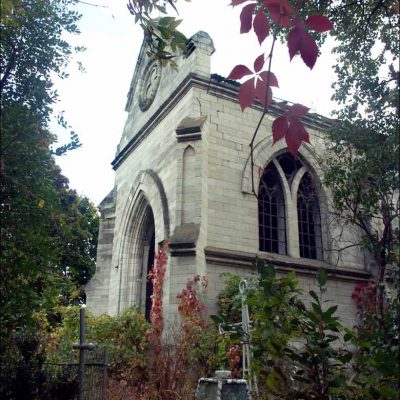
In the Valley of Roses, we find the ruined Catholic cemetery chapel: Polish and Armenian, built in 1912. In the west wing, we encounter a memorial building – the tomb of the Polish Oganowici family.
Of modest proportions, the chapel is designed in an eclectic style, inspired by the Gothic style. The plan consists of a nave with a small altar apse, polygonal in shape, with the corners supported by stepped buttresses. The appearance of the building is reminiscent of the small-scale places of worship from the flourishing period of Gothic architecture in the 12th-13th centuries in Eastern Europe, including Poland and Galicia, from where the Polish and Armenian Catholics migrated to Bessarabia…
Construction of the chapel began in 1913, commemorating the burial place of Joseph Kaetanovich Oganovich, who passed away on 14 January 1909.
The construction was completed in 1922 by G.A. Demzhanovich.
Unfortunately, today, the chapel is in an advanced state of decay…
In 1998, Pushkin Boulevard was renamed Jerusalem Street on the 3000th anniversary of the first recorded Jerusalem. Previously, before b-l [..]
Jerusalem Street
In 1998, Pushkin Boulevard was renamed Jerusalem Street on the 3000th anniversary of the first recorded Jerusalem. Previously, before b-l was named A.S. Pushkin, this street had no name.
Between Grigore Vieru Boulevard and Pushkin Street, a monument to the victims of the Jewish ghetto in Chisinau was erected on Jerusalem Street. Nearby is the main entrance to the former ghetto, which was established in the lower part of the city in July 1941 after German and Romanian units took control of Chisinau. Within weeks, more than 11,000 Jews – men, women and children – were imprisoned in the ghetto. An information board in front of the monument shows the ghetto’s boundaries.
The exact number of Jews remaining in the city at the time is unknown. Some were deported by the Soviets shortly before the war, while others were evacuated or conscripted into the Red Army. However, thousands of Jews were unable or unwilling to leave the city. Only six people emerged alive from the ghetto in 1944…
Chabad Lubavitch Central Synagogue (Synagogue of the glassmakers)
This Synagogue was built in 1896-1898 by the architect Tsalel Gershevich Ginger. For a long time there was an unspoken [..]
Chabad Lubavitch Central Synagogue (Synagogue of the glassmakers)
This Synagogue was built in 1896-1898 by the architect Tsalel Gershevich Ginger. For a long time there was an unspoken rule in Chisinau: for every 500 Jews in the city there must be one synagogue.
In 1964 the city authorities ordered the closure of all synagogues except the Glaziers’ Synagogue, which remained the only legally operating synagogue for more than 40 years. It is now run by the Chabad-Lubavitch Hasidic movement. The original mural paintings have been preserved inside. The synagogue complex includes the building and the mikveh.
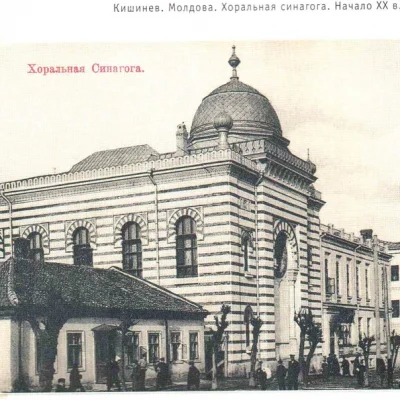
CENTRAL SYNAGOGUE OF CHISINAU its founded in 1886. “Sennaya” synagogue, located in the historical part of Chisinau, is one of [..]
Central Synagogue of Chisinau
CENTRAL SYNAGOGUE OF CHISINAU its founded in 1886.
“Sennaya” synagogue, located in the historical part of Chisinau, is one of the oldest functioning synagogues in the capital and the Republic of Moldova as a whole. Its role in the formation of the Jewish community in the region is exceptional.
In recent years an abandoned synagogue building in Chisinau has been restored and transformed into an active Community Center open to all comers. Most of the activities are subsidized and carried out by volunteers who work out of a sense of ideology and a mission to feel a sense of belonging and pride in the Jewish community of Moldova.
The Jewish Community of the Republic of Moldova was officially registered in 1997, being the successor of the Republican Society of Jewish Culture (created in 1989) and the Jewish Community of Bessarabia.
CERM is a non-governmental, non-political, non-profit, public organization, which unites all Jewish communities and organizations of the Republic of Moldova, including the regional communities of Balti, Orhei, Soroca, Bender, Tiraspol, Grigoriopol, Dubasari, Ribnitsa.
The Church of Saint Haralambie is a place of worship and an architectural monument of national significance, entered in the [..]
The Church of Saint Haralambie (1836)
The Church of Saint Haralambie is a place of worship and an architectural monument of national significance, entered in the Register of monuments of history and culture of the municipality of Chisinau. It was built in 1836. A lapidary inscription inside it with the year 1812 testifies to a possible earlier stage in the history of the church. It was the reading room of the merchant Haralambie, whose name the street in front of the church bore for a long time.
The architecture was designed in the neoclassical style, in accordance with the “Ucazuri concerning the design of stone churches”. It has a cruciform plan, made up of rectangular elements of the plan, with an elongated longitudinal axis, the central part highlighted by a dome raised on a wide drum with arched windows. On the western arm, elongated by means of a space specific to Russian architecture – the trapeza – and widened like the eastern arm by side rooms, the bell chamber – a prismatic bay with wide openings – was built. The side walls are decorated with porticoes, crowned with triangular gables, under which are the side entrances. The church is plastered on the outside, with the background of the walls showing the details – pilasters, brackets, bays, lintels, covered in a lighter shade than the rest of the building.
It is a contemporary church. Through the mercy of the Good Lord and with the blessing of His Eminence Vladimir, [..]
Saint Mucenic Valeriu
It is a contemporary church. Through the mercy of the Good Lord and with the blessing of His Eminence Vladimir, Metropolitan of Chisinau and the whole of Moldova, as a servant of the Holy Church and the desire of many people of good faith, but also through the efforts of the Protopriest Valeriu Bazatin, who undertook the commitment to build the holy place Church dedicated to “Saint Mucenic Valeriu” in the Riscani sector of Chisinau.
This work began with the decision of the Chisinau City Hall of 26.12.2000, which accepted the sale of the land with the surface of 0.256 ha to the Bazat company, which assumed the responsibility of further managing the exploitation of the territory.
Thus, during 5 years, several teams of builders worked with dedication, and on 25 May 2005 for the first time the parishioners were invited to the holy mass.

 English
 Română
  Русский