A traveler-monument, inaugurated on April 29, 1928, on the occasion of the 10th anniversary of the Union of Bessarabia with [..]
The monument of Stephen the Great and Holy
A traveler-monument, inaugurated on April 29, 1928, on the occasion of the 10th anniversary of the Union of Bessarabia with Romania. In June 1940 he was moved to Romania, and in 1942 – brought back to Chisinau, in 1944 – moved again. A year later it was brought back and reinstalled in Chisinau. Author – the sculptor Alexandru Plămădeală.
Maria of Edinburgh – Saxa – Coburg – Gotha, was born on October 29, 1875, at Eastwel Park, in the [..]
Queen Mary Monument
Maria of Edinburgh – Saxa – Coburg – Gotha, was born on October 29, 1875, at Eastwel Park, in the county of Kent – Great Britain, daughter of Duke Alfred of Edinburgh, second son of Queen Victoria of Great Britain and Grand Duchess Maria, only daughter of Tsar Alexander II of Russia and Princess Maria of Hessen.
Princess Maria’s upbringing is truly royal. An eyewitness to her adolescence, quoted by Nicolae Iorga, characterized her as “believing in kings and their missions, but also in their rights. She was not haughty, nor humble, but regal from the roots of her hair to the soles of her feet, imperious, fiery, active, a girl full of the joy of life and faith in her race’.
Married to Crown Prince Ferdinand in December 1891, Maria had to fight a permanent battle with King Carol, who isolated her completely at Peles and forbade her any contact with Romanian political or cultural figures. “Throughout my youth, the word ‘minister’ was synonymous with ‘head of mischief’,” Regina later wrote. But in just a few years, after giving birth to Charles (1893), Elisabeth (1894) and Maria (1899), Princess Maria would be one of the most splendid women in Europe. Maria’s last child, Prince Mircea, born in 1913, tragically died of typhoid fever at the age of three during the First World War. His tomb is at Bran Castle in Sinaia, Romania. Intelligent and full of vitality, Maria also embodied the romantic ideal of any man of the time, being healthy, noble in her attitudes and very much a woman. In her years of isolation she suffered terribly from the belief that she had been lured into a ‘trap’, that she had been given the ‘mission’ to produce an heir to the throne of Charles I, that she would destroy her youth and beauty in a cold castle, spied on by maids and governesses.
In October 1917, on the Moldavian front, Regina, wearing the uniform of an officer, fell in the Cireșoaia front sector in front of the 443rd quota, on the front line, in the first trench, 200 meters from the enemy. She was the most determined voice for resistance and the offensive on the Moldovan front and, if we study her memoirs carefully, the personality who ultimately decided Romania’s entry into the war on the side of the Entente.
In the biography of this prominent woman there is also a gesture that completes her unique personality: on March 26, 1926, on Annunciation Day, Queen Marie converted to Orthodoxy. In a ceremony held at the Palace, she confessed her confession, was disbaptized by Patriarch Miron Cristea and was received into the Romanian Orthodox Church.
A lover of beauty, Maria had another way of expressing herself – the artistic. Her literary works include stories, evocations, novels, memoirs, including: “My Country”, “The Dreamer of Dreams”, “A Legend from Mount Athos”, “The Story of a Disobedient Lady”, “Thoughts and Icons from the Time of War”, “Unbidden Longing”, “The Story of a Heart”, “Crowned Queens”, “Fantastic Birds in the Blue Sky”, “The Voice from the Mountain”, “Masks”, “The Story of My Life”. The literary works were written in English and translated into Romanian, some of the translations belonging to Nicolae Iorga.
Elected a member of the Academy of Fine Arts, acclaimed from the very first words as one of the great personalities of her age, the Queen won over a world whose reserve capitulates so easily both to situations and to talent. On every occasion she made a point of affirming that Romania, without pretending, does not beg. It only demands what it deserves. “We are not”, she said, “the poor relation”.
In recognition of her outstanding merits in the making of Greater Romania, on December 1, 1920, the Branului Town Council decided: “to present Her Majesty Queen Marie of Greater Romania with the ancient castle of Branului. The donation should be, above all, an expression of the sincere veneration that the people of our town feel for the great Queen who dries the tears of widows and orphans, comforts the helpless, offers help and comfort to those who are in pain and spreads blessings wherever she goes, and through all this she conquers the hearts of the people of the whole country with irresistible enthusiasm”.
The Queen’s health began to deteriorate and in 1938 she went to a clinic in Dresden for treatment. When the doctors told her that the end was near, she decided to return to her homeland and, on July 18, 1938, she passed into eternity in the Golden Chamber of Pelieresor Castle, decorated by herself with the symbols she loved: symbols of faith, light and eternal life. In her moral testament – “Letter to my Country and my People” – Queen Marie bade a touching farewell to the people with whom she identified: “From now on I will not be able to send you any more messages; but above all, remember my People that I have loved you and that I bless you with my last breath”.
In his will, he requested that his body be buried in the Episcopal church of Curtea de Argeș and his heart to be kept in a reliquary in the Stella Maris chapel of the residence in Balcic. After the cession of Cadrilater in 1940, the Queen’s heart was moved to Bran.
On March 27, 2025? on the 107th anniversary of the Unification of Bessarabia with Romania, the monument dedicated to the famous Queen was unveiled in the square of the Gheorghe Asachi High School in Chisinau.
The initiative to erect the statue belongs to lawyer Iulian Rusanovschi and was launched on March 27, 2018, at the celebration of the Centennial of the Great Union.
The monument, more than six meters high, depicts Queen Mary of Romania on the day of her coronation in Alba Iulia, holding the Christian Bible in her left hand.
The sculptor Veaceslav Jiglițchi sculpted the bronze face of Queen Maria and an international commission of experts supervised the artistic execution.
The cornerstone of Chisinau is a purely symbolic stone, placed in 1986, commemorating 550 years since the first mention of [..]
Сornerstone of Chisinau
The cornerstone of Chisinau is a purely symbolic stone, placed in 1986, commemorating 550 years since the first mention of the place name “Cheșeneu.” The initial inscription was in the Cyrillic alphabet.
On October 12, 2011, the inscription was renovated, and the text, now in the Latin alphabet, was modified.
It is believed that the city of Chisinau started its history from this location.
It is a replica of the famous Roman statue (author Ettore Ferrari), which was donated by the municipality of Rome [..]
The Capitoline Wolf in Chisinau
It is a replica of the famous Roman statue (author Ettore Ferrari), which was donated by the municipality of Rome (Italy) in the first years after the union of Bessarabia and Bukovina with Romania (1921).
In 1940, for political reasons, the statue was melted down. In 1990, the “Cultural League for the Unity of Romanians Everywhere” made a copy of the statue, which was installed in front of the National Museum of History of the Republic of Moldova in Chisinau.
The idea of initiating such an alley in the country’s capital belongs to the sculptor A. Plămădeală. The alley was [..]
The Alley of Сlassics (Writer’s Alley)
The idea of initiating such an alley in the country’s capital belongs to the sculptor A. Plămădeală. The alley was inaugurated in 1958 in the Public Garden with the first 12 busts of classical writers and poets. Currently, there are already 29 busts of important writers from Romania and the Republic of Moldova placed on the alleys of the park, with the 30th being the bust of A.S. Pushkin – the renowned Russian poet. His bust was erected in 1885, with funds raised by the city’s honorary citizens. After the tragic death of the poet, Chisinau became the third city in the former Russian Empire to commemorate him with a memorial monument. The author of the bust is the sculptor A. Opekusin.
Vasile Alecsandri (bust installed in 1957) – Writer, playwright, folklorist, politician, and diplomat.
Gheorghe Asachi (bust installed in 1957) – Poet, prose writer, and playwright.
Ion Creangă (bust installed in 1957) – Writer, storyteller, prose writer, theologian, textbook author, politician, poet, teacher, and deacon.
Alexandru Donici (bust installed in 1957) – Linguist, translator, and poet.
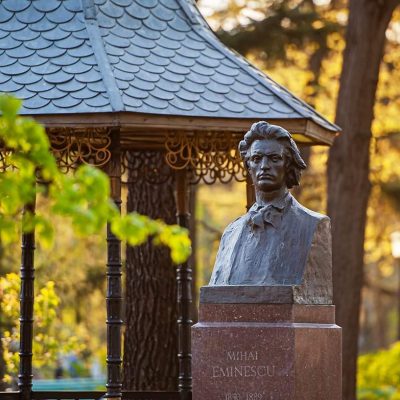
Mihai Eminescu (bust installed in 1957) – Poet, prose writer, and journalist.
Bogdan Petriceicu Hasdeu (bust installed in 1957) – Encyclopedist, writer, philologist, linguist, jurist, folklorist, publicist, historian, and politician.
Alexandru Hâjdeu (bust installed in 1957) – Scholar, lawyer, and writer.
Nicolae Milescu Spătarul (bust installed in 1957) – Writer, scholar, translator, traveler, geographer, and diplomat.
Constantin Negruzzi (bust installed in 1957) – Writer and politician.
Alecu Russo (bust installed in 1957) – Poet, prose writer, essayist, memoirist, literary critic, ideologist, and novelist.
Constantin Stamati (bust installed in 1957) – Writer.
Tudor Arghezi (bust installed in 1995) – Writer, poet, prose writer, and journalist.
George Bacovia (bust installed in 2001) – Poet and writer.
Lucian Blaga (bust installed in 1992) – Poet, writer, philosopher, linguist, translator, journalist, diplomat, essayist, university professor, librarian, and playwright.
George Călinescu (bust installed in 1997) – Historian, writer, journalist, literary critic, biographer, playwright, teacher, and librarian.
George Coșbuc (bust installed in 1996) – Poet, translator, teacher, journalist, literary critic, writer, and linguist.
Mircea Eliade (bust installed in 1997) – Historian of religions, philosopher, essayist, prose writer, and university professor.
Octavian Goga (bust installed in 2000) – Politician, poet, playwright, journalist, translator, and writer.
Nicolae Iorga (bust installed in 1990) – Historian, politician, linguist, poet, writer, philosopher, literary critic, playwright, journalist, orientalist, biographer, children’s literature author, philologist, translator, and university professor.
Alexei Mateevici (bust installed in 1990) – Poet, educator, soldier, translator, and Orthodox priest.
Adrian Păunescu (bust installed in 2011) – Poet, publicist, and politician.
Liviu Rebreanu (bust installed in 2009, restored) – Writer, journalist, playwright, and translator; associated with the “Ion Luca Caragiale” National Theatre.
Mihail Sadoveanu (bust installed in 1990) – Novelist, short story writer, journalist, essayist, translator, poet, public servant, and politician.
Nichita Stănescu (bust installed in 1990) – Poet and essayist.
Constantin Stere (bust installed in 1991) – Journalist, philosopher, literary critic, politician, lawyer, and writer.
Grigore Vieru (bust installed in 2010) – Poet, publicist, and writer.
Mihail Kogălniceanu (bust installed in 1990) – Lawyer, historian, publicist, diplomat, literary critic, and politician.
Ion Luca Caragiale (bust installed in …) – Playwright, short story writer, satirist, poet, author, theatre director, political commentator, and journalist.
Dumitru Matcovschi (bust installed in …) – Poet, prose writer, academician, publicist, and playwright.
The monument is named “Requiem for Love,” or, as locals refer to it, “Two Twin Hearts.” It is situated at [..]
The monument of Ion and Doina Aldea-Teodorovici
The monument is named “Requiem for Love,” or, as locals refer to it, “Two Twin Hearts.” It is situated at the central entrance of the “Valea Morilor” park, opposite the State University. Inaugurated in 1999, on the 7th anniversary of the passing of the famous couple of musicians, singers, composers, and patriots of the nation. The sculptor behind this creation is Iurie Canașin.
A Kilometer Zero plaque was installed in November 2012 in the center of the capital, outside the Central Post Office. [..]
Kilometer Zero
A Kilometer Zero plaque was installed in November 2012 in the center of the capital, outside the Central Post Office. It is a stylized version of the wind rose, illustrating distances to other capitals of the world from Chisinau. The Km 0 holds historical, social, and tourist significance for visitors to our capital. The marker was crafted from bronze and marble, with several capitals and their respective distances inscribed on it. The architect behind this project is Victor Vieru.
Every country boasts certain unofficial symbols that represent its identity, such as the Eiffel Tower symbolizing France, the kimono representing [..]
Tree of Life
Every country boasts certain unofficial symbols that represent its identity, such as the Eiffel Tower symbolizing France, the kimono representing Japan, wooden shoes for the Netherlands, the kilt signifying Scotland, and Italy’s association with pizza and Greece characterized by olives and deities.
In the case of Moldova, the country’s symbols include the renowned “alțiță” embroidered shirt, the rose, the white stork, and the Tree of Life. This symbol has ancient roots dating back to the Getae-Dacians, who used it on their weapons, helmets, and shields. The Tree of Life held unique symbolism, offering protection from dangers and a sense of direct connection to the supreme divinity.
Despite being primarily an Orthodox country, the Tree of Life remains a significant part of the people’s daily life, often used in funeral rituals.
The creation of the brand and logo:
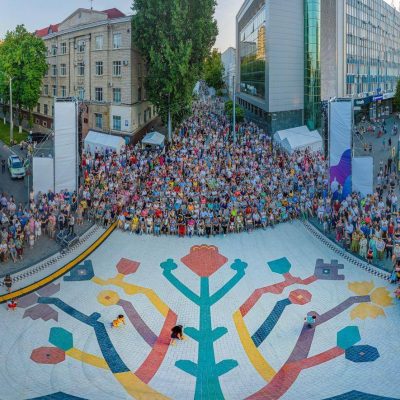
On November 20, 2014, at the Museum of Ethnography and Natural History, the Tourism Agency of the Republic of Moldova unveiled a new brand for the country’s tourism sector. Dubbed the “Tree of Life” by its creators, the logo features a stylized tree with the initials “M” at its base and a symbolic rose at the top. Accompanying the logo is the tourist slogan “Discover the routes of life,” encouraging tourists to explore new paths through hospitality, history, wine, gastronomy, and Moldovan traditions.
The Tree of Life is described as a complex symbol of national culture, chosen to represent the values and specifics of tourism in Moldova. Each branch end represents a specific symbol: the letter M symbolizes Moldova’s fertile soil, the heart represents hospitality, the glass represents the culture and traditions of winemaking, and the cross is a symbol of religious culture. The vertical lines depict the roads to be discovered in the country. The branches represent the natural development of the national tourism brand “Tree of Life,” incorporating elements reflecting the significance of tourism and winemaking, complemented by symbols from the other five strategic sectors of the national economy: light industry, information technology, automotive and electronics industry, infrastructure, and energy.
Interestingly, the tourist brand has evolved into the national brand of the country, gaining representation at various international exhibitions and events.
On 15 May 2021, a new square was inaugurated in the capital. It is located in the Rascani sector, on [..]
Monument Gugutsa
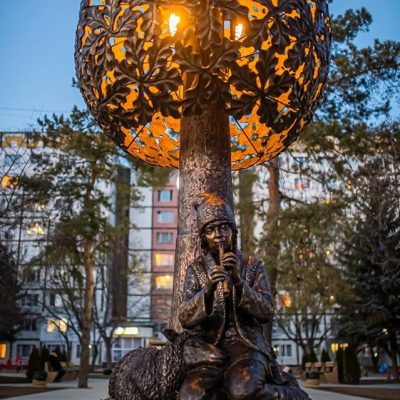
On 15 May 2021, a new square was inaugurated in the capital. It is located in the Rascani sector, on Kiev Street, and is called Guguță Square. A monument to the famous character invented by writer Spiridon Vangheli was also installed there.
The green space is called “Guguță”, and the monument to the character is the focal point of the area. The work is made of bronze, is 1.5 metres high and was created by sculptor Veaceslav Jiglițchi.
The writer Spridon Vangheli, also nicknamed “Guguță’s father” died at the age of 92 on June 21, 2024. He was buried at the Central Cemetery in Chisinau. June 24, 2024 was designated a day of mourning for the entire country.
The monument, dedicated to the ballad “Myoritsa” was installed in Chisinau at the beginning of March 2022, author – Veaceslav [..]
„Myoritsa”’s Monument
The monument, dedicated to the ballad “Myoritsa” was installed in Chisinau at the beginning of March 2022, author – Veaceslav Jiglițchi.
For Moldovans, „Myoritsa” is a historical memory. Although the plot of the Moldovan folk ballad is far from heroic, on the contrary – the hero of the ballad believes in the irreversibility of fate, which should not be fought at all, but accepted as it is… Sheep Myoritsa warns the young shepherd that two other shepherds are plotting to kill him out of envy. Anticipating his doom, the shepherd turns to his favorite sheep and shares his last wishes with it… The symbols present in „Myoritsa” originate from ancient rituals and beliefs. Historians believe that the ballad dates back to the XII-XIII centuries and is one of the oldest sources where the nationality “Moldovan” first appears.
In 1846, the writer Alecu Russo heard from the Leutarians and wrote down his version of “Myoritsa,” which was later published by another writer – Vasile Alexandri. A few years later, Alexandri encountered another version of the ballad, altered the original text, and published the revised “Myoritsa” in two collections of folk poetry.
“Myoritsa” has been translated into foreign languages many times. Like any masterpiece of folk art, it is very challenging to translate into poetic for
The monument is situated in front of the National Library of the Republic of Moldova in Chisinau. Inaugurated in 1997, [..]
The monument of Vasile Alecsandri
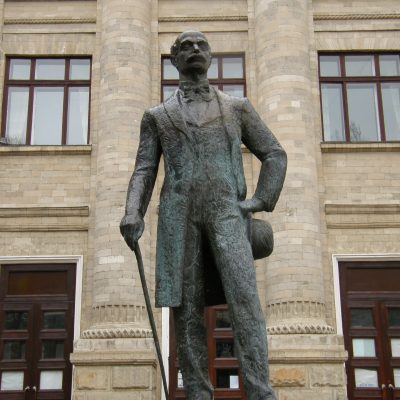
The monument is situated in front of the National Library of the Republic of Moldova in Chisinau. Inaugurated in 1997, it stands in memory of Vasile Alecsandri – poet, playwright, folklorist, politician, minister, diplomat, and founding member of the Romanian Academy. The sculptor responsible for this piece is Ion Zderciuc.
“The Wall of Glory” is the name of the mural, which was painted for two weeks by three artists, at [..]
Mural painting “Wall of Glory”
“The Wall of Glory” is the name of the mural, which was painted for two weeks by three artists, at the initiative of painter Radu Dumbravă. The king of the Dacians, Decebal, was painted on the wall of a pump factory, located on Decebal Boulevard 3. It took 60 litres of paint to complete the work. The painting was carried out in 2017, August.
The Heroes’ Cemetery Memorial Complex, known in different eras as the Heroes’ Cemetery, the Cemetery of Honour or the Romanian [..]
The Heroes’ Cemetery Memorial Complex
The Heroes’ Cemetery Memorial Complex, known in different eras as the Heroes’ Cemetery, the Cemetery of Honour or the Romanian Military Cemetery, is a historical monument located on bd. Decebal 17 in Chisinau. Here were buried soldiers of different ethnicities participating in the two world wars.
The cemetery appeared in 1918, at the end of the First World War. It was the burial place for soldiers who had fallen on the battlefield, and in later years also for war veterans. The buried soldiers were of different nationalities: Romanians, Russians, Czechs, Poles, French, Austrians, Hungarians, etc. In the interwar period, a chapel in memory of the Czech Legion was built on the cemetery grounds. The cemetery was called “Heroes’ Cemetery” until Bessarabia joined the USSR, when it was renamed Krasnodonskii. In 1927-1938, the cemetery was laid out by the “Queen Mary” National Settlement for the Cult of Heroes. The fallen soldiers of the Second World War were also buried here in the summer of 1941. Sources also mention that an unidentified number of prisoners of war from Germany, Austria, Italy and other countries were buried in the same cemetery.
At that time, the cemetery had an area of 2.4 ha. Access to the cemetery was via a monumental entrance, consisting of a six-metre-wide staircase with 50 steps and an architectural portal at the base consisting of two 10-metre-high reinforced concrete pillars, each bearing an eagle with spread wings. The columns dominated a vast semicircular square surrounded by walls and ornaments. Shaped like an irregular polygon, the cemetery had an old Byzantine-style chapel at its centre, around which six grave plots were laid out. The steps were connected to the chapel by an alley.
After 1944, the chapel was destroyed and the cemetery ground was levelled by bulldozer. During this process, several graves were unintentionally disinterred, bringing out bones and various personal objects (wristwatches, cigarette boxes, daggers, etc.) In 1959, what remained of the cemetery was demolished, except for the columns at the entrance, and in 1961 the Chiril Draganiuc Institute of Pulmonology and Physiology was built. The foundation of the chapel was preserved and a terrace was set up there for the patients to rest. In the early 1990s, when the hospital was no longer functioning, a wooden cross with the inscription “Glory to the Heroes of the Romanian Army” was installed on the foundation of the former chapel, an initiative of the politician Gheorghe Ghimpu. The hospital was demolished at the end of 2007. shortly after it became private property.
In the Cemetery of Honour in Chisinau were buried 1645 soldiers, including 431 Romanians (66 in graves, 365 in the crypt), 234 Russians (27 in graves, 207 in the crypt), 29 Austrians, 39 Czechs, 35 French and 6 Poles fallen in World War I, as well as 96 Romanian soldiers fallen in World War II. Around the chapel there were six plots with 136 graves in which 202 heroes were buried and two crypts with 572 unidentified Romanian and Russian heroes.
In 2013, the Republican Association of War Participants (ARPR) said it was able to identify about 200 of the more than 3,000 graves that existed in the late 1940s in the memorial complex. These include 89 intact Romanian graves from the Second World War, the grave of Italian soldier Alciro Deviani (who died in October 1941) and 36 graves of Soviet soldiers who died in the infirmaries in Chisinau. Among those buried in the cemetery are two charity sisters. Another five graves identified belong to Czechoslovak soldiers out of 29 who lost their lives in Chisinau after the withdrawal of Czechoslovak legions from Bolshevik Russia. Thirty graves have also been attributed to French officers who died in southern Bessarabia during the Second World War. According to the ARPR, German and Hungarian prisoners who were part of NKVD construction detachments during the post-war reconstruction of the capital are buried at the “Heroes’ Cemetery”. Nowadays, there are regular clean-ups and memorial services for the buried.
The steam locomotive at the Chisinau Railway Station always attracts the eyes and curiosity of tourists. On it is a [..]
Steam Locomotive
The steam locomotive at the Chisinau Railway Station always attracts the eyes and curiosity of tourists. On it is a commemorative plaque with the following text:
“Built by the Czegelski factory (in the name of Joseph Stalin) in 1950. Factory number 1469.
The inscription on the side of the locomotive: ‘Operated in freight traffic and pushing trains on the Ungheni-Chisinau-Ungheni section until 1968’.
The markings on the tanks indicate the year of construction of the locomotive – 1950, the city of Poznan.
The first Czegelski-branded railway wagons were produced in 1921. And in 1926 the production of steam locomotives started. By 1958 the Czegelski factories produced about 2627 steam locomotives. If we talk about wagons, during this period 7500 wagons were produced, which could withstand temperatures down to minus 50 degrees.
This plant still produces high-quality wagons and locomotives today.
What happened on 28 June 1956 in Poznan?
On this day, factory workers took to the streets to protest against working conditions and pay. This event was called the Poznań June or the 1956 Poznań Protests (Polish: Poznański Czerwca 1956, also known as the 1956 Poznań Uprising), and was the first general strike in the history of the Polish People’s Republic.
Thousands of people gathered in the city centre, near the secret police building of the Ministry of Public Security. At first, the event was orderly, but then events got out of hand and riots broke out in the city centre, sparked by clashes between security forces and demonstrators. Workers destroyed the PORP city committee building and stormed the prison, releasing political prisoners.
According to various reports, between 57 and 74 people were killed in the conflict and around 500 injured (including military personnel).
Initially, 323 people were arrested and 154 were tried. 37 detainees appeared in court, most of them on criminal charges. Eventually, two were released, four received suspended sentences, 23 were sentenced to prison terms ranging from two to six years, but all but those responsible for the killing of the policeman were soon released.
On 21 June 2006, on the occasion of the 50th anniversary of the events, the Sejm of Poland declared 28 June a national holiday in Poland under the title “Day of commemoration of the events of June 1956 in Poznan”.
To commemorate these events, in 2016, a mural was created reflecting the history of the plant on the 60th anniversary of the events.
Hristo Botev Petkov (1848 – 1876) was an exceptional Bulgarian poet, publicist, revolutionary, and a national hero of Bulgaria. Born [..]
Monument to Hristo Botev
Hristo Botev Petkov (1848 – 1876) was an exceptional Bulgarian poet, publicist, revolutionary, and a national hero of Bulgaria.
Born on January 6, 1848 (December 25, 1847 O.S.) in the village of Kalofera, which, like the rest of Bulgaria at that time, was part of the Ottoman Empire, he hailed from a humble family. His father, Botev Petkov (Botyo Petkov), was a teacher, translator, and educator. Hristo was born on the feast of the Nativity of Christ and was given the name Hristo. In the 19th century, Bulgarian surnames were derived from the father’s name, and according to linguistic norms of the time, the surname “Hristo” sounded like “Botev” and was written as “Botjov” (variant – “Botjov”). The writer signed his works as “Botjov,” but according to modern rules, the surname is written and pronounced as “Botev.”
Despite his short 29-year life, Botev left behind a limited literary legacy, notable for embodying the revolutionary idea in artistic form. His poems, as well as his life, exemplified the harmonious fusion of talent for revolutionary work with artistic creation. The small number (about 20) of Botev’s surviving poems had a significant impact on the development of Bulgarian literature, gaining popularity among the Bulgarian peasantry and expressing their revolutionary sentiments.
Throughout his brief life, he passionately fought for Bulgaria’s liberation from the Turkish yoke. He visited Kishinev several times, as evidenced by a memorial plaque at the intersection of Pushkin and Metropolitan Varlaam streets, on the building of the former Victoria Hotel.
The monument to the great poet was erected in Kishinev in 1977, on the 100th anniversary of Bulgaria’s liberation from the Turkish yoke. The architect was G. Solominov. Rehabilitation of the monument took place in 2023, and on October 31 of the same year, it was reopened. The monument bears the poet’s words: “Тоз, който падне в бои за свобода, той не умира” (“He who falls fighting for freedom does not die”).
Mikhail Orlov (1788 – 1842). Decembrist, major-general of the Russian army. From 1820 – commander of the 16th Infanteria Division, [..]
The bust of Mikhail Orlov
Mikhail Orlov (1788 – 1842). Decembrist, major-general of the Russian army. From 1820 – commander of the 16th Infanteria Division, located in Besarabia. One of the organizers of the Masonic lodge “Ovidiu-25”. Headed the Decembrist organization of Kishinev. The bust is installed on B.P. Hashdeu Street in front of the publishing house “Litera”. Authors – sculptor Y. Kanashin, architect F. Naumov, 1975.
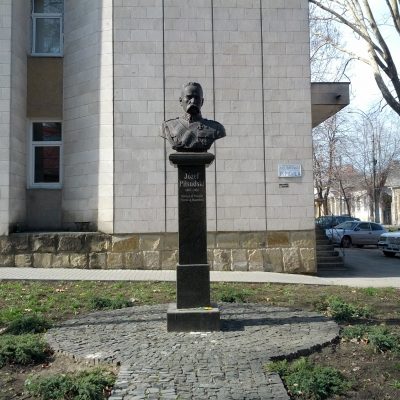
A bust commemorating Marshal Józef Piłsudski was unveiled on November 20, 2014, at the intersection of Mitropolit Petru Movilă and [..]
Bust of Marshal Jozef Pilsudski
A bust commemorating Marshal Józef Piłsudski was unveiled on November 20, 2014, at the intersection of Mitropolit Petru Movilă and 31 August 1989 streets, approximately in the area where the Consulate of the Republic of Poland was situated in Chisinau during the interwar years.
Józef Piłsudski (1867-1935) was a Polish revolutionary and statesman, serving as the first head of state (1918-1922) of the reborn Poland and the founder of the Polish Armed Forces. As the Prime Minister of Poland, Piłsudski worked to bolster his country’s independence through alliances with Western powers, notably France and England, as well as with friendly neighbors Romania and Hungary. During the interwar period, he made several official visits to Romania, including Bessarabia.
In April 1932, Marshal J. Piłsudski visited Chisinau, staying for four days to express unwavering support for his ally and Poland’s refusal of the territorial claims to Bessarabia asserted by the Soviets. The monument commemorates Marshal Jozef Piłsudski’s visit to Chisinau in the interwar period and signifies the amicable relationship between the Republic of Poland and the Republic of Moldova. The statue of this esteemed Polish politician was crafted by the Moldovan sculptor Veaceslav Jiglițchi.
The monument to the great Polish writer Adam Mickiewicz was unveiled on April 28, 2021, at the library in Chisinau [..]
Adam Mickiewicz Monument
The monument to the great Polish writer Adam Mickiewicz was unveiled on April 28, 2021, at the library in Chisinau that bears his name. The statue was sculpted by the renowned artist Veaceslav Jiglițchi, with support from the Embassy of the Republic of Poland in Chisinau, the Polish Ministry of Foreign Affairs, and Polish entrepreneurs in the Republic of Moldova.
The personality of Adam Mickiewicz, regarded as one of the finest Polish romantic poets of the 19th century, holds immense significance for the Polish identity in Chisinau and the Republic of Moldova.
In front of the Roman Catholic Cathedral “Divine Providence” in the capital, the monument of Holy Father Pope John Paul [..]
Monument to Pope John Paul II
In front of the Roman Catholic Cathedral “Divine Providence” in the capital, the monument of Holy Father Pope John Paul II (b. 1920 – d. 2005) was unveiled on August 21, 2016. The ceremony was organized by the Embassy of the Republic of Poland in Chisinau and the Roman Catholic Diocese.
The monument portrays Pope John Paul II seated on a bench. Sculptor Veaceslav Jiglițchi completed the work in just two months.
Pope John Paul II, born in Poland, is the first non-Italian pope and served as the head of the Catholic Church from October 1978 until his passing in April 2005.
It is the first bust on the Alley of the Cinematographer, inaugurated in 2011, next to the “Patria” Cinema. Today, [..]
The bust of Emil Loteanu
It is the first bust on the Alley of the Cinematographer, inaugurated in 2011, next to the “Patria” Cinema. Today, the Cinema bears his name. Author – Andrei Rizescu.
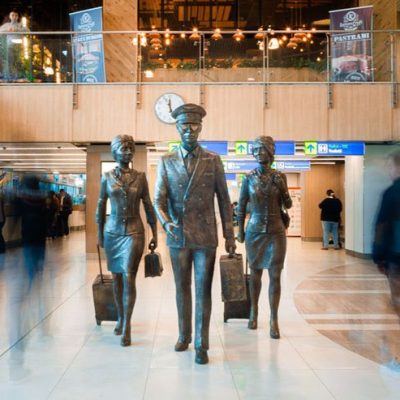
In the waiting room of Chisinau International Airport, there is a beautiful sculpture called “The Crew.” It was crafted in [..]
Triple sculpture “The Crew”
In the waiting room of Chisinau International Airport, there is a beautiful sculpture called “The Crew.” It was crafted in 2018 by the sculptor Veaceslav Jiglițchi, an honorary citizen of the capital. The triptych represents a pilot and two stewardesses, symbolizing the crucial roles they play in ensuring the comfort and safety of passengers during the flight.
The smallest monument in the Republic of Moldova, measuring only 11 cm in height, was cast in bronze and installed [..]
Moldova’s Little Prince Statue
The smallest monument in the Republic of Moldova, measuring only 11 cm in height, was cast in bronze and installed on “planet B-612” in 2018 – specifically on sphere number 23 along the fence in Valea Morilor Park in Chisinau. The concept originated from Igor Udușlivîi, a resident of the capital, who also brought the project to fruition. Despite being a relatively recent addition, tourists already claim that it brings good luck.
A double monument, arguably the most romantic in Chisinau, was unveiled on Pedestrian Street Eugen Doga on October 14, 2017. [..]
Statues of lovers on the Pedestrian Street
A double monument, arguably the most romantic in Chisinau, was unveiled on Pedestrian Street Eugen Doga on October 14, 2017. The author of the monument is sculptor Pavel Obreja. Additionally, along the Pedestrian Street, there is an exhibition featuring the sale of handicrafts crafted by folk artisans from the country.
In mid-December 2017, a new urban sculpture portraying young skateboarders with a dog emerged in Valea Morilor Park in the [..]
Sculpture of young skateboarders
In mid-December 2017, a new urban sculpture portraying young skateboarders with a dog emerged in Valea Morilor Park in the capital. The sculptor behind this composition is Petru Glavan.
The monument, along with the one installed on the pedestrian street Eugen Doga depicting a pair of lovers, is part of the project “Sculptures that Look into the Eyes.”
The composition comprises four elements: a boy, a girl, a dog, and a skateboard. The girl is learning to skateboard, and the boy is assisting her. He supports her hand to prevent her from falling, and between them is the dog.
It’s noteworthy that the dog was crafted by another sculptor, Vasile Sitar, “in the likeness” of the dachshund belonging to the former Polish Ambassador to Moldova. This is how the dachshund was immortalized in the sculpture :).
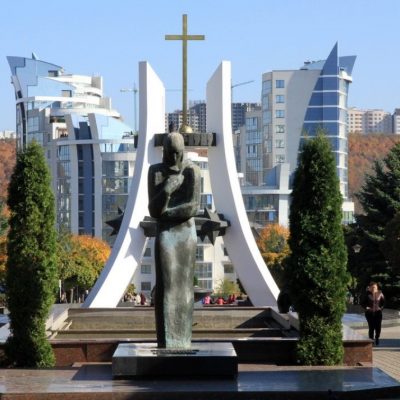
This poignant monument, resembling a painful shard of memory frozen in time, is the creation of the renowned artist and [..]
Memorial to the Victims of Fascism
This poignant monument, resembling a painful shard of memory frozen in time, is the creation of the renowned artist and sculptor Aurel David. Erected in 1991, it serves as a solemn reminder that “nobody forgets, nothing is forgotten.”
Situated in the Râșcani sector (“Poșta Veche”) of the capital, it stands on the grounds where mass executions of Moldovans, Jews, Roma, and Russians took place during the years of World War II.
Historians have found that one of the less developed actors in the events of the Russo-Turkish War of 1806-1812, involved [..]
Manuc Bey – Armenian Prince
Historians have found that one of the less developed actors in the events of the Russo-Turkish War of 1806-1812, involved in political-diplomatic actions, who had influence over the Russo-Ottoman negotiations was the influential and wealthy Manuc (Emanuel) Mirzaianț (there are different spellings of his name: Mirzaian, Mârzaian, Manuc bey etc.), of Armenian origin, known in his time as Manuc Bey.
Manuc Bey (son of Mardiros Mirzaian and Mamila Hamum Oglu: 1769-1817), who began his career as a merchant south of the Danube, ended up as a knight of the Order of St. Vladimir (3rd degree), Russian state councillor (equivalent to the rank of general), informer for Russian diplomacy, banker and landowner with ambitious economic plans in Bessarabia and beyond… For his activity in Wallachia he was awarded the rank of serdar (1802) and paharnic (1803).
For his services to the Ottoman Empire, in 1807 he was granted the rank of Grand Dragoman of the Porte (for the first time this position was entrusted to a non-Franco-Katarite), in 1808 – the title of bei (prince) of Moldavia, which turned out to be, de facto, an honorary one (he did not hold any dominion in the Principalities). Subsequently, the title of “bei” i.e. “prince” was not confirmed in Russia. Only the descendants of Manuc Bei in Bessarabia were “ennobled” by marrying descendants of aristocratic descent.
The merchant, merchant and polyglot diplomat (he knew about 12 languages) Manuc Bey benefited from a rich historical-literary bibliography from which it is easy to see that he exercised, often from the shadows, political-economic actions with an impact on the events in the Romanian Principalities, Russia and the Ottoman Empire. At the same time, there are still many less researched aspects and many unexplored documents that would add to the knowledge of this complex and controversial figure. The diplomatic activity of the famous Manuc Bey is primarily linked to the signing of the Russian-Turkish peace treaty of 16/28 May 1812, in the context of influence peddling, after which part of the Moldavian territory was annexed by the Russian Empire and for more than 100 years would bear the name of Bessarabia.
Manuc Bey played an active role as an intermediary in the secret peace negotiations between the Russian and Ottoman authorities, and was a useful agent of Russia, promoting its geopolitical interests and using influence peddling. It should be recalled that, for his services to the Russian crown and at his repeated requests in 1805-1806, just before the outbreak of war with the Turks, he was issued a passport as a subject of the Russian Empire on 22 May 1806. From this point of view, it was also “natural” for a new citizen of Russia, who counted on her political support and material sustenance, to collaborate by all means with the protector state, including those of the intelligence services of the time. Of his many political and economic activities, more or less enlightening, for us he remained, after all, the man who built the famous inn in Bucharest that still bears his name today – where the Peace of 1812 was signed and whose secret (behind-the-scenes) protagonist he was at certain stages of the diplomatic negotiations.
On 18 October 1812 Manuc Bey and Galib Efendi left Bucharest, having been invited by the aian (governor) of Rusk. And already in December he returned to the capital of the Romanian Country, where he was warned of the danger to his life, which led him to take refuge in April 1813 in Sibiu. In June 1813 Manuc Bey’s family reunited in Brasov. After his refuge in Transylvania, he went to Vienna, where, on 3 October 1814, he had an audience with Emperor Alexander I, who gave him the title of titular state councillor (“действительный статский советник”).
In April 1815 the Russian Foreign Minister informed the administration in Chisinau that Alexander I had allowed Manuc Bey, “known for his loyalty to Russia”, to settle in Bessarabia. He settled with his family on his estate in the village of Hancesti, where he died suddenly on 20 June 1817. Legend has it that he fell off his horse because his saddle straps were cut. The evil gurus say that he was thus punished by the Ottomans for treason.
The legendary Armenian leader was buried in the porch of the Armenian church in the old centre of Chisinau.
The monument was inaugurated on May 9, 1975, on the occasion of the 30th anniversary of the Soviet victory in [..]
“Eternity” Memorial Complex
The monument was inaugurated on May 9, 1975, on the occasion of the 30th anniversary of the Soviet victory in World War II.
During the Soviet period the complex was known as the “Victory Memorial”. Under the 25 m high pyramid, consisting of 5 bayonets, in honor of the 5 years of war, burns an eternal flame of memory. Authors – sculptors A. Maiko and I. Poniatowski, architect A. Minaev.
The Memorial Complex “To the Sons of the Motherland – the Eternal Memory”
The idea of erecting a monument in honor of the 12,500 soldiers who did their “international duty” and the 301 [..]
The Memorial Complex “To the Sons of the Motherland – the Eternal Memory”
The idea of erecting a monument in honor of the 12,500 soldiers who did their “international duty” and the 301 soldiers who fell in the war in Afghanistan came up in 2002. The place for the monument was chosen and accepted in the Rascani sector the capital.
The authors of the project are were the architect Vasili Eremciuc and the sculptor Boris Dubrovin.
The monument in memory of the victims of the deportations of the communist regime „The Train of Pain”
A Monument erected in honor of those deported people from Moldova during the three waves of deportation: in June 1941, [..]
The monument in memory of the victims of the deportations of the communist regime „The Train of Pain”
A Monument erected in honor of those deported people from Moldova during the three waves of deportation: in June 1941, July 1949 and April 1951 (a total of about 58,000 people were deported). It was inaugurated on August 23, 2013 on The Train Station Alley. The author of the monument is the sculptor Iurie Platon. The bronze sculpture is 3 meters high and 12 meters long.
Monument-spring “Cișmeaua General Georgescu P. Ion”
On the Romanian Army Day, marked annually on October 25, the monument “General Georgescu P. Ion’s Cemetery”, located in Valea [..]
Monument-spring “Cișmeaua General Georgescu P. Ion”
On the Romanian Army Day, marked annually on October 25, the monument “General Georgescu P. Ion’s Cemetery”, located in Valea Morilor Park, was re-inaugurated and consecrated in Chisinau.
It was originally installed in 1937, in honour of the victories of the Romanian Army in the battles of Mărăști and Mărășești in the First World War. The Cișmeaua was once known as “General Pion’s Spring” because General Pavel Ion Georgescu, who was called Pion for short, was the initiator of this monument.
Behind this monument there are now three plaques, which commemorate tragic events in our history. It is about the year 1940 – when the USSR conquered Bessarabia, northern Bukovina, Herta County and in the period from June 1940 to July 1941, several historical personalities were captured and tortured. Their bodies were found many years later in mass graves at the exit of the “Valley of the Mills” park.
He was born on 25 December 1883 in Zănoaga (Romania) in a priest’s family.
He attended the “Carol I” National College in Craiova and the “Mihai Viteazul” High School in Bucharest, then the Military School of Artillery and Engineering (1904-1906) and finally the Faculty of Mathematics.
Military ranks: second lieutenant-1906, lieutenant-1910, captain-1914, major-1917, lieutenant-colonel-1920, colonel-1926, brigadier general-1935, major general-1942.
Military functions: teacher and commander of the Artillery School in Timișoara (1926-1928) and of the Army Arsenal (1930-1931), of the 1st Artillery Brigade in Chișinău until 1937, of the 20th Infantry Division in Tg. Mures (1937-1939), then of the 7th Territorial Corps Sibiu.
He was a professor of ballistics at the Polytechnic Institute of Timișoara.
In the First World War he distinguished himself in the battles of Cașin and Mărășești (Pion trench).
In the village of Seini (Satu Mare, Romania) he built an Orthodox church and in Zănoaga he erected a bust of Stephen the Great.
Between 1937 and 1939, as a division general, he was commander of the fortifications at Poarta Someșului. Also during this period he erected a living monument, made of 10,000 fir trees, on Comja Hill (650 m – Gutâiului Mountain), inscribed with the poet’s name – “Eminescu”. The cemetery of General Georgescu P. Ion (“PION” – as he was called, honorary citizen of Seini, post mortem) is visible from the plane, from the DE 58, towards Satu Mare.
On 1 September 1940, as commander of the 7th Territorial Corps, he and other officers took part in leading the demonstration in Sibiu against the Vienna Dictatorship.
He was decorated with several Romanian and foreign orders and medals.Since 1946 he has been under constant surveillance by the Securitate and has been arrested several times. He died in 1956.
It was inaugurated on April 22, 1993. The authors – the architect S. Şoihet and the sculptor N. Epelbaum. The [..]
Monument to the Victims of the Chisinau Ghetto
It was inaugurated on April 22, 1993. The authors – the architect S. Şoihet and the sculptor N. Epelbaum.
The Chisinau ghetto was created on July 25, 1941 by order of the military governor of Bessarabia, General Constantin Voiculescu. On August 11, there were 10,578 people in the ghetto, later the number increased to 11,525 with the arrival of Jews from nearby towns. According to the 1942 census of the authorities, only 100 Jews remained in Chisinau, of which 99 were in the ghetto. Only 6 Jews survived until the Soviet army entered Chisinau in the summer of 1944.
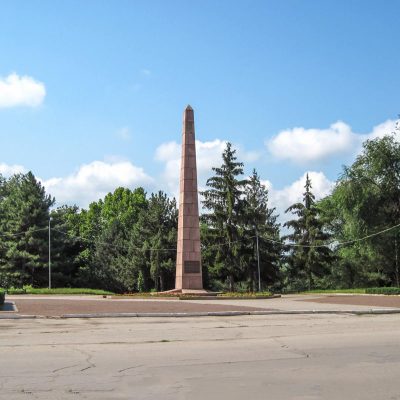
The memorial complex was erected in honor of the detachments of Bulgarian volunteers, formed in Chisinau on the eve of [..]
Shipka Obelisk
The memorial complex was erected in honor of the detachments of Bulgarian volunteers, formed in Chisinau on the eve of the Russo-Turkish war of 1877-1878.
The complex consists of an obelisk, a chapel and a square. The chapel was built in 1882 on the site where on April 12 (1877) the parade of Russian troops and Bulgarian volunteers took place (the famous “Skakovoie Pole” (horse racing ground).
The obelisk was inaugurated in 1966. The guest of honor at the opening of the monument was the world’s first cosmonaut Yuri Gagarin.
In one of the courtyards of the Rascani sector an older monument was hidden. Supposedly erected around 1960-1964, it is [..]
Monumentul Naiului
In one of the courtyards of the Rascani sector an older monument was hidden. Supposedly erected around 1960-1964, it is dedicated to the most famous national musical instrument – the Nai.
General name: Nai
Local name: Fluierar, Fluieraș, Fluierici, Fluierător, Moscal, Muscal, Șuieriță
Short definition: The Nai is a traditional end-blown woodwind instrument of the flute family.
Circular: The Nai is one of the oldest musical instruments in the world and one of the most perfect archaic instruments. The origin of the nai is lost in times long gone. Neither the inventor nor the area of origin of the nai has yet been established. As with other traditional musical instruments, polygenesis also applies to this aerophone. According to some sources, the instrument is about six thousand years old. Six thousand years ago, musical sounds were defined by the order of this reed-pipe link, which was the primordial pipe. Archaeological and historical records prove the presence of the pipe in all corners of the world. Under different names, the nai is found in many countries around the world: antara – in Peru and Bolivia; biwabon – in Japan; kuviklî, kuviciki or pipe – in Russia; lalave, palina, rihe or tenaho – in the Solomon Islands; mishi – in the Democratic Republic of Congo; musikâr – in Turkey;
syrinx – in Greece; skuduciai or skadutas – in Lithuania; zuffolo or zuffolo pastorale – in Italy, etc. Throughout the world, the instrument has circulated and still circulates under the name of Pan’s flute, a name that has become established due to the legend that depicts the Greek god Pan playing this instrument, attributing to this deity the role of creator of the flute. Philologists explain the etymology of the instrument’s name in the Persian-Arabic-Turkish word nay or ney, which, according to Curt Sachs, means reed whistle. Nay mus in Persian means Pan’s whistle, and miskal, musikâr or musqal in Persian, Arabic and Turkish also means Pan’s whistle.
In our cultural-ethnic space, the flute has been known since ancient times. Pictorial evidence from antiquity, found in centres inhabited by the Geto-Dacians, depicts musical-choreographic scenes with the presence of mythological divinities (heroes dancing to the sounds of the flute, fauns with a flute, Pan with a kettledrum and flute, etc.), all dating from long before our era (from the 6th century BC). Sculptural images and inscriptions attested at Histria, Tomis, Callatis depict several musicians (instrumentalists) playing musical instruments, including the syrinx (nai), in various poses. We find it depicted on the bas-relief on the wall of the sarcophagus from the discovered in Oltenia. In the historical and literary writings of the Roman poet Ovid (1st century AD) the presence of the nai in the musical practice of the Geto-Dacians is mentioned. Mention of the presence of the syrinx in choreographic performance is attested in the 1st century AD. 2nd century AD north of the Danube by the Greek writer Lucian of Samosata. The Dionysian deity’s relief appears on a marble slab with an inscription (241 AD), discovered at Tomis, two corybanites armed with swords and shields rhythmically support a war dance in the presence of Pan (with the traditional nai) and Dionysus. The nai is referred to as a pipe in the work ‘The Teachings of Neagoe Basarab to his son Theodosius’ (1512-1521). In the Principality of Monaco, the nai began to be popularised on a massive scale in the 18th century, when it was included in lute bands alongside the violin and the cobza. The organologist Tiberiu Alexandru suggests the hypothesis that the construction of the reed-pipe nai proves its primary functionality in the rustic and bucolic environment. The next mention of the functioning of the pipe in our traditional musical culture comes from 1774, when the Russian General-feldmarshal Pyotr Rumyantsev, who took part in the Russian-Turkish war of 1768-1774, including the battles of Larga and Cahul (1770), addresses the Divan of Moldavia and Wallachia with the request to send to the imperial palace in St. Petersburg the instrumental ensemble composed of the violinist-brothers Ivanta and the naist Stancu. Fr.J. Sulzer in his work History of Transalpine Dacia (1781, Vienna, vol. II, p. 417) also reports on the existence of the nai in the lute inlays in the lowlands of Moldavia and Wallachia. The fame of the naijo reached beyond the borders of the country from the second half of the 18th century, and the former French secretary to Grigore III Ghica Jean-Louis Carra noted in 1777 in Histoire de la Moldavie et de la Valachie, avec une dissertation sur l ‘etat actuel de ces deux Provinces that the naijo (‘the eight-holed whistle’), together with the violin and the cobza, was one of the country’s instruments. History has preserved several names of famous instrumentalists, who delighted listeners in the country and abroad with their interpretive art: Stancu, Năstasă Muscalagiul, Paraschiv Muscalagiul, Mihalachi Roșu – a member of the Taraf led by the famous Barbu Lăutarul who is said to have possessed the naiola, T. Teodorescu, I. Pădureanu, Angheluș Dinicu, Radu Ciolac and others. Under different names the naius is recorded in several written sources published in the country and abroad: Papageno’s flute (in the German Allgemeine Musikalsche Zeitung, nos. 46 and 47, 1821), muscal (in Dionysius Fotino’s General History of Dacia, 1819, reed (in the travel notes of the Russian officer V. Gorceakov, 1820-23), Pan’s flute (in the work of the English traveller W. Wilkinson’s Tableau historique, géographique et politique de la Moldavie, 1821), nai (in the songbook of the Austrian violinist and critic Alfred Henrich Ehrlich Air nationeax roumains, 1850 and in the novel by the German writer Wilhelm de Kotzebue Lascar Viorescu, 1851).
In the second half of the 19th century, the art of playing the nai was presented and appreciated abroad: in Belgium, in Russia – in Sankt-Petersburg, Moscow, Baku, the nai performers were accompanied by the tarafols led by G. Ochialb, S. Pădureanu. It is even believed that it was under the impression of these ensembles that the Russian composer N. Rimsky-Korsakov introduced the naiola in the third act of the score of his opera “Mlada” (1893). However, it was also during this period that the naius was gradually suppressed from the composition of the inlays. In the ensembles conducted by I. Perja, C. Marin, C. Parno, Gh. Heraru – the most representative for the late sec. XIX – înc. sec. 20th century in Moldova on the left of the Prut – the nai mike is not recorded. It gradually returns again in the composition of instrumental ensembles in the second half of the 20th century. Nowadays, the nai is mainly used in non-traditional environments as a component instrument in folk music bands and folk ensembles.
The mural with the name “Hope” was painted by the painter Dmitrii Potapov in collaboration with several students from the [..]
Mural painting “Hope”
The mural with the name “Hope” was painted by the painter Dmitrii Potapov in collaboration with several students from the State University “Ion Creanga”. “Hope” was painted on a 14-storey block of flats from the 17th century. Botanica in Chisinau, near the “Zimbru” stadium (47/6 Dacia Boulevard).
The work depicts the image of a schoolgirl coming home from school. On her way home, the girl makes friends with everyone around her: with nature and birds, she plays with the sun’s rays, but her aspirations lead to the stars…
In Chisinau, in the square of the State University of Moldova, you can find a sculptural composition, a bit strange, [..]
Stone of Peace
In Chisinau, in the square of the State University of Moldova, you can find a sculptural composition, a bit strange, which for an uninformed person remains unimportant. But this is the famous “Stone of Peace“, erected to commemorate the victims of the atomic bombings of Hiroshima and Nagasaki. The sculpture was erected in 2018 to mark the 25th anniversary of the establishment of Moldovan-Japanese relations.
Interestingly, the “Stone” is a monolith with an engraved pectoral relief, depicting a woman , with the face of the goddess Kanon, praying, wishing herself and everyone eternal peace, as well as the inscription “From Hirosima”. The stone itself was brought from Japan and is part of the pavement of the railway line damaged by the atomic bombing of the Japanese city of Hiroshima on 6 August 1945 at 8.15am.
Such sculptural compositions can be found in over 100 countries. The city of Chisinau became 37th on the list of such sculptures. They are displayed in museums, parks and other public areas, built at the initiative of the “Stone of Peace” Association in Japan.
The monument to Taras Shevchenko in Chisinau was erected in 2006 by a Moldovan sculptor with Ukrainian roots Peotr Gherman [..]
The monument to Taras Shevchenko
The monument to Taras Shevchenko in Chisinau was erected in 2006 by a Moldovan sculptor with Ukrainian roots Peotr Gherman and installed in the Riscani sector of Miron Costin Street in the square of the Taras Shevchenko Gymnasium. Taras Shevchenko Gymnasium.
In different years in Moldova monuments to the Great Kobzar were also installed in the cities of Balti, Briceni, Tiraspol, Bender, Camenca.
This honor of the Ukrainian poet was established due to the consolidation of the Ukrainian nation and society around the highest values of establishing a sovereign, independent and democratic Ukraine.
Every year on March 9, on the birthday of the great Ukrainian poet, the Shevchenko Days are held – it is a holiday that consolidates the entire Ukrainian people, both in Ukraine and abroad. This tradition is also alive in Moldova, because in our country Ukrainians are the second largest nation. Taras Shevchenko, undoubtedly, belongs not only to the Ukrainian people, although his creativity and his whole life are inseparably connected with it; – but part of the world heritage. Taras Shevchenko (1814 – 1861) chose a difficult, full of trials fate. All creativity is permeated with ardent love for his native land. His thoughts and fiery word reflected the aspirations of the working people for a better life. He is called a harbinger of a new life, a people’s prophet, a titan of the spirit, who is rooting for the fate of his people. He left a spiritual testament to his descendants, passed on from generation to generation.
Great Kobzar became a great personality not only of Ukrainian, but also of world literature, receiving the right to immortality.
Shevchenko’s songs and thoughts are close to the folk Ukrainian poetry. They are as melodic, simple and heartfelt, as deep in thought as the songs composed by the people. They are vivid pictures, where life itself is seen, given without embellishments and additions …
The Taras Shevchenko Gymnasium in Chisinau is an educational institution located in the Riscaniovca neighborhood and is an important educational institution for the local Ukrainian community. The school actively supports cultural and linguistic diversity, offering education in both Ukrainian and Romanian languages.
The school hosts a variety of cultural events aimed at preserving and promoting Ukrainian culture among students. In recent years, the gymnasium has become an important center for Ukrainian refugee children who have arrived in Moldova. In response to the increasing number of children needing instruction in their native language, the gymnasium has opened additional classes with instruction in Ukrainian and Romanian. This allows children not only to preserve their national identity, but also to integrate more easily into the Moldovan educational system.
A vestige of the Soviet past. It was erected in 1953. The statue of the communist Grigore Kotovski, participant in [..]
The statue of Grigore Kotovski
A vestige of the Soviet past. It was erected in 1953. The statue of the communist Grigore Kotovski, participant in the Russian Civil War, was erected by a group of sculptors and painters – L. Dubinovschi, K. Kitaika, I. Perșudcev and A. Poseado, after the schematics of the architect F. Naumov. A controversial monument, after many disputes, it remains in its old place, in front of the hotel “Cosmos” on Negruzzi Boulevard.
Plaque in memory of the illegally condemned to the Soviet GULAG
On June 29, 2024, a plaque was inaugurated in memory of the mayors, priests, intellectuals, and farmers from Bessarabia, who [..]
Plaque in memory of the illegally condemned to the Soviet GULAG
On June 29, 2024, a plaque was inaugurated in memory of the mayors, priests, intellectuals, and farmers from Bessarabia, who were illegally condemned to the Soviet GULAG in 1941. It was placed on a commemorative stone in the square of the railway station, near the monument dedicated to the victims of Stalinist deportations. Those were hard times for our ancestors, when the most educated, learned, and hardworking people were deported. The entire intellectual elite of our people was taken away. This imprint will remain forever in our hearts.

 English
 Română
  Русский