Location Description : Sensorica is the first immersive and interactive art museum in the Republic of Moldova, located in Chișinău. [..]
Sensorica – Moldova’s First Immersive Museum
Location Description :
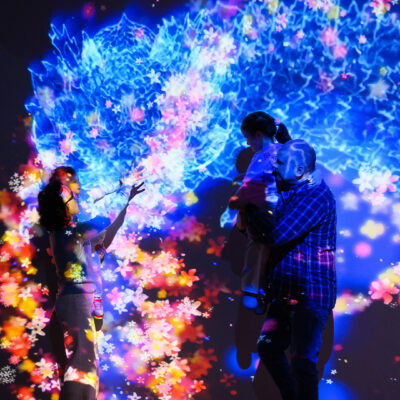
Sensorica is the first immersive and interactive art museum in the Republic of Moldova, located in Chișinău. The space covers an area of 250 m², where cutting-edge technology and digital art merge to transform the visitor from a simple spectator into an integral part of the exhibition. Through the use of motion sensors, the installations come to life and respond to human gestures. The museum’s uniqueness lies in its dynamism: themes change periodically, offering ever-new digital universes. It is a modern cultural destination, suitable for all ages, offering a captivating alternative to classic museums.
Visitor Experiences:
Visitors at Sensorica step into a world where everything comes to life with every step. The interactive installations respond to touch, allowing anyone to shape the surrounding images, lights, and sounds, transforming the visit into a personalized experience. The museum has no fixed path, offering the freedom to explore each area at your own pace, whether for moments of relaxation or curiosity. Thanks to the unique aesthetics, the space is a popular destination for photos and videos. Each visit opens a gateway to new emotions, leaving guests with visual and sensory memories filled with magic.
The Wine Museum in Stăuceni is a small yet valuable cultural destination dedicated to Moldova’s winemaking traditions. It is located [..]
The Wine Museum in Stăuceni
The Wine Museum in Stăuceni is a small yet valuable cultural destination dedicated to Moldova’s winemaking traditions. It is located on the grounds of the prestigious National College of Viticulture and Winemaking in Stăuceni, an institution founded in 1842. Just a few kilometers from Chișinău, the museum offers visitors an authentic glimpse into the history and technology of Moldovan wine production.
The exhibition features a variety of historical items: vintage wine bottles, traditional tools, viticultural equipment, and educational materials used to train professionals in the field. Notably, visitors can admire various types of old glass containers once used for bottling Moldovan wines.
The museum is closely connected to the college’s educational and practical activities, which include a small-scale working winery where students participate in the winemaking process — from grape harvesting to bottling. As such, the museum serves as both an exhibition space and an educational laboratory.
This museum is part of Wine Tourism Route (national) No. 2, which links Stăuceni with Cricova, Orheiul Vechi, and Brănești. The route is often featured in 5–7 hour guided tours offered by ANTREC and specialized agencies. It is a perfect stop for wine lovers, tradition seekers, and those passionate about rural heritage.
Widely known as the Water Tower, it was reopened in the autumn of 2011, after a break of almost 10 [..]
Museum of the City of Chisinau (Water Tower)
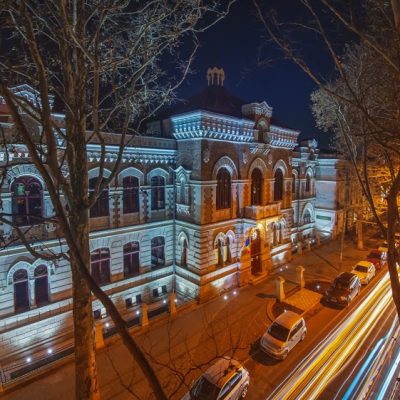
Widely known as the Water Tower, it was reopened in the autumn of 2011, after a break of almost 10 years… Although it has been partially damaged over the years, the building was rebuilt according to the images dated in the 1980-1983 years period, except for the fire-pit at the top, originally built of wood, later re-shaped from stone.
The construction of the Tower began in 1860, and was finished only after 28 years – in 1888 (its doors being opened even later – in 1892), when Carol Schmidt became mayor of Chisinau. He, together with architect Alexander Bernardazzi, built two water towers, only one of which has survived to the present day.
The Water Tower can boast about being one year younger than the Eiffel Tower in Paris. Its height is 27m.
The tower has 4 permanent exhibition halls. The oldest exhibit is a clay vessel from the 4th century AD.
Formed on December 21, 1983, the institution underwent several name changes before adopting its current designation. Presently, the National Museum [..]
The National Museum of History of Moldova
Formed on December 21, 1983, the institution underwent several name changes before adopting its current designation. Presently, the National Museum of the History of Moldova operates under the authority of the Ministry of Culture of the Republic of Moldova, with its scientific activities overseen by the Academy of Sciences. The museum is situated in the former boys’ gymnasium building in Chisinau.
The museum’s heritage, initially comprised of the collections from the Military Glory Museum and the historical artifacts from the State Museum of History and Study of the Natal Country, has progressively expanded over the years. Through research, donations, and acquisitions, the institution has acquired pieces of significant scientific value.
Between 1989-1995 and 2006-2007, the museum’s patrimony experienced growth and diversification through substantial transfers of heritage from several dismantled museums. These included the Republican Museum of Friendship of Peoples, the Museum of History of the CPM, the Republican Museum of the History of Comsomol, the Republican Museum “G. I. Kotovski and S. Gh. Lazo,” the Republican Museum of the History of Religion, the Memorial Museum of Bulgarian Volunteers, and the Museum of Archaeology of the ASM.
In 1991, the museum unveiled its first permanent history exhibition, “Pages of Multi-Millennial History,” which covers the historical period from ancient times to 1940. Additionally, in August 1990, the diorama of the Iasi-Chisinau operation was inaugurated on the ground floor, followed by the opening of the “Treasure” exhibition in the basement in 1994, showcasing noble metals.
As of now, the National Museum of the History of Moldova safeguards 348,619 pieces of the country’s cultural heritage.
National Museum of Ethnography and Natural History
Its history begins in 1889, when the Zemstva of Bessarabia organized the first Agricultural and Industrial Exhibition, which was also [..]
National Museum of Ethnography and Natural History
Its history begins in 1889, when the Zemstva of Bessarabia organized the first Agricultural and Industrial Exhibition, which was also the basis for the foundation of the museum institution. Being the oldest museum in the Republic of Moldova, its name has often been changed over the years. Today it holds an enormous heritage of about 135 thousand exhibits.
The permanent exhibition operates under the title “Nature. Human. Culture” with an area of over 2000 m2.
The museum also has a Temporary Exhibition Hall, in which numerous seminars, master classes and exhibitions take place, both from its own heritage and from the heritage of other local museums and from abroad. The exhibitions of handicrafts have become traditional and are organized every year.
Its history began in 1889 when the Zemstva of Bessarabia organized the first Agricultural and Industrial Exhibition, laying the foundation for the establishment of the museum institution. As the oldest museum in the Republic of Moldova, its name underwent several changes over the years. Today, it houses an extensive heritage of about 135 thousand exhibits.
The permanent exhibition, titled “Nature. Human. Culture,” occupies an area of over 2000 m2.
The museum also features a Temporary Exhibition Hall, hosting numerous seminars, master classes, and exhibitions, showcasing both its own heritage and that of other local museums and international collections. Handicraft exhibitions have become traditional and are organized annually.
Folklore events, national and international competitions, and festivals regularly take place in the museum, highlighting folk creations from across the country.
Within the museum’s premises, there is a Botanical Garden with a Vivarium, gathering the most prevalent species of plants, trees, and shrubs from the Republic of Moldova, along with exotic birds, reptiles, and fish.
The Museum building, designed by architect V.N. Țiganco, was completed in 1905, and the inauguration took place in June 1906.
This museum is situated in the center of Chisinau, making it the sole institution of its kind in the Republic [..]
National Art Museum of Moldova
This museum is situated in the center of Chisinau, making it the sole institution of its kind in the Republic of Moldova. Established in 1939 by the sculptor Alexandru Plămădeală and Auguste Baillayre, a French painter and professor at the “School of Fine Arts” in Chisinau, who also served as the inaugural director of the National Art Museum of Moldova.
The museum’s collection encompasses over 39,000 works, providing a comprehensive overview of the development of fine arts from the XV-XXI centuries. It consistently features exhibitions showcasing European, Russian, and Oriental art. Presently, the museum is housed in the former girls’ gymnasium building, originally founded by Princess Natalia Dadiani in the early 20th century.
The history of urban environmental transport in Chisinau traces back to 1888 when the City Duma, under the leadership of [..]
Museum of Electric Transport Chisinau
The history of urban environmental transport in Chisinau traces back to 1888 when the City Duma, under the leadership of the mayor Carl Schmidt, entered into an agreement with a Belgian company to establish a new transportation network—the “horse streetcar” or horse-drawn streetcar. This significant transport revolution unfolded in 1889 when Bessarabia received its first two streetcars. The initial line opened on Aleksandrovskaya Street (now Stefan Velikogo Boulevard), covering a total length of 6400 m, or 6 miles. While wealthier citizens still favored carriages and phaetons, the “horse carriage” provided a more affordable and comfortable option for students and individuals with modest incomes. The first seven open cars were acquired in Warsaw, and seven closed ones in Odessa.
In 1896, an “Anonymous Kishinev Society” was established in Brussels, purchasing the streetcar fleet and becoming its monopoly owner. Subsequently, the Duma initiated the construction of a new line connecting the train station to the city center. By 1910, the total length of the routes had expanded to almost 13 km due to the gradual shift from horse carriages to more economical electric traction. The comfort of cars also improved over time. By 1939, the Kishinev streetcar fleet boasted 50 cars, carrying 175,000 passengers that year.
Following World War II, the fate of the Chisinau tramway underwent significant changes. Over 60% of the cars were severely damaged or captured by the retreating German army. Post-war, the state took over the city streetcar service, but due to the unavailability of the narrow gauge 1,000-millimeter track used in Kishinev, repairs were slow. Only 17 cars were restored by 1952. In 1956, the streetcar fleet received additional cars from Germany. Despite these efforts, the narrow gauge railway was never replaced with the broad gauge one.
In 1949, the first trolleybus MTB started operating in Chisinau. Initially, both streetcars and trolleybuses coexisted until 1959 when the streetcars were entirely replaced by 50 trolleybuses. The trolleybuses served various routes in the city.
The first museum dedicated to electric transport in Chisinau was established in 1974 inside a retired trolleybus. This unique museum operated for a decade before its exhibits were moved to the building of the former Belgian Trolleybus Company from the early 19th century in 1984. Today, the museum is open to visitors, and admission is free.
Natural History Museum of Moldova State University
Established in 1952 through the efforts of students and faculty at the biology faculty, this museum boasts a collection exclusively [..]
Natural History Museum of Moldova State University
Established in 1952 through the efforts of students and faculty at the biology faculty, this museum boasts a collection exclusively gathered from expeditions organized by the faculty. Graduates of the program, who later gained recognition as biologists, contributed significantly to the exhibits.
Specialists in the field brought and meticulously prepared animals, fish, and birds from various corners of the world for the museum. The collection also features an impressive array of reptiles, birds, and mammals indigenous to the Republic of Moldova.
A truly exceptional specimen in the collection, unparalleled worldwide, is a 2-day-old baby sperm whale. Additionally, the museum showcases the skeletal vertebrae of a 28-meter-long blue whale and the jawbone of an adult sperm whale.
Presently, the museum’s collection comprises over 10,000 exhibits, many of which are unique and found in only one specimen globally. Over the course of more than 40 years, the museum has been under the dedicated leadership of an outstanding specialist, guide, and director – Mr. Poznakomkin Stanislav.
Located at the entrance of Chisinau, near the City Gates, the Village Museum can be considered an oasis of revelation [..]
The Village Museum
Located at the entrance of Chisinau, near the City Gates, the Village Museum can be considered an oasis of revelation and tranquility. It is the perfect place for meditation, where visitors are enchanted by the enchanting landscape that exudes a fairy-tale atmosphere.
Established in 1991 as a branch of the National Museum of Ethnography and Natural History, the Village Museum was officially inaugurated as such in May 1995, showcasing the ambiance of a Basarabian village from the 17th to 19th centuries. The museum is home to a collection of folk architecture monuments.
The inaugural addition to the museum in 1995 was the windmill from the village of Opaci, in the Causeni district. Unfortunately, this windmill was destroyed in a fire in 2001 and has yet to be restored. Currently, the museum complex is home to the oldest ecclesiastical monument in the Republic of Moldova – a wooden church brought from the village of Hirișeni for restoration and preservation. Erected in 1642, this church stands as one of the tallest wooden churches in the country, reaching a height of 27 meters.
The Zemstvo Museum, listed in the Register of Architectural Monuments as the “Building of the former orphanage, later the headquarters [..]
Zemstvо Museum
The Zemstvo Museum, listed in the Register of Architectural Monuments as the “Building of the former orphanage, later the headquarters of the Zemstva Guberniale of Bessarabia,” is a historical building located at 103 Alexei Shciusev Street in Chisinau. It is a monument of architectural and historical significance on a national scale, consisting of four buildings, and has been entered into the Register of Monuments of History and Culture of the municipality of Chisinau with the initiative of the Academy of Sciences. However, at the moment, it does not operate as a museum.
In 1918, when Bessarabia became part of Romania, the Zemstva ceased its activities, and the building served exclusively as a museum space until 1932. From 1932 to 1938, the building complex was taken over by the Faculty of Agronomy of the University of Iasi.
After World War II, there were plans to revitalize the museum, but these were not successful. The opportunity for redevelopment occurred only in 2010 when the building came under the administration of the Museum of Ethnography, and the entrance received the inscription “Muzeul Zemstvei.” One of the four buildings (located at the corner of Sfatul Țării Street) has been rehabilitated and now serves as the headquarters of the Agency for Inspection and Restoration of Monuments.
There are ongoing plans to rehabilitate and restore the museum, but these have not been realized yet.
The Museum of Human Anatomy at “Nicolae Testemitanu” University is far more than a simple exhibit; it is a unique [..]
Human Anatomy Museum
The Museum of Human Anatomy at “Nicolae Testemitanu” University is far more than a simple exhibit; it is a unique collection renowned at the international level for the quantity and quality of the specimens it houses.
Presently, the Anatomy Department’s museum boasts one of the most valuable and impressive collections of unique anatomical pieces, ranking among the few of its kind in Europe. It has garnered high esteem from international experts. The museum is widely popular, playing a vital role in disseminating knowledge about the human body, morphological and functional peculiarities at different stages of pre- and postnatal ontogenesis, the impact of various harmful factors, and the influence of lifestyle on the activity of organs and organ systems. It is a frequent destination for pupils and teachers from towns and villages across our country, as well as for students from local colleges and universities, and numerous foreign delegations.
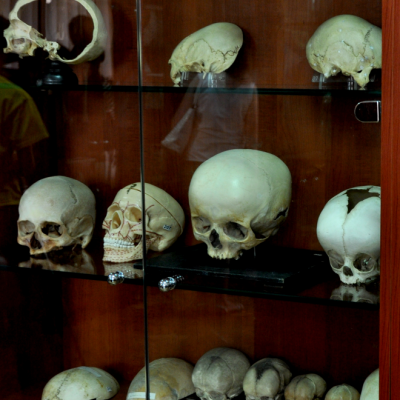
The collection of the Museum of Human Anatomy comprises approximately 2000 items of significant scientific and didactic value. It includes bones, skeletons, wet preparations (joints, muscles, internal organs, and organ systems), embryos in various stages of development, plastinated anatomical sections, malformations, monstrosities, etc. These specimens are preserved in a formalin solution, and they also encompass pieces obtained through corrosion and mummification, as well as anatomical dummies. Together, they constitute a valuable treasure at our Alma Mater.
This museum is also an important national monument, listed in the Register of Historical and Cultural Monuments of Chisinau. The [..]
The Chisinau „Aleksandr Pushkin” House-Museum
This museum is also an important national monument, listed in the Register of Historical and Cultural Monuments of Chisinau.
The building is historically significant because it was the residence of the young Russian poet Aleksandr Pushkin, who, at the age of 21, lived here for several months after being exiled by the Russian Tsarist government to the capital of Bessarabia. Pushkin arrived in Chisinau in September 1820.
Originally owned by General Inzov, the house became an official museum on February 10, 1948. The museum’s exhibits include materials related to Pushkin’s time in Chisinau, such as paintings, prints, decorative art objects from the late 18th and early 19th centuries, sculptures, and editions of his works written during his time in Bessarabia.
It is worth mentioning that only two houses where Pushkin lived are believed to have been preserved worldwide, and one of them is located in Chisinau.
The museum is situated within the house where the renowned Soviet architect Alexei Shchusev (1873-1949) was born and lived for [..]
Alexei Shchusev House-Museum
The museum is situated within the house where the renowned Soviet architect Alexei Shchusev (1873-1949) was born and lived for 24 years. Erected in 1851-1853, this building is now recognized as a monument of national architectural and historical significance, duly recorded in the Register of Monuments of History and Culture of the municipality of Chisinau.
The museum’s origin dates back to 1947 when Alexei Shchusev himself organized the Museum of Soviet Architecture. It was initially curated with drawings, models, documents, and letters from the architect’s personal archive. However, the museum did not withstand the test of time and was dismantled in the early 1950s.
In 1973, on the occasion of the great architect’s 100th anniversary, the museum was rejuvenated. A permanent exhibition dedicated to the life and work of Alexei Shchusev was inaugurated, and it continues to operate to this day.
Additionally, the museum hosts a mini-exhibition paying homage to another notable personality—Alexandro Bernardazzi, the first official architect of Chisinau (1831-1907).
The museum’s collection comprises over 20,000 items, including photographs, documents, and military artifacts. These exhibits were gathered by the museum’s [..]
Military History Museum
The museum’s collection comprises over 20,000 items, including photographs, documents, and military artifacts. These exhibits were gathered by the museum’s staff from the residents of Chisinau, with some originating from the National Army.
Beyond the hall dedicated to the armed conflict in Transnistria, the museum boasts additional permanent exhibition spaces covering a broad historical spectrum. The exhibits span from the ancient period and Daco-Roman wars to the medieval and modern eras. Visitors can explore displays on Russo-Turkish wars, the First and Second World Wars, and the intervening period.
At the entrance to the Military Museum, visitors can access valuable information about the establishment of the “Sfatul Ţării” (The County Council). In 2015, the museum inaugurated a new section that delves into the events spanning from June 28, 1940, to March 5, 1953, focusing on the three waves of mass deportations.
It is the newest museum in Chisinau, inaugurated in 2018 within the National Library. The museum’s collection is primarily sourced [..]
The Museum of Books
It is the newest museum in Chisinau, inaugurated in 2018 within the National Library. The museum’s collection is primarily sourced from the library’s “Old and Rare Books” section, which currently houses over 30 thousand documents.
The museum showcases various intriguing forms of books that have existed throughout history. The compact hall is filled with information, exhibits, and curiosities, offering insights into book binding, the evolution of writing systems, the earliest manuscripts, the history of printing, and the pioneers of printing art, including the fascinating world of “tiny books.”
Among the notable items at the Museum of Books are a fragment of The Quran, a medallion book measuring 11-15 mm, a souvenir edition of the Two Penny Bag measuring 60×40 mm, and many others. The oldest exhibit on display is the manuscript “Ostrog’s Gospel,” dating back to 1056, while the oldest printed book in the collection dates to 1551, featuring a commentary on “Aristotle’s Categories.”
Located right in the city center, at the intersection of Bd. Mitropolit G. Bănulescu-Bodoni and Bd. Ștefan cel Mare, it [..]
„Alexander” Art Gallery
Located right in the city center, at the intersection of Bd. Mitropolit G. Bănulescu-Bodoni and Bd. Ștefan cel Mare, it was founded in 2000 by Alexandru Neceainecu (architect) and Natalia Obadă (artist).
Here, in a small room, the works of several artists from Moldova are exhibited for sale, showcasing different styles such as symbolism, naive art, or primitivism. Paintings, graphics, sculptures, papier-mâché, ceramics, and interior decorations constitute just a small part of the diverse collection on display in this compact space in the center of the capital.
The largest and most significant art exhibition center in the country and the capital, it consistently hosts exhibitions featuring the [..]
Exhibition Centre “Constantin Brancusi”
The largest and most significant art exhibition center in the country and the capital, it consistently hosts exhibitions featuring the titular members of the Union of Artists of the Republic.
Temporary exhibitions encompass paintings, graphics, decorative arts, ceramics, and sculptures created by artists—both emerging talents and renowned figures, hailing from both local and international art scenes.
The exhibition center’s openings are renowned for their exceptional contributions to the realm of contemporary art.
The Church Museum was legally founded on April 4, 1904, with the establishment of the Church Historical-Archaeological Society in Chisinau, [..]
Ruins of the Church Museum/Old Cathedral
The Church Museum was legally founded on April 4, 1904, with the establishment of the Church Historical-Archaeological Society in Chisinau, initiated by the distinguished Basarabian scholar Ioan Halippa.
According to the by-laws, the Society’s objective was the comprehensive study of the local Church’s history, starting from the dawn of Christianity in Bessarabia. The Society focused its activities on researching, preserving, and studying monuments related to the establishment of churches, the formation of parishes, the ecclesiastical hierarchy, religious-moral life of the clergy and laity, educational aspects, and efforts against the spread of heresies and sects. The Society collected written documents concerning the ecclesiastical domain, ecclesiastical books, icons, and other ecclesiastical items. It also gathered, described, and processed archaeological-church, historical, and ethnological materials held by institutions and private individuals.
To achieve its goals, the Society had the authority to maintain church antiquities, operate a museum, library, archive, and publish a magazine. Between 1909 and 1934, the Society published a scientific magazine, featuring contributions from Romanian hierarchs, priests, theologians, and researchers from Bessarabia and later from all over Romania, totaling twenty-four volumes.
The Society pursued another goal outlined in its regulations, namely, to enrich the collection of the church museum.
In 1920, the museum received a visit from Romanian King Ferdinand I and Queen Maria, accompanied by Royal Princess Elisabeth. Other notable visitors included Metropolitan Miron Cristea (future patriarch of the Romanian Orthodox Church), Octavian Goga (Minister of Religious Affairs), and Visarion Puiu (Bishop of Argeș). In 1919, O. Tafrali, a professor at the University of Iasi, visited the museum. Nicolae Iorga, who took interest in the museum’s treasures, noted his impressions in the visitors’ golden book in 1919: “I have examined the beautiful collection, taking it upon myself to enrich it; I have admired what love united with faith and hard work can do.”
Until 1940, the Museum was situated in the building of the Diocesan House on Emperor Alexander Boulevard, known as the “Serafimovsky Dom” (Serafim’s House) in honor of Archbishop Serafim Ciceagov, the building’s founder. In 1941, the Soviet army demolished the building, and after the war, it was completely razed.
In 1940, the museum was evacuated to Romania. With the re-establishment of church life in Bessarabia in 1941, efforts were made to revive the Museum, initiated by parish priest Father Paul Mihail. However, the Soviet return halted the Museum’s progress, and the heritage disappeared without a trace.
After 1944, the museum was devastated, and the museum’s possessions were evacuated to Plopșor, Dolj County, Romania. When the Soviet army occupied Romania, the crates containing the museum’s possessions disappeared, and the fate of the exhibits remains unknown.
The curator of the Museum, Father Paul Mihail, worked tirelessly for the rehabilitation and conservation of church antiquities. However, he suffered greatly after the museum’s destruction and the disappearance of the artifacts.
The building of the Museum, situated near the church of St. Archangels Michael and Gabriel, was demolished in the 1960s. The Old Sobor was also demolished by Soviet authorities and replaced by the “Moscow” cinema, later transformed into the “Eugen Ionesco” Theatre. The Diocesan House building was demolished in 1960 during urban architectural changes, with a monument dedicated to the heroes of the komsomol erected in its place.
On November 5, 2021, on the occasion of the 200th anniversary of the death of Metropolitan Gavriil Bănulescu-Bodoni and his canonization, archaeological excavations were initiated near the “Eugen Ionesco” Theatre to uncover the foundations of the Church Museum building and the residence of Metropolitan Bănulescu-Bodoni. Traces of a building and three underground stone structures, demolished in the 1960s, were discovered and partially excavated in this area. Plans are underway to initiate a project to preserve and transform the remnants of the disappeared buildings, including the Church of Archangels Michael and Gabriel (Old Cathedral) and the Church Museum, into a museum complex on the land adjacent to the Eugen Ionesco Theatre.
These actions aim to contribute to the restoration, preservation, and sustainable valorization of archaeological sites with significant historical and architectural value.
The provided text is based on an article signed by Father Maxim Melinti.

 English
 Română
  Русский